
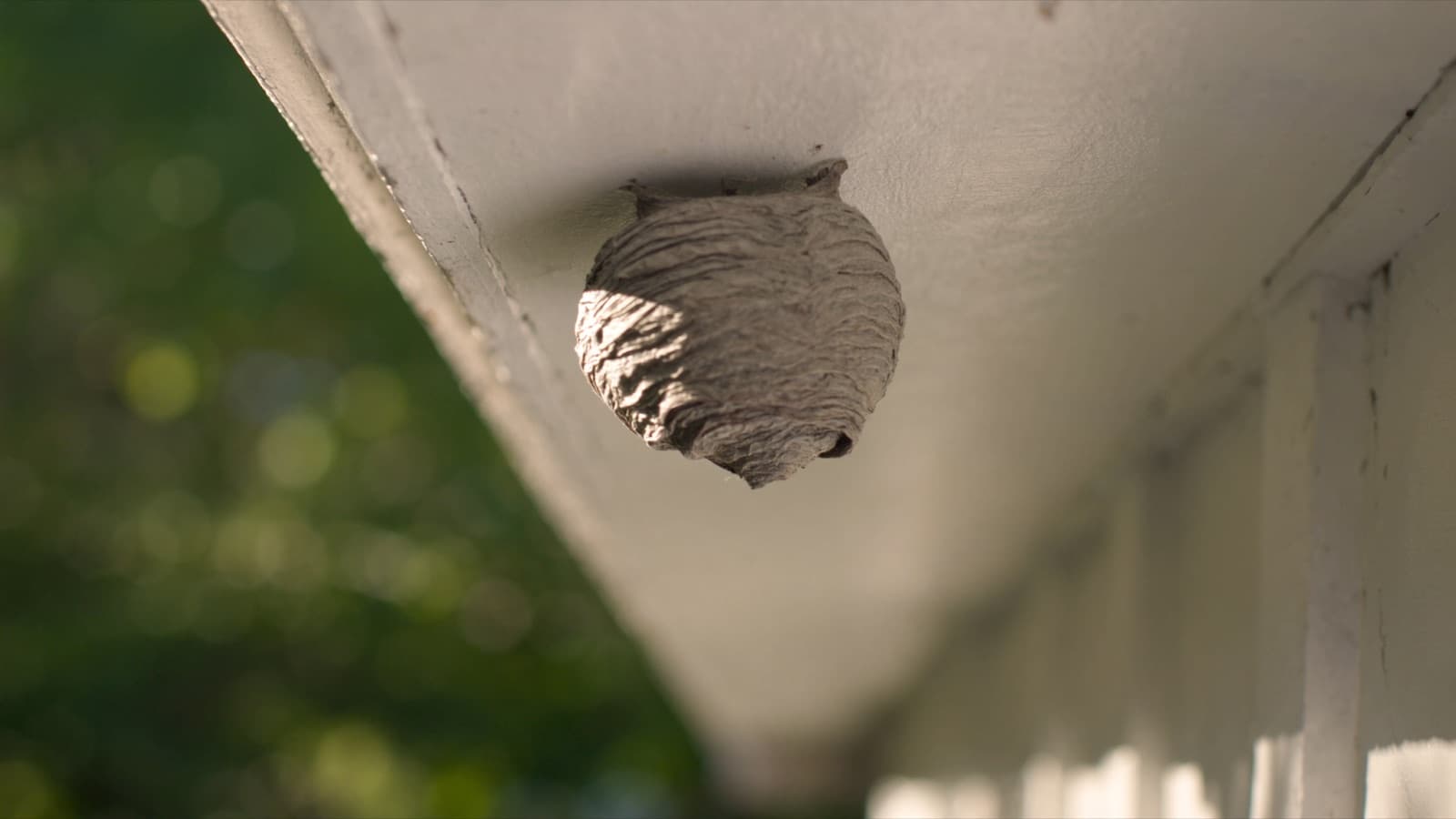
How Many Wasps Could Be in a Nest I'm Attempting to Eliminate?
At a Glance
- The call: A small early-season paper-wasp nest might hold a few dozen wasps. A mature eastern yellowjacket colony can exceed 3,000 — and the difference isn't visible from the entrance.
The short of it
A small early-season paper-wasp nest might hold a few dozen wasps. A mature eastern yellowjacket colony can exceed 3,000 — and the difference isn't visible from the entrance.
The full picture
The range, by rough situation
A small, early-season paper-wasp nest — the kind found under an eave before workers have fully built up — can be a modest colony of a few dozen individuals or fewer. By contrast, Cornell IPM notes that the eastern yellowjacket (Vespula maculifrons), one of the yellowjackets common across the Northeast and New Hampshire, can build colonies of roughly 2,000 to 3,000 workers, and other extension figures describe some nests exceeding 10,000 cells in a season. In southern New Hampshire that maximum lands in late summer and early fall, just before the first sustained hard freeze — around Manchester the local average first 32°F freeze is near October 19 — so a nest found in September is far more likely to be near peak size than one found in June. Bald-faced hornet and European hornet colonies generally fall somewhere in between, typically in the hundreds of workers by late summer.
Why the number matters more than almost any other factor
Colony size is the single biggest driver of how bad a disturbance could get, because a defended nest recruits nestmates through an alarm response rather than relying on one or two individuals to respond. A small colony has a limited number of wasps that could possibly respond to a disturbance; a large one can mount a coordinated response involving hundreds of workers within seconds. That's a meaningfully different physical situation, even though both might look like "a wasp nest" from a few feet away.
Why you can't reliably estimate it by looking
An exposed paper-wasp nest at least shows its comb, which gives some rough sense of scale. A ground, wall-void, or attic nest shows none of that — the entrance hole looks the same whether a few dozen or a few thousand wasps are behind it, and traffic level at any given moment doesn't reliably scale with total colony size. That uncertainty is itself one of the reasons concealed nests are treated more cautiously on this hub than exposed ones, independent of any other factor.
The honest line — A small early-season paper-wasp nest might hold a few dozen wasps. A mature eastern yellowjacket colony can exceed 3,000 — and the difference isn't visible from the entrance.
Key takeaways
- A small, early-season paper-wasp nest may hold only a few dozen wasps.
- A mature eastern yellowjacket colony can reach around 3,000 workers, with some nests exceeding 10,000 cells.
- Colony size directly predicts how coordinated and severe a defensive response could be if the nest is disturbed.
- Concealed nests give no reliable visual clue to colony size, unlike an exposed comb.
- Uncertainty about size is one more reason concealed nests are treated more cautiously than exposed ones.
Where to go next
Identification, sting treatment, per-species DIY viability, and nest-reuse facts each live on the hub that owns them. We route, we don't rebuild.
DIY viability by species
The router's source of truth — which nests are DIY-able.
Go thereIdentify the species
Tell the wasps, hornets, and lookalikes apart.
Go thereSting & allergy treatment
What to do about a sting or a reaction.
Go thereNest reuse & winter
The colony dies at frost; the nest is never reused.
Go there
Can't tell how big the colony behind that entrance is?
Anchor can assess a concealed nest's likely size and species before anyone attempts anything.
Frequently asked questions
Sources(2)
- [1]Cornell IPM — Yellowjackets and baldfaced hornets
Eastern yellowjacket (Vespula maculifrons) common in the Northeast; colonies reaching roughly 2,000–3,000 workers
extensionverified 2026-07-17 - [2]Penn State Extension — Getting Rid of Paper Wasps, Yellowjackets and Other Stinging Insects
Small exposed paper-wasp nests vs. large, populous yellowjacket and hornet colonies
extensionverified 2026-07-17
Written & reviewed by
VerifiedDaniel Brady
NH-Licensed Pesticide Applicator · License #782664 (NHDAMF, RSA 430)
Daniel Brady is the New Hampshire–licensed applicator behind Anchor Pest Services, a family-owned pest control company serving the Manchester area since 2017.
Last updated 2026-07-17
The size you can't see
Don't guess at what's behind the entrance
A licensed technician can evaluate a concealed nest without the guesswork a homeowner is stuck with from outside.
- Family-owned since 2017
- NH License #782664, category F1 (RSA 430, NHDAMF)
- Member, NEPMA