
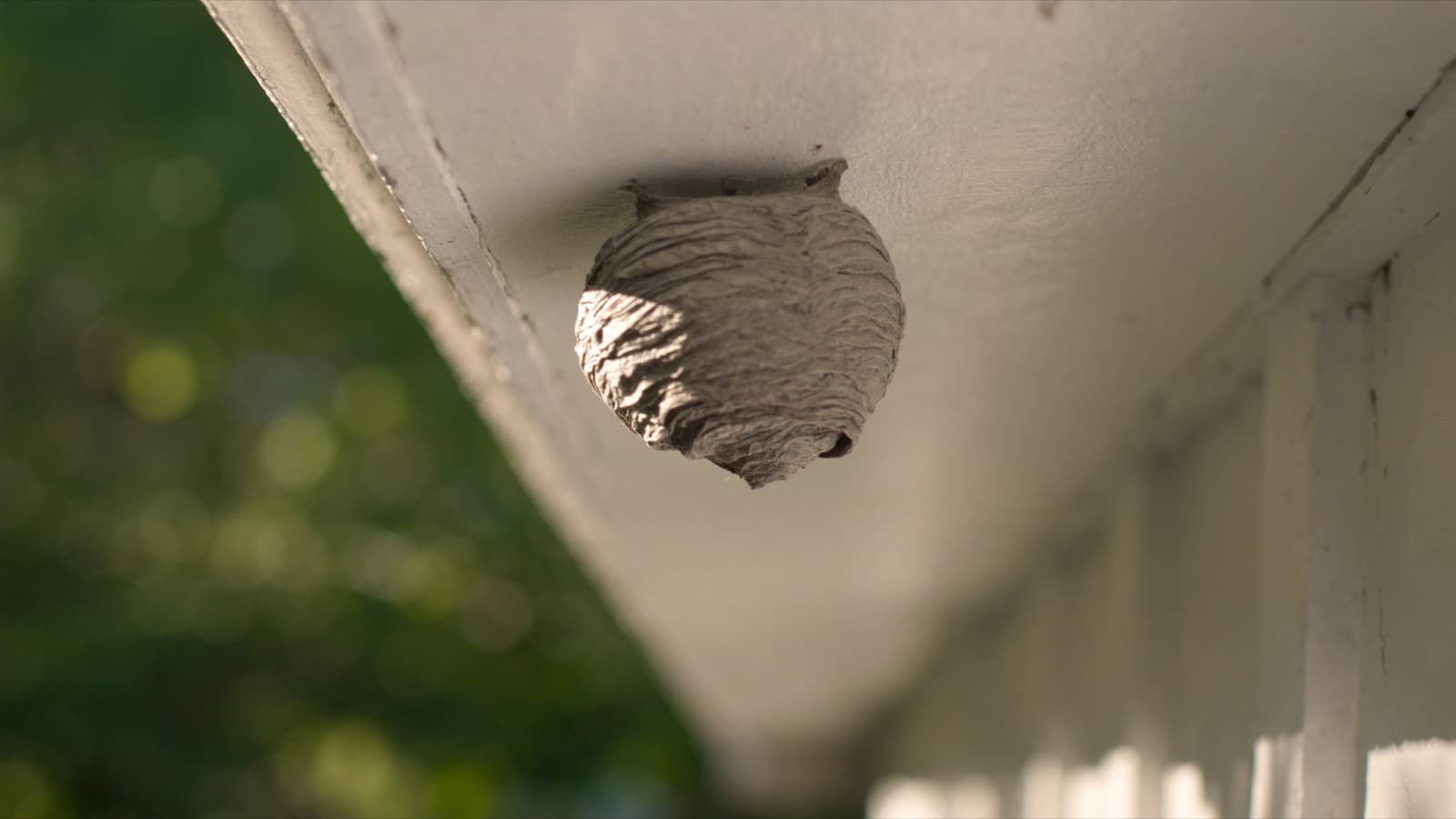
Is DIY Wasp Nest Removal Safe Without Protective Gear?
At a Glance
- The call: Gear helps against a defended colony. It doesn't create one where none exists, and it doesn't remove the danger where one does.
- Your nest: Yellowjacket (aerial, ground, or unknown)
Should you do this? It depends entirely on which nest
The generic question has no generic answer. Your nest is one row below — the others are the argument that this page isn't just selling you a “no.”
One question, six honest answers — one per nest.
- Mud dauber (solitary)
Solitary — no colony to defend, essentially no swarm response. Gear is not the deciding factor.
Go - Paper wasp — small, exposed, early-season nest
Low-to-moderate risk before workers hatch and while the nest is reachable — here, gear genuinely earns its keep.
Go with gear - Yellowjacket (aerial, ground, or unknown)Your nest
Large, coordinated colony defense; ground nests add vibration triggers and concealment. Gear reduces risk, it doesn't remove it.
No-go - Bald-faced hornet
Large aerial colony, aggressive when disturbed, often high off the ground — a fall risk stacked on a sting risk.
No-go - European hornet
Concealed cavity nests plus nighttime activity defeat the usual safe-timing rule other species allow.
No-go - Any species, in October
By the time a sustained hard freeze has come through, the colony is already finished and the nest will never be reused — there's no gear question left to answer.
Do nothing
“Is it safe to remove a wasp nest?” has no answer. “Is it safe to remove THIS nest?” has six.
Derived from: /top-diy-methods per-species verdicts (mud-dauber diy_friendly, paper-wasp doable_with_care, yellowjacket / bald-faced-hornet / European hornet pro_recommended) + /winter-pests-shift/wasps (colony dies at a sustained hard freeze; the nest is never reused).
Why you should doubt us on this
We make money when you call us — so here is a test that doesn't depend on trusting our word.
We make money when you call us for a removal, and this page's headline answer is close to “call a professional.” That is worth being suspicious of — a pest company saying nest removal is dangerous is not automatically being brave.
If it's a mud dauber, do it yourself — no gear required — we say so in public, on our own DIY page. If it's a small, exposed paper-wasp nest found early in the season, do it yourself with basic gear — we say that too. Neither of those cases requires calling Anchor, and you don't have to take our word for either verdict: /top-diy-methods carries both, published independently of this page.
See the proof on Mud DauberThe no-go on this page is for the cases where you don't know what's in the nest, or you do know it's a yellowjacket, hornet, or a concealed underground or in-wall colony. That's hundreds to thousands of workers with a coordinated chemical alarm response — a mud dauber and a small paper-wasp nest simply don't have that mechanism. Gear helps against a defended colony; it does not create one where none exists, and it does not remove the coordinated-defense risk where one does.
The full picture
Why this question has no single answer
Cooperative-extension entomologists consistently describe a risk hierarchy, not a single risk level, for stinging-insect nests. A solitary mud dauber does not defend its nest at all — UNH Extension notes that because it nests individually, “disturbing a nest doesn't call out a large swarm of defenders,” and Purdue Extension rates its sting among the mildest of any stinging insect. A small, exposed paper-wasp nest found early in the season, before workers have hatched, sits a step up: still capable of stinging, but manageable with care and the right timing. A mature yellowjacket, bald-faced hornet, or European hornet colony is a different animal entirely — hundreds to thousands of workers that release an alarm pheromone when the nest is disturbed, recruiting nestmates into a coordinated attack within seconds. Underground and in-wall nests are the most hazardous of all, because they are easy to disturb by accident (mowing, trimming, vibration) and hard to treat completely. Protective gear is real protection against the second and third categories — it is close to irrelevant for the first.
What gear actually changes, and what it doesn't
For a nest with a colony behind it, the protective elements extension entomologists actually recommend are specific: coveralls sealed at the wrists and ankles, gloves sealed to the sleeve, and a veil that fully covers the face, since some stinging insects can direct venom toward the eyes. Standing to the side of an aerial nest rather than underneath it, and keeping several feet of distance, meaningfully lowers the odds of being stung. None of this makes the job safe in an absolute sense — UNH Extension's own warning is blunt: don't think protective clothing makes you invincible. Spraying a defended nest provokes exactly the coordinated response the gear is trying to survive, and a botched attempt can mean dozens of stings in the time it takes to retreat. That volume matters even for someone with no known allergy — a multicenter hospital study of over a thousand wasp-sting patients found that in-hospital death was several times more likely once a person had been stung more than ten times in one incident, from the toxic load of the venom itself, not only from an allergic reaction. Gear buys a margin. It does not buy immunity.
Kids, pets, allergies, and hidden nests
None of the calculation above changes if children, pets, or anyone with a known stinging-insect allergy are nearby — they should be kept well away from any nest being treated, gear or no gear, both for sting risk and for spray residue. A known allergy in the household is its own reason to skip DIY entirely, regardless of which species is involved. Anaphylaxis is a real, fast-moving medical emergency, and we never attempt to diagnose one from a description online — if anyone shows a severe reaction, that is a call to 911, and the Northern New England Poison Center (1-800-222-1222) is the right call for sting or exposure questions that are not a clear emergency. Full guidance on recognizing and responding to a sting reaction lives on our /yellowjackets hub, not here. Underground and in-wall nests deserve their own caution regardless of gear: they're often discovered by accident, harder to fully treat, and can send agitated wasps into a living space instead of outdoors.
The DIY hand-off, by species
This page answers the safety question in general; the actual how-to for each situation lives on our /top-diy-methods hub, one species at a time, so a genuine DIY case doesn't get buried under a blanket warning. If you already know your nest is a mud dauber or a small, early-season paper-wasp nest, the router above shows why those are treated differently here — and /top-diy-methods walks through what to do next. If you're not sure what you're looking at, /wasp-species is the place to identify it before deciding anything, not this page. And if it's already late in the fall, the honest move for most nests is often no move at all — see the router's last row, and /winter-pests-shift/wasps for why.
The honest line — Gear helps against a defended colony. It doesn't create one where none exists, and it doesn't remove the danger where one does.
Key takeaways
- There is no single answer — risk depends on species, nest size, location, and season, not on gear alone.
- Mud daubers are solitary and essentially defenseless as a colony — gear is not the deciding factor for them.
- A small, exposed, early-season paper-wasp nest is the one case where gear genuinely makes DIY removal reasonable.
- Yellowjacket, bald-faced hornet, and European hornet colonies — and any underground or in-wall nest — are a professional job regardless of gear.
- By the time a sustained hard freeze has passed through in fall, the colony is already finished and the nest will never be reused — there's nothing left to gear up for.
Where to go next
Identification, sting treatment, per-species DIY viability, and nest-reuse facts each live on the hub that owns them. We route, we don't rebuild.
DIY viability by species
The router's source of truth — which nests are DIY-able.
Go thereIdentify the species
Tell the wasps, hornets, and lookalikes apart.
Go thereSting & allergy treatment
What to do about a sting or a reaction.
Go thereNest reuse & winter
The colony dies at frost; the nest is never reused.
Go there
Not sure what's actually in the nest?
Anchor's licensed technicians handle the yellowjacket, hornet, and hidden nests this page says to leave alone — the ones gear alone can't make safe.
Frequently asked questions
Sources(4)
- [1]UNH Cooperative Extension — Bees, Wasps and Hornets
Mud dauber solitary/non-defensive behavior; protective-gear and timing guidance; “protective clothing doesn't make you invincible”
extensionverified 2026-07-17 - [2]Purdue Extension — Stinging Insects (E-253)
Solitary wasps rarely sting and do not defend a nest or burrow
extensionverified 2026-07-17 - [3]Penn State Extension — Getting Rid of Paper Wasps, Yellowjackets and Other Stinging Insects
Small exposed nests vs. large colonies; treatable-with-care distinctions by nest size and species
extensionverified 2026-07-17 - [4]Xie et al. 2013, PLOS ONE — Clinical Features of Severe Wasp Sting Patients
In-hospital mortality higher with >10 stings than ≤ 10 stings (5.2% vs 1.0%), from toxic organ injury independent of allergy
academicverified 2026-07-17
Written & reviewed by
VerifiedDaniel Brady
NH-Licensed Pesticide Applicator · License #782664 (NHDAMF, RSA 430)
Daniel Brady is the New Hampshire–licensed applicator behind Anchor Pest Services, a family-owned pest control company serving the Manchester area since 2017.
Last updated 2026-07-17
Before you touch it
Know your nest before you decide anything
A mud dauber and a yellowjacket colony are not the same decision. If you're unsure which one you have, or it's underground or in a wall, talk to a licensed technician first.
- Family-owned since 2017
- NH License #782664, category F1 (RSA 430, NHDAMF)
- Member, NEPMA