
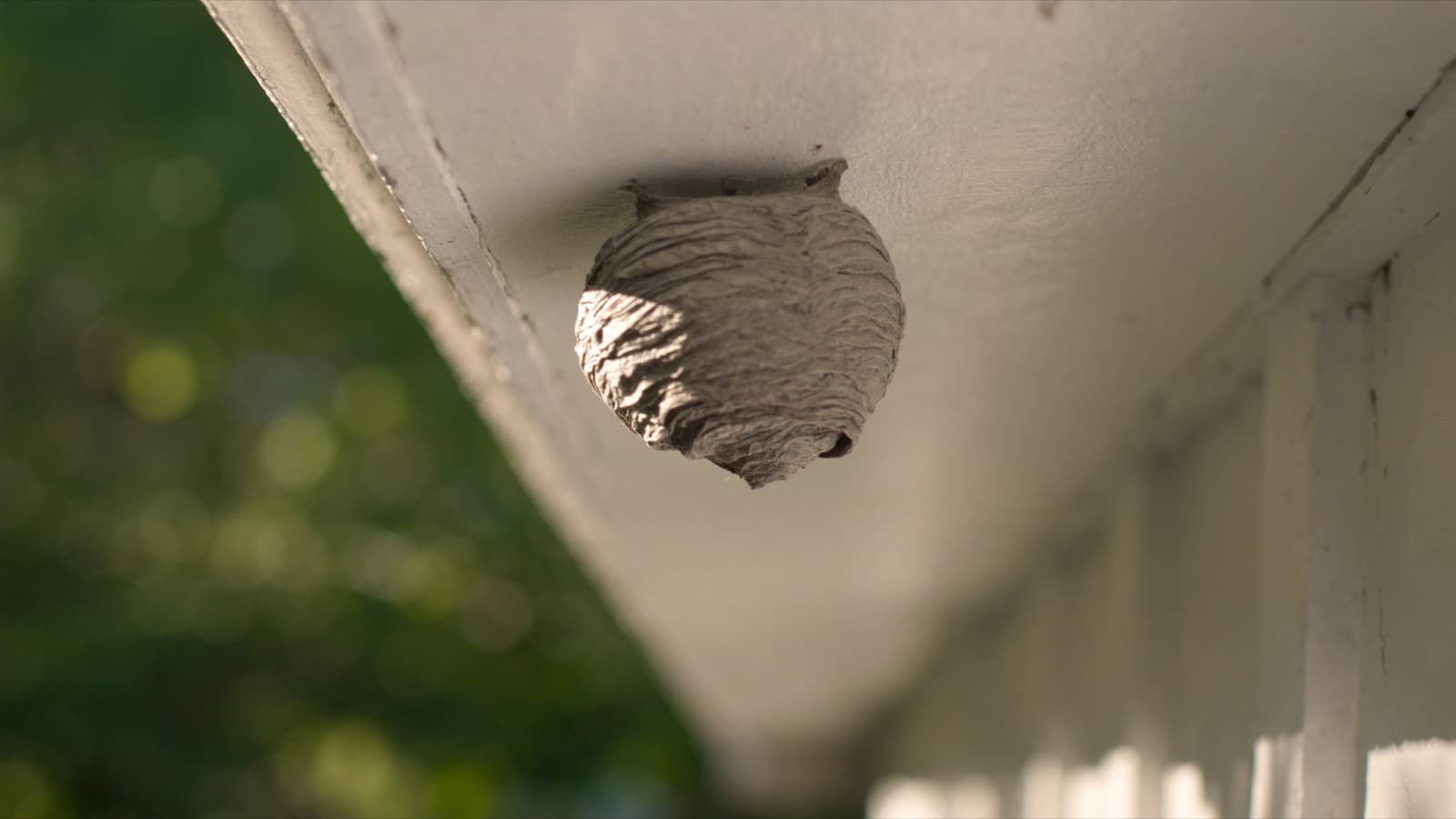
Is It Ever Safe to Remove a Nest During the Day?
At a Glance
- The call: For most nests, no — daytime is when the most workers are out and active. Night is the safer window, and it matters most for the nests worth attempting at all.
- Your nest: depends entirely on which nest — see the router
Should you do this? It depends entirely on which nest
The generic question has no generic answer. Your nest is one row below — the others are the argument that this page isn't just selling you a “no.”
One question, six honest answers — one per nest.
- Mud dauber (solitary)
Solitary — no colony to defend, essentially no swarm response. Not on the router's danger end at all.
Go - Paper wasp — small, exposed, early-season nest
Low-to-moderate risk before workers hatch and while the nest is reachable — gear and timing genuinely earn their keep here.
Go with gear - Yellowjacket (aerial, ground, or unknown)
Large, coordinated colony defense; ground nests add vibration triggers and concealment.
No-go - Bald-faced hornet
Large aerial colony, aggressive when disturbed, often high off the ground.
No-go - European hornet
Concealed cavity nests plus nighttime activity defeat the usual safe-timing rule other species allow.
No-go - Any species, in October
By the time a sustained hard freeze has come through, the colony is already finished and the nest will never be reused.
Do nothing
“Is it safe to remove a wasp nest?” has no answer. “Is it safe to remove THIS nest?” has six.
Derived from: /top-diy-methods per-species verdicts (mud-dauber diy_friendly, paper-wasp doable_with_care, yellowjacket / bald-faced-hornet / European hornet pro_recommended) + /winter-pests-shift/wasps (colony dies at a sustained hard freeze; the nest is never reused).
Why you should doubt us on this
We make money when you call us — so here is a test that doesn't depend on trusting our word.
We make money whenever the honest answer skews toward 'don't do this yourself,' and a page about timing is an easy place to quietly nudge every case toward night-time caution and a call to us.
If it's a mud dauber, time of day genuinely doesn't matter — daytime removal is fine, no gear or special timing required, and we say so on our own DIY page. A small, exposed, early-season paper wasp nest is also a reasonable DIY case with basic gear, day or night.
See the proof on Mud DauberThis page defaults to no-go for daytime removal because most nests people ask about are social colonies with real daytime activity to avoid — yellowjacket, mature paper wasp, or hornet. For those, switching to night is real risk reduction, not a solved problem, which is why the router above still lands on a professional for the colony rows regardless of timing.
The full picture
Why daytime is the riskiest window for a real colony
During the day, a meaningful share of a social wasp colony's workers are out foraging and can return to defend the nest the moment it's disturbed, while the colony as a whole is simply more alert and active in daytime temperatures. Extension guidance is consistent: treat after dark, using a red-filtered light source since wasps see red light poorly, rather than a bright white flashlight that will draw them toward it.
Where the day-vs-night rule stops mattering
For a solitary mud dauber, this entire consideration is close to moot — there's no colony to be more or less alert, and no coordinated defense to avoid triggering, so time of day genuinely doesn't decide the outcome the way it does for a social species. A small, exposed, early-season paper-wasp nest sits in between: night still helps, since even a young colony has some defensive capacity, but the bigger factor for that case is how early in the season and how few workers have hatched.
What 'ever safe during the day' actually means
The honest answer isn't a flat no across every nest — it's that daytime removal of a genuine colony (yellowjacket, hornet, or a mature paper-wasp nest) is consistently the riskiest choice available, and switching to after dark is real, evidence-based risk reduction for the nests where DIY is otherwise reasonable. It doesn't turn a defended yellowjacket or hornet colony into a safe daytime project regardless of timing.
The honest line — For most nests, no — daytime is when the most workers are out and active. Night is the safer window, and it matters most for the nests worth attempting at all.
Key takeaways
- Daytime is when the most workers are active and able to defend a disturbed nest — the riskiest window for a real colony.
- Extension sources recommend after-dark treatment, using red light rather than white light, for nests where DIY applies.
- Time of day is largely irrelevant for a solitary mud dauber — there's no colony response to avoid.
- Switching to night doesn't make a yellowjacket or hornet colony a safe daytime-equivalent project.
Where to go next
Identification, sting treatment, per-species DIY viability, and nest-reuse facts each live on the hub that owns them. We route, we don't rebuild.
DIY viability by species
The router's source of truth — which nests are DIY-able.
Go thereIdentify the species
Tell the wasps, hornets, and lookalikes apart.
Go thereSting & allergy treatment
What to do about a sting or a reaction.
Go thereNest reuse & winter
The colony dies at frost; the nest is never reused.
Go there
Not confident about timing your own removal?
For anything beyond a mud dauber or a tiny early-season nest, a licensed technician removes the timing risk entirely.
Frequently asked questions
Sources(3)
- [1]UNH Cooperative Extension — Bees, Wasps and Hornetsextensionverified 2026-07-17
- [2]Ohio State University Extension — Controlling Wasps, Yellowjackets and Bees (HYG-2075)extensionverified 2026-07-17
- [3]Penn State Extension — Getting Rid of Paper Wasps, Yellowjackets and Other Stinging Insectsextensionverified 2026-07-17
Written & reviewed by
VerifiedDaniel Brady
NH-Licensed Pesticide Applicator · License #782664 (NHDAMF, RSA 430)
Daniel Brady is the New Hampshire–licensed applicator behind Anchor Pest Services, a family-owned pest control company serving the Manchester area since 2017.
Last updated 2026-07-17
Before you touch it
Let us handle the nests where timing really matters
Night helps with the easy cases. It doesn't fix the hard ones.
- Family-owned since 2017
- NH License #782664, category F1 (RSA 430, NHDAMF)
- Member, NEPMA