
What Attracts Acrobat Ants to Your House?
At a glance
- Short answer: Acrobat ants want food, moisture, and a nesting spot — nothing about them is unusual.
- The verdict: The usual four
The attractant verdict
Four possible answers to why this species turned up. Three stay unlit — and that's the argument: the honest answer could have been any of them, and for this species it wasn't.
This is the most common answer in this hub — an answer, not a shortfall.
Acrobat ants want food, moisture, and a nesting spot — nothing about them is unusual.
Our own previous page said acrobat ants are ‘drawn to your home mainly because of food, moisture, and nesting sites’ — which, unusually for this catalogue, was already an accurate summary.
Worker ants forage along scent trails toward sugary or greasy food and the honeydew produced by aphids and scale insects on nearby plants, then nest in damp or decayed wood, insulation, or wall voids where moisture is already a problem.
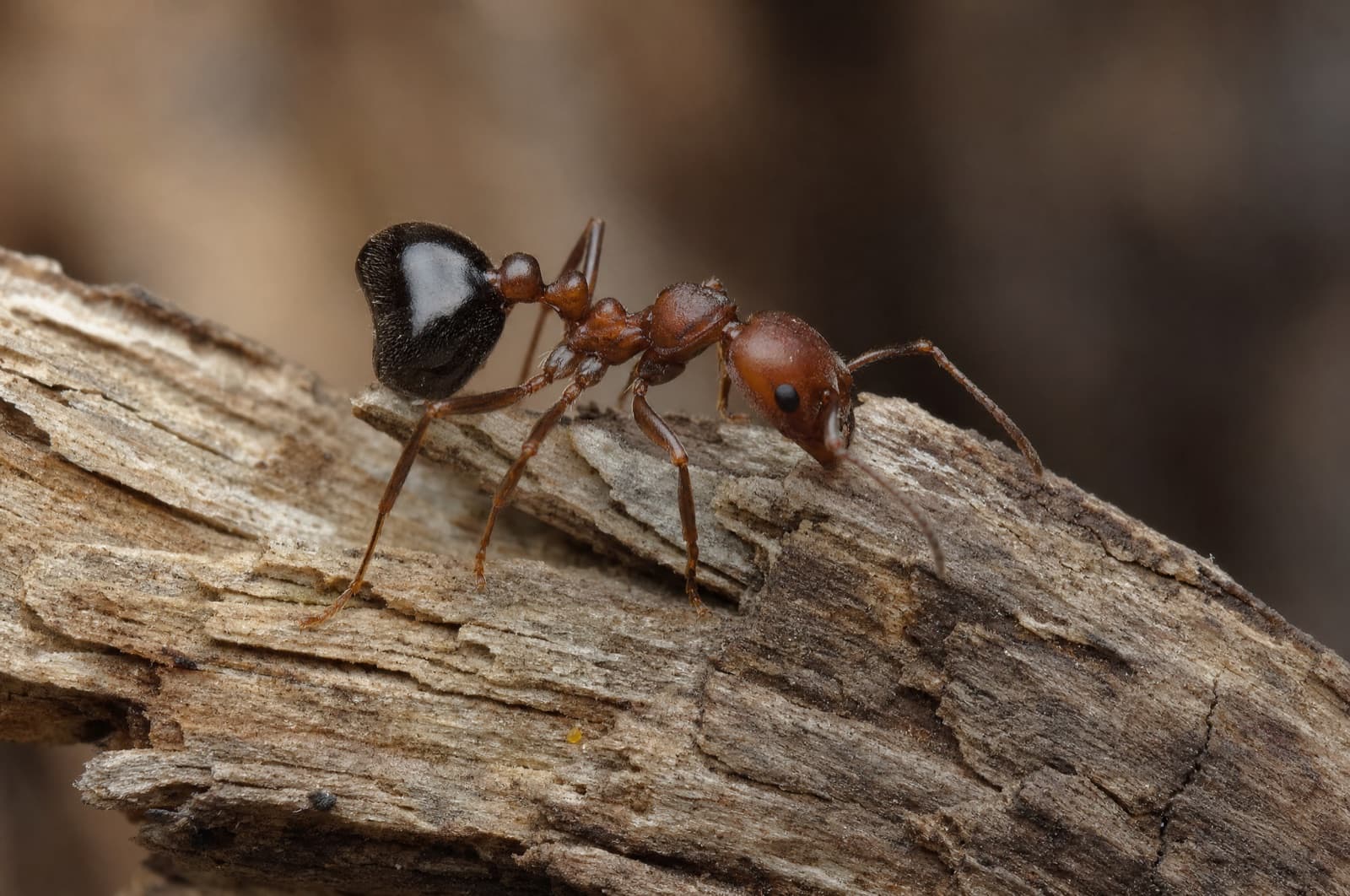
“An acrobat ant colony is a moisture flag: they move into wood a leak already softened — often old carpenter-ant galleries — and raise their heart-shaped abdomen over their back when disturbed. Food and damp wood are the whole draw.”
Why it's here, in full
Why food, moisture, and shelter is the whole answer
Acrobat ants (Crematogaster spp.) are common structural ants that forage for sugars, proteins, and honeydew from aphids or scale insects on nearby trees and shrubs, then carry it back to the colony. Workers strongly favor nesting in wood that is already damp, decayed, or hollow — old carpenter-ant galleries, water-stained siding, wet insulation — so a colony indoors is more often a sign that moisture reached the wood first than that the house did anything to summon the ants. In southern and central New Hampshire, the combination that produces indoor colonies is common in older wood-framed homes: winter ice dams and spring snowmelt saturate roof edges and sill plates, and by summer the softened wood is exactly the harborage acrobat ants exploit. That is the entire mechanism: food outside, moisture-damaged wood inside, and an ant that exploits both.
How to tell it's actually this species
Real signs only — a species with four honest tells gets four, and stops. Where a sign is weak on its own, we say so.
Thin, wandering ant trails along countertops, baseboards, or houseplants leading to food or honeydew-producing insects
Could be something else: Most household ants leave similar trails; the trail alone doesn't identify the species.
A sharp, unpleasant smell when several ants are crushed at once
Fine wood shavings or debris (frass) collecting near a damp windowsill, sill plate, or wall void
Could be something else: Frass this fine also comes from carpenter ants and other wood-damaging insects — it's a moisture signal more than a species ID.
Small satellite nests appearing in insulation, wall voids, or under mulch near a persistent moisture source
Want acrobat ants gone?
This page only answers why it's here. Every removal step for this exact species — what to seal, what to set, what actually works — lives on its own dedicated guide.
Two questions, two pages
Here: why it turned up at all — the honest answer, blame removed.
There: the step-by-step removal guide for this exact species.
Key takeaways
- Acrobat ants forage for food and honeydew, then nest in wood that's already damp or decayed.
- A colony indoors is more often a moisture signal than anything else.
- Removal is a different question — see /top-diy-methods/acrobat-ant.
Already dealing with acrobat ant?
This page is about why it's there. Getting rid of it is covered at /top-diy-methods/acrobat-ant.
Frequently asked
Sources(2)
- [1]NC State Extension — Acrobat Ants
Acrobat ant nesting in hollow stems/decayed wood and honeydew feeding on scale insects
extensionverified 2026-07-17 - [2]University of Minnesota Extension — Ants
General household-ant nesting near moisture and foraging toward food sources indoors
extensionverified 2026-07-17
Written & reviewed by
VerifiedDaniel Brady
NH-Licensed Pesticide Applicator · License #782664 (NHDAMF, RSA 430)
Daniel Brady is the New Hampshire–licensed applicator behind Anchor Pest Services, a family-owned pest control company serving the Manchester area since 2017.
Last updated Jul 2026
Food, water, warmth, shelter — the usual four
If it's already inside, we handle the rest
Same-day inspections across southern and central New Hampshire.
- Family-owned in Manchester since 2017
- NH commercial applicator #782664, category F1
- We will tell you when the answer is do nothing
NH License #782664 · No obligation · We answer in person
Your next step
- Next step
How to Use Ant Shield Insect Killer Granules by Spectracide
Read the answer - What to do next
Acrobat Ant — Quick ID for New Hampshire Homeowners
Read the answer - What to do next
Ant Infestation Signs: How to Tell What Species You Have and How Bad It Is
Read the answer - Also relevant
How to Get Rid of Acrobat Ants
Read the answer - Also relevant
Acrobat Ant — Quick ID for New Hampshire Homeowners
Read the answer - Also relevant
How to Get Rid of Acrobat Ants
Read the answer