
What Attracts Boxelder Bugs to Your House?
At a glance
- Short answer: Boxelder bugs aren't coming in for food or water. They want winter shelter, and a nearby female boxelder tree predicts which house gets swarmed.
- The verdict: The belief is wrong
The attractant verdict
Four possible answers to why this species turned up. Three stay unlit — and that's the argument: the honest answer could have been any of them, and for this species it wasn't.
Boxelder bugs aren't coming in for food or water. They want winter shelter, and a nearby female boxelder tree predicts which house gets swarmed.
Our own previous page said boxelder bugs are attracted to a house "mainly due to warmth and shelter" as the weather cools, which is closer to correct than most folk explanations, but it stops short of naming what actually determines which specific house gets swarmed.
A nearby female (seed-bearing) boxelder tree, or occasionally maple or ash, which the bugs feed on outdoors all summer — followed by a sun-exposed wall, often facing south or west, that offers a place to gather and find a way into cracks and voids before winter.
“It isn't food or water indoors. It's a female boxelder tree nearby, and a sunny wall to gather on before the cold sets in.”
Proximity to a female, seed-bearing boxelder tree (or secondarily maple or ash), which the bugs feed on throughout summer. Extension entomology states boxelder bugs "seldom develop in sufficient numbers to be a nuisance unless a female boxelder tree is in the neighborhood," and that they gather on warm, sun-exposed walls in large numbers specifically near such trees.
It means the determining factor for whether a specific house gets swarmed isn't anything about the house's food, water, or warmth — it's whether a host tree happens to be nearby, which is a landscape fact, not a housekeeping one.
Calibrated from: Colorado State University Extension — Boxelder Bugs, https://extension.colostate.edu/resource/boxelder-bugs/
Why it's here, in full
Not food, not water — a host tree, then a sunny wall
Boxelder bugs feed almost entirely on the seeds of female (seed-bearing) boxelder trees, with maple and ash as secondary hosts, and that summer feeding relationship — not anything happening inside a house — is what determines whether a property develops a large population at all. Colorado State University Extension states plainly that these bugs "seldom develop in sufficient numbers to be a nuisance unless a female boxelder tree is in the neighborhood," and separately notes they're often found sunbathing on warm, south-facing structures in large numbers specifically near those trees.
Our old page's "warmth and shelter" framing correctly identifies the goal once bugs start moving toward a house in fall, but it skips the more useful, more specific fact: the tree, not the house, is what built up the population in the first place.
Once inside, they don't feed — the folk belief about food is simply wrong
A common belief holds that boxelder bugs come inside seeking food and water once the furnace kicks on. Extension sources are direct that this isn't how the species behaves: boxelder bugs do not feed or reproduce indoors. What draws them toward a structure in the first place is the search for a protected overwintering site, and a warm, sun-exposed wall — reached from a nearby host tree — is where that search concentrates. Once inside a wall void or attic, they're simply waiting out the winter in a dormant state; any bugs seen wandering indoors on a warm day are the same population being roused by heat, not evidence of active feeding or breeding.
How to tell it's actually this species
Real signs only — a species with four honest tells gets four, and stops. Where a sign is weak on its own, we say so.
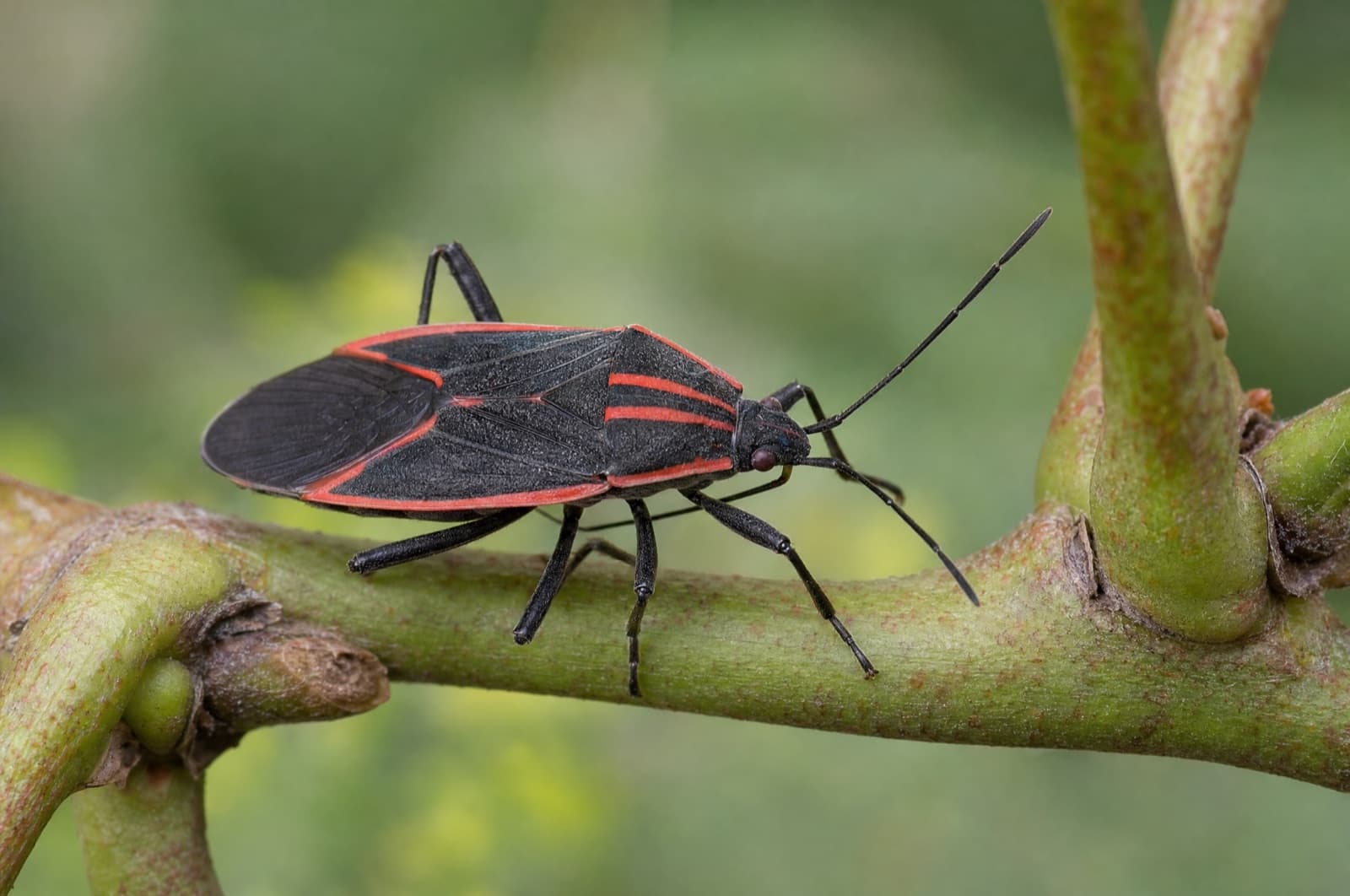
Groups of black bugs with reddish-orange wing markings gathering on a sunny, south- or west-facing wall in fall
Bugs found indoors along windowsills or in wall voids during winter warm spells
Could be something else: This reflects an already-sheltering population being roused by household heat, not a new arrival or an indoor food source.
A female (seed-bearing) boxelder, maple, or ash tree growing on or near the property
Occasional reddish-orange staining on light-colored surfaces where bugs have been crushed or have fed briefly
Want boxelder bugs gone?
This page only answers why it's here. Every removal step for this exact species — what to seal, what to set, what actually works — lives on its own dedicated guide.
Two questions, two pages
Here: why it turned up at all — the honest answer, blame removed.
There: the step-by-step removal guide for this exact species.
Key takeaways
- It isn't food or water indoors. It's a female boxelder tree nearby, and a sunny wall to gather on before the cold sets in.
- It doesn't feed or breed indoors — it's only there for winter shelter.
- What actually matters: the outdoors nearby, shelter.
- If it's already inside, removal is a different question — see /top-diy-methods/boxelder-bug.
Seeing boxelder bugs gather on your walls each fall?
This page is about why they showed up. Exclusion and removal options are covered at /top-diy-methods/boxelder-bug.
Frequently asked
Sources(2)
- [1]Colorado State University Extension — Boxelder Bugs
Boxelder bug population size tied to proximity of a female seed-bearing host tree; aggregation on sun-exposed walls
extensionverified 2026-07-17 - [2]University of Minnesota Extension — Boxelder Bugs
Boxelder bugs entering structures for winter shelter, not feeding or reproducing indoors
extensionverified 2026-07-17
Written & reviewed by
VerifiedDaniel Brady
NH-Licensed Pesticide Applicator · License #782664 (NHDAMF, RSA 430)
Daniel Brady is the New Hampshire–licensed applicator behind Anchor Pest Services, a family-owned pest control company serving the Manchester area since 2017.
Last updated Jul 2026
A nearby tree explains it, not your kitchen
Dealing with boxelder bugs every fall?
Same-day inspections across southern and central New Hampshire — we'll help identify entry points and nearby host trees.
- Family-owned in Manchester since 2017
- NH commercial applicator #782664, category F1
- We will tell you when the answer is do nothing
NH License #782664 · No obligation · We answer in person