
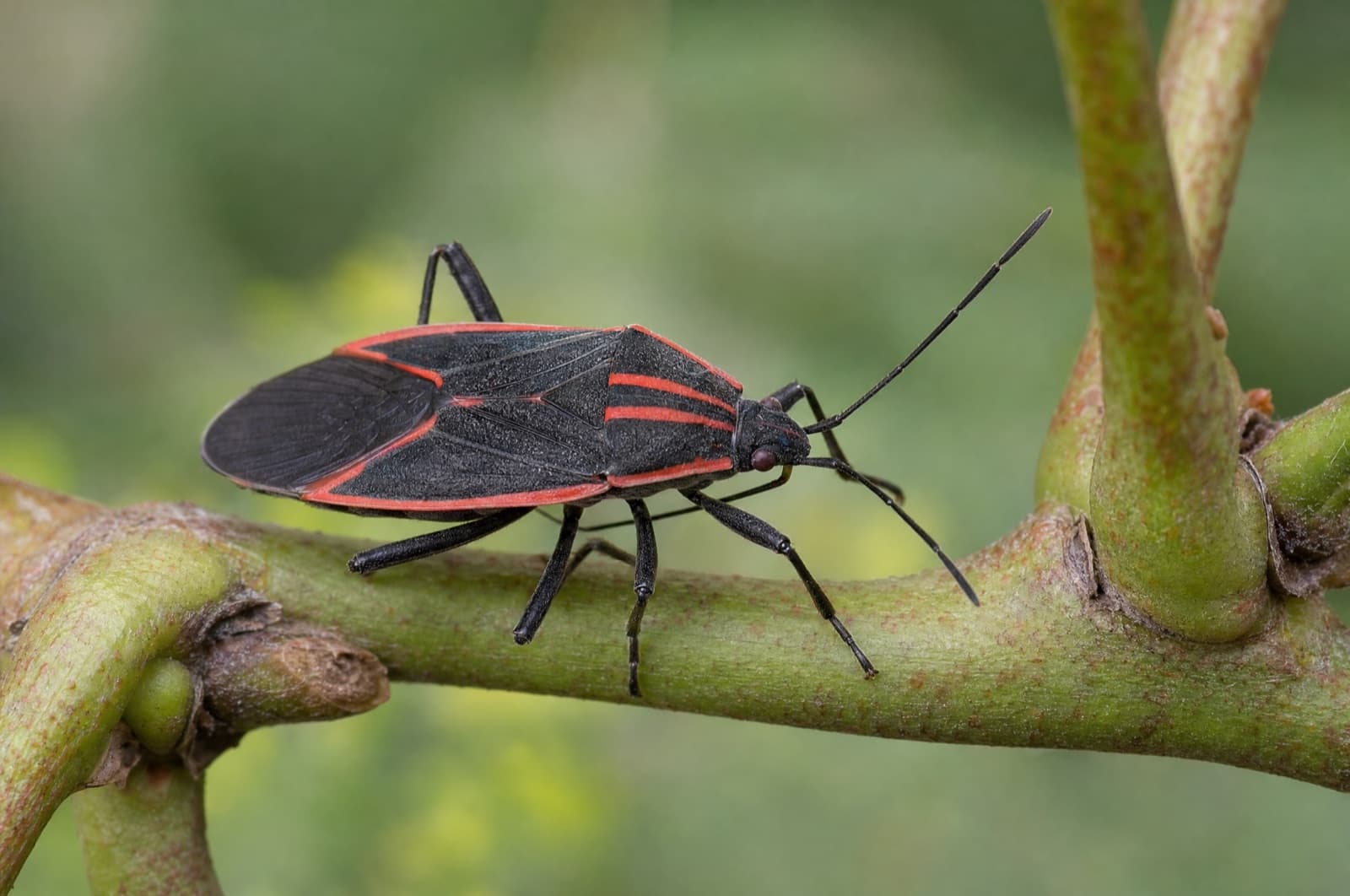
How to Get Rid of Boxelder Bugs
At a glance
- Difficulty: Beginner
- Time: A weekend of sealing in late summer; ongoing vacuuming through fall
- Cost: Low — caulk, screen, and a vacuum
- Success: Good for keeping most out with well-timed fall sealing; homes with nearby boxelder or other maples will see some every year
Can you DIY Boxelder Bug?
The verdict on Boxelder Bug DIY
A beginner-friendly DIY — technique matters more than difficulty.
The boxelder bug (Boisea trivittata) feeds mainly on female, seed-bearing boxelder maples in summer and seeks overwintering shelter on sun-exposed walls each fall. It doesn't bite people or damage the structure — the only real complication is that its fecal spots can stain curtains and walls, so avoiding crushing or aggressive sweeping matters. Sealing gaps before fall and vacuuming indoor strays handle a typical home without a pro.
The 5 DIY methods — honestly graded
Every approach graded for this species, in IPM order — prevention first, chemistry late. Pick a method to see how it works, the steps, and what it actually takes.
Prevention / Exclusion
Works wellThe most durable fix — works when done BEFORE the fall push; does nothing once bugs are already inside.
Boxelder bugs cluster on sun-exposed walls in fall and squeeze through small gaps to overwinter. Closing those gaps ahead of that seasonal push is what reduces next year's numbers.
Best for: Reducing the annual fall invasion
Seal gaps before the fall push
Caulk gaps around windows, doors, and pipes, and seal foundation and siding cracks, prioritizing south- and west-facing exposures where they cluster.
TipDo this work in late summer to early fall, before the ~Oct 19–29 first hard frost in Manchester.CautionProximity to seed-bearing boxelder maples raises pressure regardless of sealing quality.
Tools & materials
Why DIY falls short here
Not scare tactics — the specific, proportionate reasons a home attempt can stall for this species.
Nearby host trees re-pressure the home
Homes near seed-bearing female boxelder maples (or other maples/ash) get re-supplied with bugs every year regardless of sealing quality — expect recurring bugs, not zero.
Staining from crushing or aggressive sweeping
Fecal spots from crushed or roughly-handled bugs stain curtains, walls, and carpet, which is why gentle vacuuming or soapy water beats swatting.
Sealing after entry
Sealing done after bugs have entered wall voids misses the ones already inside for that season — the window that matters is before the fall push.
How risky is it, really?
An honest read — most nuisance species are genuinely low risk, and we say so.
Boxelder bugs are harmless overwintering visitors, not a health threat. They don't bite, carry disease, or damage the structure. The real nuisance is fecal-spot staining from crushing or aggressive handling.
- Fecal-spot staining on curtains, walls, and carpetOccasional
Mainly from crushing or rough sweeping — vacuum or use soapy water instead
University of Wisconsin Horticulture
- Bite, sting, or disease transmissionRare
Not documented — boxelder bugs do not bite people to feed and carry no known disease risk
UNH Cooperative Extension
- Structural damageRare
They feed on boxelder maple seeds, not building materials, and cause no structural harm
National Pesticide Information Center
Tired of the Annual Boxelder Bug Invasion?
Sealing a home surrounded by maples is a bigger job than it looks. Anchor Pest Services handles exclusion and correctly-timed exterior treatment across southern and central New Hampshire. Family-owned since 2017, NH license #782664.
Call a pro when…
- Year after year of heavy fall invasions despite your own sealing
- Entry points you can't safely reach (high soffits, multi-story fascia)
- You want a timed exterior barrier applied correctly in the pre-entry window
General Pest Control
You rarely need a pro for boxelder bugs — this is a seal-and-vacuum job. The exception is a home near heavy boxelder or maple cover under recurring heavy pressure where a correctly-timed exterior barrier is worth the labor savings.
Keep them out
- Seal exterior gaps before the first hard frost (~mid-to-late October in Manchester)
- Prioritize south- and west-facing walls where bugs cluster
- Vacuum, don't crush, to avoid fecal-spot staining
Boxelder bugs in New Hampshire
New Hampshire's abundant maple cover, including boxelder maples, gives this species plenty of summer feeding habitat before it seeks winter shelter each fall. The move indoors lines up with Manchester's average first hard frost, roughly October 19–29 (NOAA), making late summer through early October the window for sealing.
Peak season
Fall, just before the first hard frost
First-frost anchor
Manchester first hard frost ~Oct 19 (50%) / Oct 29 (80%), NOAA 1991–2020
Make sure it's a Boxelder Bug
Two quick detours worth taking — confirm the ID, then learn what drew it in so it doesn't come back.
Frequently asked
Sources & further reading(3)
- [1]University of Wisconsin Horticulture — Boxelder Bug (Boisea trivittatus)
Biology, host-tree association, fecal staining, control recommendations
extensionverified 2026-07-13 - [2]UNH Cooperative Extension — Boxelder Bug Fact Sheet
NH-relevant biology and control guidance
extensionverified 2026-07-13 - [3]National Pesticide Information Center — Boxelder Bugs
Harmless-to-humans status, chemical control notes
govverified 2026-07-13
Written & reviewed by
VerifiedDaniel Brady
NH-Licensed Pesticide Applicator · License #782664 (NHDAMF, RSA 430)
Daniel Brady is the New Hampshire–licensed applicator behind Anchor Pest Services, a family-owned pest control company serving the Manchester area since 2017.
Last updated July 2026
Other species you can tackle
Same category — the dot shows each one's DIY verdict at a glance (green = friendly, amber = doable with care, red = call a pro).
Professional Pest Control
Tired of the Annual Boxelder Bug Invasion?
Sealing a home surrounded by maples is a bigger job than it looks. Anchor Pest Services handles exclusion and correctly-timed exterior treatment across southern and central New Hampshire. Family-owned since 2017, NH license #782664.
- Timed pre-frost exclusion
- NH-licensed applicators (#782664)
- Free inspection — same-day service across southern NH
NH License #782664 · No obligation · We answer in person
Your next step
- Book a NH pro
Pest Control Services
Licensed, family-owned pest control across southern NH.
Book now - What to do next
Boxelder Bugs in New Hampshire — ID, Why They Invade & Control
Read the answer - Also relevant
Boxelder Bugs in New Hampshire — ID, Why They Invade & Control
Read the answer - Also relevant
Household Pest Prevention: Seal, Store, and Time It Right
Read the answer - Also relevant
How do I identify boxelder bugs inside?
Read the answer - Also relevant
How to eliminate boxelder bugs from indoor spaces?
Read the answer