
Boxelder Bugs in New Hampshire — ID, Why They Invade & Control
Also called Maple bug · Box bug · Goldenrain bug
The boxelder bug is a harmless black-and-red insect that masses on sunny NH walls each fall seeking a place to overwinter. It does not bite, breed indoors, or damage your home — though crushed bugs can stain light surfaces. The durable fix is sealing entry points before mid-October, not spraying.
- Adult size
- ~½ in (11–14 mm)
- UNH Extension; Animal Diversity Web
- ID tell
- Three bright red stripes on the black pronotum
- UNH Extension
- NH massing starts
- Early September
- UNH Extension
- Breeds indoors?
- No — overwinters only
- UMN Extension
- NH status
- Present but relatively uncommon (tied to boxelder maple)
- UNH Extension
- Eggs / lifespan
- 200–300 eggs per female; ~1 year
- Animal Diversity Web
The fall wall-clusterer that doesn't bite or breed indoors
That mass of black-and-red bugs on your sunny south-facing wall is a boxelder bug — and despite what the internet implies, a 'red-and-black invasion' is not an infestation. Boxelder bugs do not bite, feed, or reproduce indoors. They are overwintering guests waiting for spring, and the anti-fearmonger verdict is the honest one.
The NH-seasonal story: boxelder bugs begin massing on warm, solar-heated south- and west-facing walls in early September, chasing warmth ahead of Manchester's first hard frost (~Oct 19 at 50% probability; Oct 29 at 80% per NOAA 1991–2020 normals). Once temperatures drop, they slip into wall voids and structural gaps to overwinter. On any warm winter or spring day, a few may emerge indoors seeking light or warmth.
There is a useful NH nuance most sites skip: boxelder bugs are actually relatively uncommon here because they depend on the female (seed-bearing) boxelder maple (*Acer negundo*), itself an uncommon tree in New Hampshire. If you have them, there is almost certainly a female boxelder, silver maple, or ash nearby. The only real downside is fecal staining if bugs are crushed indoors. The durable fix is a caulk gun before mid-October — not a spray. UNH Cooperative Extension explicitly states insecticide sprays are generally not recommended for this nuisance.
How to identify a boxelder bug
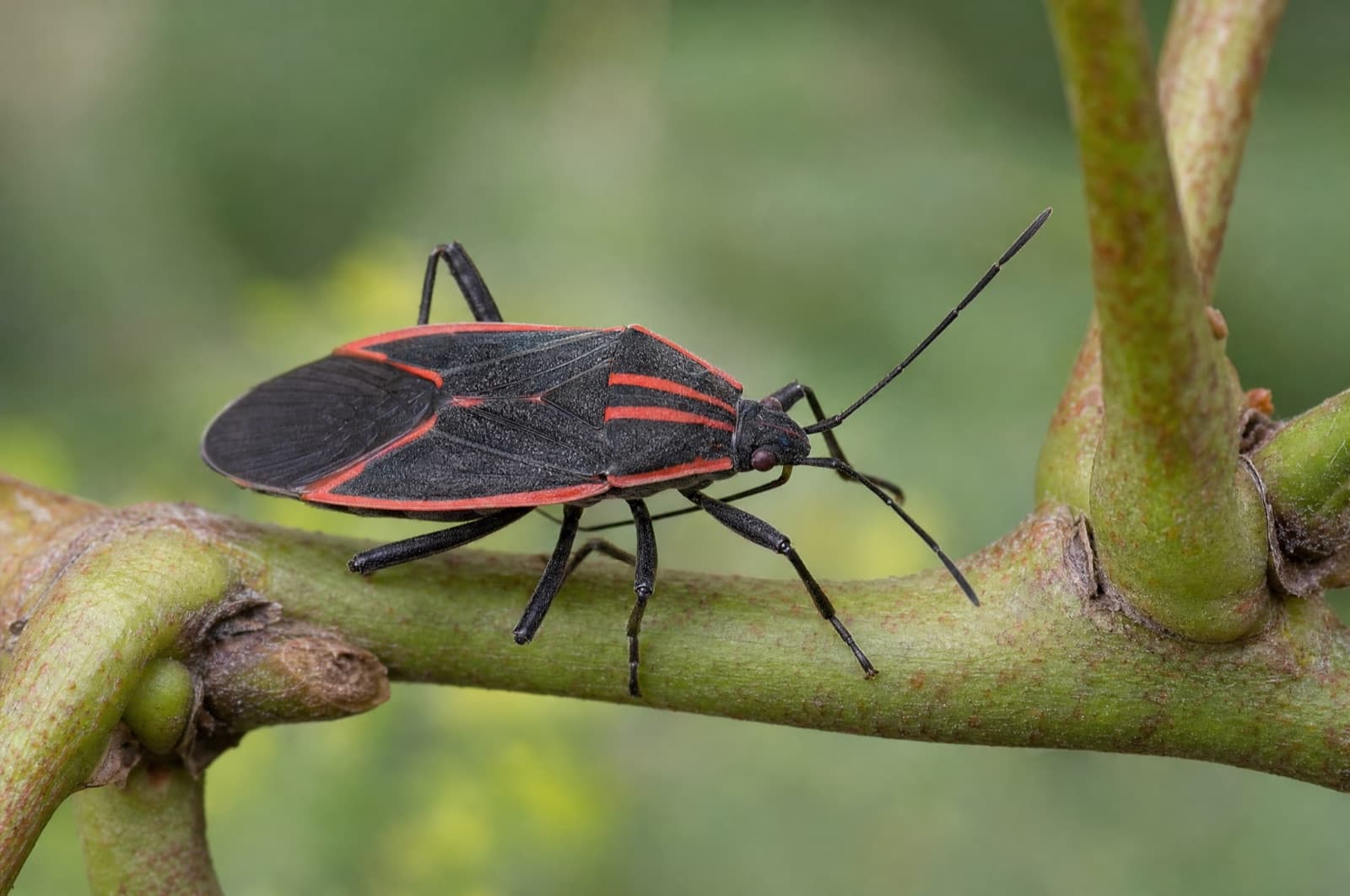
Three features clinch the ID instantly: the three bright red stripes on the black pronotum, the red-edged wings that form an X pattern at rest, and the flat elongate-oval body about ½ inch long. Nymphs are wingless and bright red — they look very different from the adult but share the same red-and-black palette.
Boxelder bug
- Scientific name
- Boisea trivittata
- Family
- Rhopalidae (scentless plant bugs)
- Size
- 11–14 mm (~½ in)
- Coloration
- Black with three red pronotal stripes, red wing margins; bright red abdomen under wings; nymphs wingless and vivid red
- Habitat
- Boxelder, silver maple, and ash trees in summer; south- and west-facing building walls in early fall; wall voids and structural gaps through winter
- Active season
- Massing on walls September–October; overwinters in wall voids; emerges on warm winter/spring days
- Diet
- Sap and seeds of boxelder (Acer negundo), silver maple, and ash; does not feed indoors
- Reproduction
- 1–2 generations per year outdoors on host trees; does not reproduce indoors
- Lifespan
- ~1 year; each female lays 200–300 eggs
Native to North America; found coast to coast wherever host trees grow; present but relatively uncommon in NH due to the limited range of the boxelder maple
The tells — key ID features
- Three bright red stripes on the black pronotum — the single best field ID cue.
- Red margins outlining flat wings that form a distinctive X pattern at rest.
- ~½ inch, flat elongate-oval body; noticeably narrower than a stink bug.
- Bright red abdomen visible when wings open in flight.
- Nymphs are wingless and vivid red, often the first sight in spring.
- Long antennae, six legs, and a piercing-sucking beak (used only on plant material).
Size, to scale
11–14 mm (~½ in)
About the length of an aspirin tablet on its side — noticeably narrower and flatter than a stink bug
Brown marmorated stink bug
How to tell — Stink bug is mottled brown and shield-shaped; boxelder bug is black with red stripes and narrower.
Western conifer seed bug
How to tell — Seed bug is brown, much larger (~¾ in), and has distinctive leaf-shaped flares on the hind legs.
Milkweed bug (Oncopeltus fasciatus)
How to tell — Milkweed bug is larger, found on milkweed plants, and lacks the three pronotal stripes.
Elm seed bug
How to tell — Elm seed bug is smaller (~⅓ in), rusty-toned, and not confirmed in NH — suspect boxelder bug first.
Signs of a problem
Boxelder bugs are easy to spot because they aggregate in large, visible numbers. Here is what each sign tells you.
Clusters of black-and-red bugs on sunny exterior walls in September–October
What it means — Classic fall aggregation — they are seeking solar warmth before overwintering, not establishing an infestation.
Bugs streaming in around window frames, door trim, siding gaps, or utility penetrations
What it means — Entry gaps are present; this is your cue to seal before frost.
Active bugs appearing indoors on warm winter or spring days
What it means — They successfully overwintered in your wall voids and are re-emerging — they did not breed indoors.
Reddish or brownish fecal stains on light curtains, walls, or sills
What it means — Resting or crushed bugs; stains are the main cosmetic nuisance, especially on light fabrics.
Nymphs (bright red, wingless) on host trees or garden surfaces in late spring–summer
What it means — The outdoor population is cycling normally near a nearby host tree.
The real risks, calibrated
Boxelder bugs are one of the safest fall invaders a NH homeowner will encounter. Honest verdict: the risks are low across the board.
Staining of light surfaces
Low riskOnset: On contact if bugs are crushed
Fecal spotting and a faint odor on light curtains, walls, or upholstery when bugs are crushed or large numbers rest in one spot.
Bite or sting
Low riskOnset: Essentially never
Boxelder bugs have a piercing beak for plant feeding but cannot meaningfully bite a human; the rare accidental contact causes at most a minor pinprick.
Cosmetic plant damage
Low riskOnset: Summer months near host trees
Occasional feeding on boxelder seeds and developing maple leaves causes minor, cosmetic blemishes on fruit — not a significant horticultural problem for NH homeowners.
Allergen or health risk
Low riskOnset: Not documented
No documented human allergen response or disease transmission attributable to boxelder bugs.
DIY — what works, what backfires
The most effective boxelder-bug strategy is entirely preventive: seal entry points before the first frost. Once they are inside wall voids, most control options become impractical.
What actually works
- Seal all gaps before mid-October: caulk around windows, door frames, siding joints, soffit seams, and utility penetrations — especially on sunny south- and west-facing walls.
- Vacuum indoor bugs rather than crushing them; empty the vacuum bag promptly and dispose of it outdoors.
- Knock exterior wall clusters off with a forceful stream of water or a dilute soapy-water spray — this disperses them without staining and discourages re-aggregation.
- Repair or replace damaged door sweeps and window screens before fall.
- Consider removing or pruning nearby female (seed-bearing) boxelder maple trees to reduce the source population over several seasons.
What backfires
- Don't crush boxelder bugs indoors — they stain light surfaces and produce a faint odor.
- Don't rely on indoor insecticide sprays; UNH Cooperative Extension states sprays are generally not recommended for this nuisance invader.
- Don't assume spraying the exterior will stop the fall influx — exclusion is the only durable fix.
- Don't wait until bugs are already inside; the window to act is early September through mid-October.
Boxelder bugs in southern and central New Hampshire
Boxelder bugs are present across NH but relatively uncommon compared with the brown marmorated stink bug or western conifer seed bug — their numbers are tightly tied to the availability of seed-bearing boxelder maples near the home. Where those trees exist, fall aggregations on south- and west-facing walls can be significant. Anchor's service area cities from Manchester to Salem and Bedford see them most years on homes with nearby boxelder or silver maple. The window for effective exclusion is early September through mid-October, before Manchester's first hard frost.
Peak season
Masses on walls early September onward; overwinters indoors; emerges on warm winter/spring days
You might actually have
- Brown marmorated stink bug (same fall wall-clustering behavior)
- Western conifer seed bug (same fall entry, bigger, leaf-footed)
- Cluster fly (same fall overwintering, different cluster)
- Multicolored Asian lady beetle (same fall clustering, orange, different cluster)
We serve these communities
- NH-licensed applicator · #782664
- Same-day service
- Family-owned since 2017
Service Area Map
Southern New Hampshire
When to call Anchor Pest Services for boxelder bugs
Most boxelder-bug situations are manageable with exclusion alone. Consider a professional when fall clusters are large and recurring year after year, bugs are entering your living space despite DIY sealing efforts, or you want an expert assessment of all entry points around a complex roofline or older siding.
When to call a pro
- Large, recurring fall clusters that overwhelm DIY exclusion attempts.
- Bugs consistently getting into living areas despite caulking and door sweeps.
- You cannot locate or seal the primary entry points on a complex or multi-story exterior.
- A full exterior inspection is needed ahead of fall to identify all vulnerable gaps.
Seal your sunny walls before mid-October
Boxelder bugs target south- and west-facing walls that collect solar heat. Focus caulking and gap-sealing efforts on those faces of the house first, completing the work before Manchester's first frost (~Oct 19).
Repair screening and door sweeps in late summer
Inspect all window screens, soffit vents, and door sweeps in August so repairs are done before boxelder bugs begin massing in early September.
Reduce host trees near the foundation
Female boxelder maples within 50 feet of the home are the seed source that supports large local populations. Removal or replacement with a male cultivar (which produces no seeds) is the most lasting long-term solution.
Not sure it's a boxelder bug?
A licensed NH technician can confirm the species and tell you honestly whether it's a DIY fix or a job for a pro — free inspection, same-day service across Southern New Hampshire.
Frequently asked questions
Sources(6)
- [1]UNH Cooperative Extension — Seasonal Insect Invaders in NH Homes
NH presence, massing timing, exclusion-over-spray guidance
extensionverified 2026-06-30 - [2]University of Minnesota Extension — Boxelder Bugs
Does not bite, breed, or damage indoors; risk assessment
extensionverified 2026-06-30 - [3]Animal Diversity Web — Boisea trivittata
Adult size 11–14 mm; female lays 200–300 eggs; ~1-year lifespan
encyclopediaverified 2026-06-30 - [4]Wisconsin Horticulture Extension — Boxelder Bug
Solar-heated south/west wall attraction behavior
extensionverified 2026-06-30 - [5]Garden.org — NOAA Frost Date Calculator (Manchester, NH)
Manchester first hard frost ~Oct 19 (50%) / Oct 29 (80%), NOAA 1991–2020 normals
govverified 2026-06-30 - [6]UNH Cooperative Extension — Insect & Other Arthropod Identification
NH entomology identification service and presence verification
extensionverified 2026-06-30
Written & reviewed by
VerifiedDaniel Brady
NH-Licensed Pesticide Applicator · License #782664 (NHDAMF, RSA 430)
Daniel Brady is the New Hampshire–licensed applicator behind Anchor Pest Services, a family-owned pest control company serving the Manchester area since 2017.
Last updated 2026-06-30

New Hampshire pest control
Dealing with boxelder bugs in your home?
Anchor Pest Services identifies and handles boxelder bug problems across southern and central New Hampshire. Family-owned since 2017, NH license #782664.
- NH-licensed applicators (#782664)
- Same-day service · free inspection
- Family-owned since 2017
Your next step
- Fall guide
Fall Pest Control in New Hampshire
What matters before frost: the fall invader window, mice at the foundation, and what to seal first.
Read the answer - What to do next
How to Get Rid of Boxelder Bugs
Read the answer - What to do next
How do I identify boxelder bugs inside?
Read the answer - What to do next
How to eliminate boxelder bugs from indoor spaces?
Read the answer - What to do next
Box Elder Bugs in the House in Winter — NH Timing Guide
Read the answer - What to do next
Natural Control for Fall Invaders and Fabric Pests in NH Homes
Read the answer