
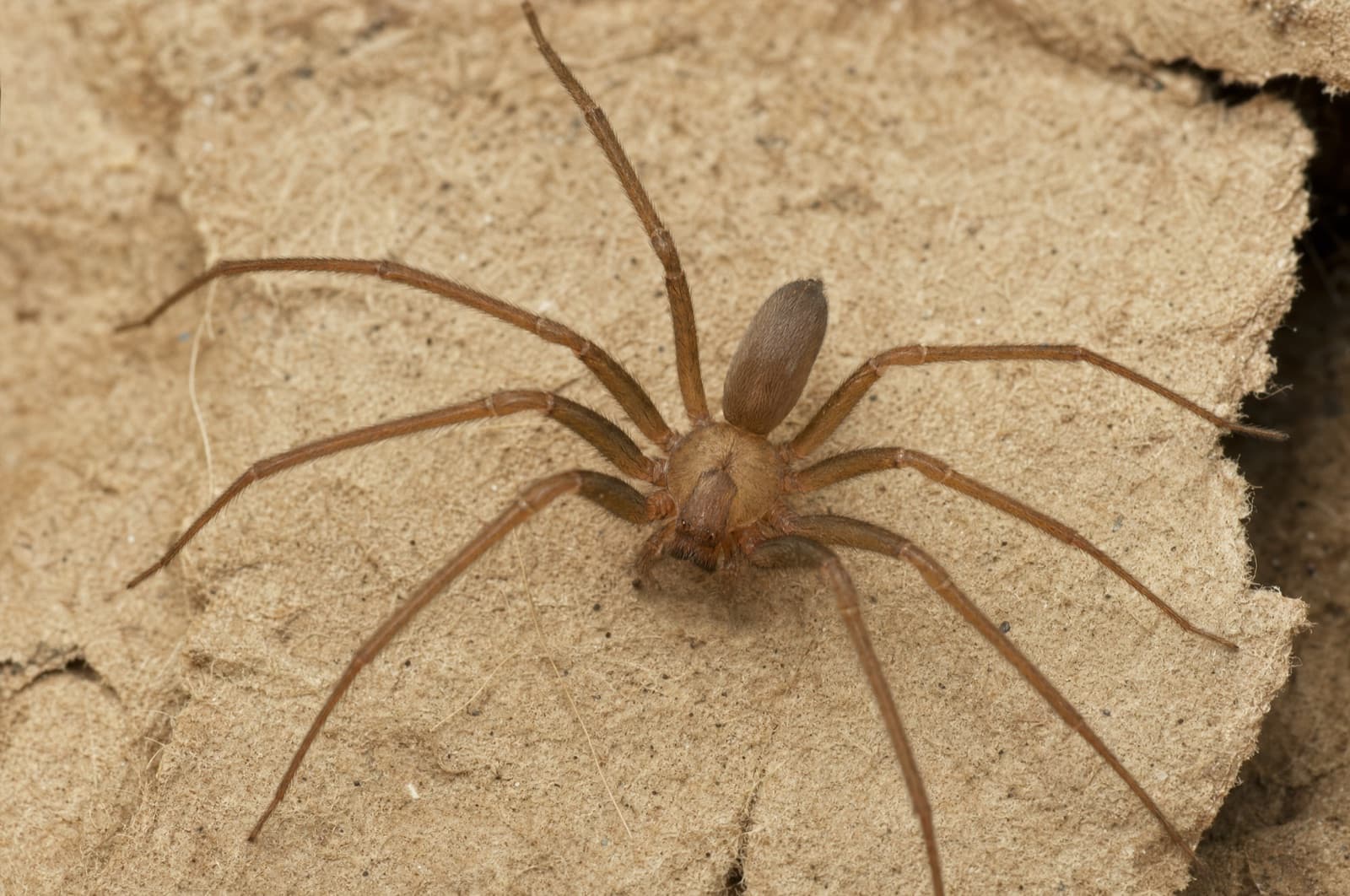
What Attracts Brown Recluse Spiders to Your House?
At a glance
- Short answer: Brown recluse spiders aren't established in New Hampshire — nothing here attracted one.
- The verdict: You didn't attract it — you carried it in
16 states
Where brown recluse populations are confirmed established — none of them in New England
Penn State Extension
The attractant verdict
Four possible answers to why this species turned up. Three stay unlit — and that's the argument: the honest answer could have been any of them, and for this species it wasn't.
Brown recluse spiders aren't established in New Hampshire — nothing here attracted one.
Our own previous page said the brown recluse ‘is attracted to your house mainly because it offers an environment that meets its needs for shelter, food, and safety’ — language that treats it as a routine New Hampshire resident. It isn't one, and that framing was the error.
Nothing about a New Hampshire house draws in a brown recluse, because the species doesn't live here. It's established in exactly 16 states — a band running from the southern Midwest through the south-central states — and has never naturalized in New England. A genuine specimen this far outside its range is explained by transport: most often a box, piece of furniture, or shipment that traveled from a state where the spider is actually established.
“You almost certainly haven't found a brown recluse. New Hampshire is outside its range — we say ‘not established’ rather than ‘never recorded,’ because a rare carried-in specimen can't be ruled out, but that's the exception, not something the house did.”
Why it's here, in full
Why our own old page had the wrong spider in mind
The brown recluse (Loxosceles reclusa) has a well-documented, limited range: entomological surveys place its established populations in 16 states, forming a band from the southern Midwest through the south-central U.S. New England is not part of that range, and New Hampshire's climate is well outside what the species tolerates. A University of New Hampshire review of reported cases notes that brown recluse bites have been ‘diagnosed in states far outside its range, from California to New Hampshire,’ even though the spider is not established in any of them. That means our own legacy page's framing — that a house ‘meets its needs’ and attracts one — described an animal that, for practical purposes, isn't in New Hampshire to be attracted.
What a real sighting almost always means
On the rare occasion a genuine brown recluse does turn up here, entomologists attribute it to transport — a spider riding in a box of belongings, a piece of furniture, or a shipment that originated within its actual range — not to the species expanding into New Hampshire on its own. If you've found a spider you're worried about, the more likely explanation is a common New Hampshire species that resembles it, since several local spiders are frequently mistaken for brown recluses. Species identification is covered at /pests/brown-recluse-spider; this page's job is only to correct the idea that a New Hampshire house attracted one.
How to tell it's actually this species
Real signs only — a species with four honest tells gets four, and stops. Where a sign is weak on its own, we say so.
A single spider inside an item just unpacked from a move, delivery, or shipment originating in the central or southern U.S.
A skin lesion diagnosed as a ‘brown recluse bite’ without an actual spider ever being caught
Could be something else: Most diagnosed ‘brown recluse bites’ in states outside its range turn out to be something else entirely — often a bacterial infection — because the diagnosis is easy to make and hard to disprove without a specimen.
Repeated, ongoing sightings of a similar spider in the same part of the house over weeks or months
Could be something else: Repeated sightings point to a locally established spider — almost certainly a common house or cellar spider — not a brown recluse, which cannot establish a breeding population in New Hampshire.
Want brown recluse spiders gone?
This page only answers why it's here. Every removal step for this exact species — what to seal, what to set, what actually works — lives on its own dedicated guide.
Two questions, two pages
Here: why it turned up at all — the honest answer, blame removed.
There: the step-by-step removal guide for this exact species.
Key takeaways
- Brown recluse spiders are not established in New Hampshire — 16 states have confirmed populations, none in New England.
- A NH sighting is almost always a misidentified local species, not a brown recluse.
- A genuine specimen this far out of range is explained by transport, not attraction.
- Identification and removal are different questions — see /pests/brown-recluse-spider and /top-diy-methods/brown-recluse-spider.
Not sure what you're actually dealing with?
This page is about why it showed up (or didn't). Removal, once you know what it is, is covered at /top-diy-methods/brown-recluse-spider.
Frequently asked
Sources(3)
- [1]Penn State Extension — Brown Recluse Spiders
Brown recluse established range of 16 states, none in New England
extensionverified 2026-07-17 - [2]UNH Magazine — brown recluse bite misdiagnosis outside its range
Brown recluse bites diagnosed in states 'far outside its range, from California to New Hampshire' despite the spider not being established there
academicverified 2026-07-17 - [3]Saupe et al. — Tracking a medically important spider, PLOS ONE (2011)
Current brown recluse range centered from Kansas to Kentucky and southern Iowa to Louisiana — no New England presence
academicverified 2026-07-17
Written & reviewed by
VerifiedDaniel Brady
NH-Licensed Pesticide Applicator · License #782664 (NHDAMF, RSA 430)
Daniel Brady is the New Hampshire–licensed applicator behind Anchor Pest Services, a family-owned pest control company serving the Manchester area since 2017.
Last updated Jul 2026
We'll tell you honestly what you have
Free inspection, straight answer
Same-day inspections across southern and central New Hampshire. If it isn't what you think it is, we'll say so.
- Family-owned in Manchester since 2017
- NH commercial applicator #782664, category F1
- We will tell you when the answer is do nothing
NH License #782664 · No obligation · We answer in person