
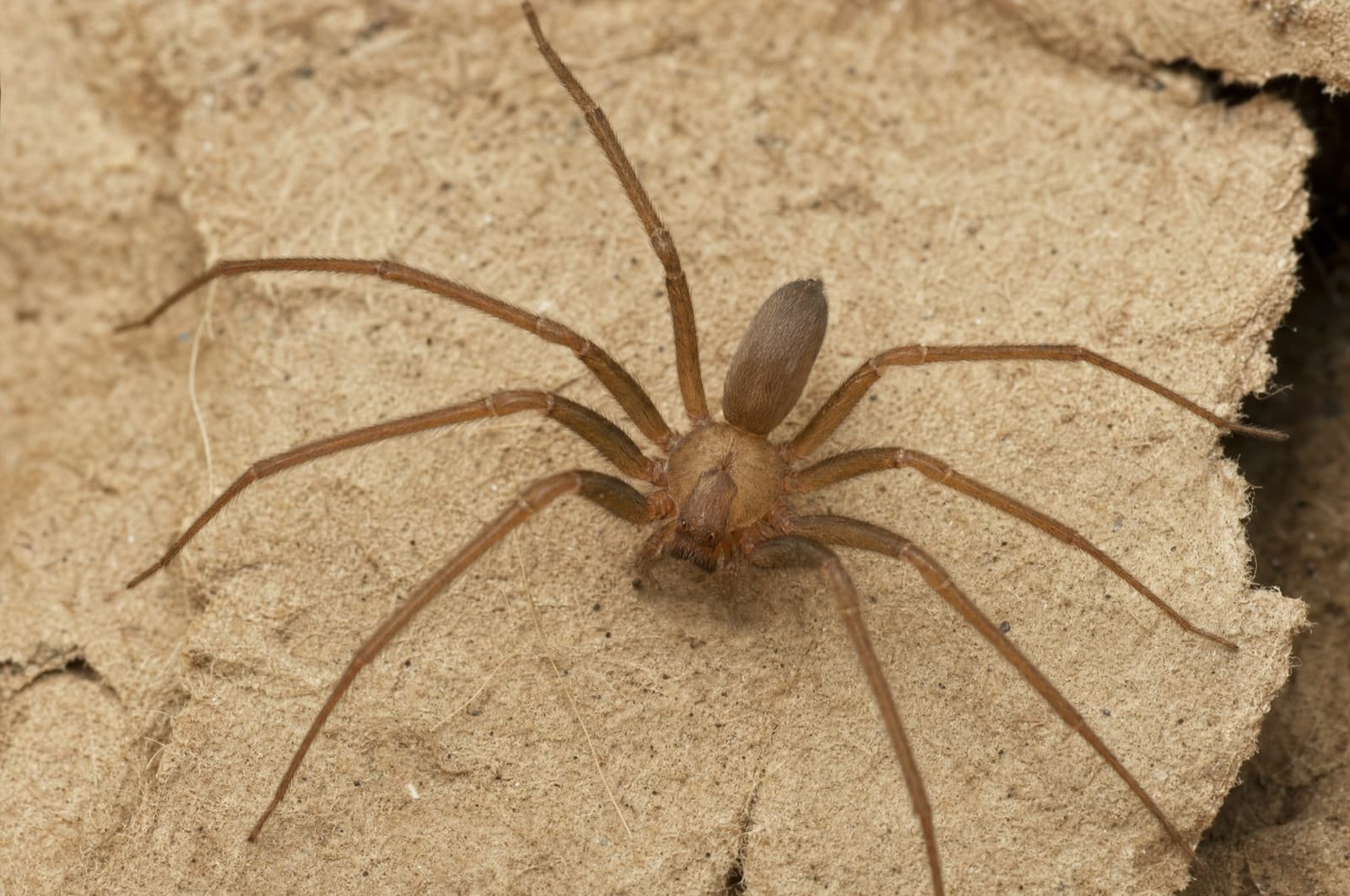
Brown Recluse Spider: Is It in New Hampshire? (No)
Also called Violin spider · Fiddleback spider
The brown recluse spider is not established in New Hampshire — its range is the south-central and lower-Midwest United States, and the region's climate cannot support it. Nearly every 'recluse bite' reported in New England turns out to be a harmless look-alike, a bacterial skin infection, or another cause entirely.
- NH presence
- NOT established (absent)
- Penn State Extension; UNH Magazine
- Actual range
- South-central / lower-Midwest US (~16 states)
- Penn State Extension
- Eye count
- 6 eyes in 3 pairs
- vs 8 in most spiders; Penn State Extension
- Body size
- ~⅜ inch
- Penn State Extension
- NH 'recluse bites'
- Almost always a misidentification
- incl. MRSA/infection; CT Poison Control
Not in New Hampshire — here's what you actually found
The brown recluse spider (Loxosceles reclusa) is not established in New Hampshire — not uncommon, not rare, not occasional. Not here. Its natural range is the south-central and lower-Midwest United States: Missouri, Kansas, Oklahoma, Texas, and neighboring states with hot, dry conditions the New England climate cannot provide. Every authoritative source — Penn State Extension, UNH, and Connecticut Poison Control — confirms that brown recluse spiders do not have established populations anywhere in New England.
This matters because 'recluse bite' is one of the most common misdiagnoses in emergency medicine. In New England, reported recluse bites almost always turn out to be a bacterial skin infection (MRSA is frequently the real culprit), a bite from a harmless NH spider, or another dermatological condition entirely. If someone in NH believes they were bitten by a recluse, the most likely explanation is that they were not — and the wound deserves prompt medical evaluation rather than a hunt for a spider that is not present here.
This page exists to help NH residents rule out the brown recluse: understand what it actually looks like, understand why it cannot establish in New England, and — most importantly — identify the three harmless NH spiders that people most commonly mistake for it.
How to identify a brown recluse — so you can rule it out
These features describe the true brown recluse as it exists within its actual range. In New Hampshire, use this as a rule-out checklist — if the spider you found does not match all three diagnostic features, it is almost certainly a harmless NH species.
Brown Recluse
- Scientific name
- Loxosceles reclusa
- Family
- Sicariidae
- Size
- ~⅜ inch body (roughly a dime)
- Coloration
- Uniform light tan to medium brown; no stripes, spots, or pattern on abdomen; violin-shaped mark on cephalothorax
- Habitat
- Hot, dry, undisturbed spaces — within its range: cardboard boxes, clothing piles, attic insulation. Cannot sustain populations in New England climate.
- Active season
- Within its range: most active at night year-round in warm conditions
- Diet
- Small insects; nocturnal hunter within its range
- Reproduction
- Within its range only; not applicable in NH
- Lifespan
- 1–2 years within range
South-central and lower-Midwest US only — approximately 16 states including Missouri, Kansas, Oklahoma, and Texas. Not established in any New England state.
The tells — key ID features
- Six eyes arranged in three pairs (dyads) — most spiders have eight; requires magnification or a clear photograph to confirm.
- Dark violin-shaped mark on the cephalothorax (the 'fiddle neck' points toward the abdomen).
- Uniform, lightly haired abdomen with no stripes, spots, or distinctive pattern.
- Body roughly ⅜ inch (about the size of a US dime), with uniformly colored legs.
- Remember: in New Hampshire, none of these features can get you to 'brown recluse' — the species is absent here.
Size, to scale
~⅜ inch body
Roughly the size of a US dime
Cellar spider (Pholcus phalangioides)
How to tell — Extremely long, thin legs and a tiny pale body — completely different body plan from the recluse. Harmless and common in NH basements year-round.
Wolf spider (Hogna spp.)
How to tell — Much larger, hairy, and ground-hunting; may have a mottled brown pattern but has eight eyes in a distinctive arrangement and no violin mark. Harmless.
Yellow sac spider (Cheiracanthium spp.)
How to tell — Small, pale yellow or tan, found on walls and ceilings at night; no violin mark, eight eyes. The most commonly misidentified 'recluse' in NH. Mildly venomous but not medically significant.
Signs of a problem
There are no signs of brown recluse in New Hampshire because the species is not established here. What NH residents observe and report as 'recluse signs' are almost always attributable to harmless native spider species or, in the case of wounds, to bacterial infection.
A brown, dime-sized spider found indoors
What it means — Almost certainly a cellar spider, wolf spider, or yellow sac spider — all harmless NH residents. Photograph it and request a professional ID before assuming the worst.
A necrotic, expanding, or slow-healing skin wound
What it means — Seek medical attention immediately. The most common cause of necrotic wounds in New England is MRSA or other bacterial infection, not spider venom. Do not wait for a spider identification.
A violin-shaped marking on a brown spider
What it means — Many NH spiders have similar patterns. Confirm the six-eye arrangement under magnification before concluding recluse — and remember, it is almost certainly a harmless species.
The real risks, calibrated
The brown recluse is not in New Hampshire, so resident exposure risk is essentially zero. The following is provided for awareness only — applicable only within the recluse's actual south-central US range.
Loxoscelism (within recluse range only — not applicable in NH)
ModerateOnset: Hours to days after bite
Within the spider's actual range, some bites cause progressive skin necrosis requiring wound care and medical treatment. This does NOT apply to NH residents. If you have a worsening wound anywhere in the body, see a physician — do not attribute it to a spider you have not confirmed.
Misdiagnosis risk in New Hampshire
ModerateOnset: Immediate (wrong ID leads to wrong treatment)
Attributing a wound to a recluse bite in NH delays identifying the real cause — most often MRSA or another bacterial infection — and getting appropriate treatment. A physician should evaluate all necrotic or slow-healing wounds promptly.
DIY — what works, what backfires
The appropriate DIY response to a suspected recluse in NH is not fumigation — the species is absent here. The right steps are identification, medical care if a wound is involved, and learning the harmless NH look-alikes.
What actually works
- Photograph the spider clearly from multiple angles before doing anything else — top, side, and (if possible) underside.
- Submit the photo to a pest professional, UNH Cooperative Extension, or your state entomology department for positive identification.
- See a physician promptly for any worsening, slow-healing, or necrotic wound — do not wait for a spider ID to get medical care.
- Learn the three harmless NH look-alikes most commonly mistaken for recluse: cellar spider, wolf spider, and yellow sac spider.
What backfires
- Do not apply insecticides for a spider you have not confirmed is present — and since recluse is not established in NH, no treatment is warranted.
- Do not dismiss a worsening wound as 'just a spider bite' and delay medical care — see a physician.
- Do not rely on the violin mark alone as diagnostic — many NH spiders have similar markings; eye arrangement is the more reliable confirming feature.
When to call a pest professional about a brown spider in NH
If you have found a spider you believe is a recluse, a pest professional can provide confirmed identification — almost certainly revealing a harmless NH species. Professional treatment targeting the brown recluse specifically is not warranted in New Hampshire because the species does not live here.
When to call a pro
- You believe you have found a brown recluse — submit for professional ID (it is almost certainly a harmless NH spider).
- You are experiencing recurring spider issues in your home and want the actual resident species identified and managed.
Get a confirmed ID before treating
A professional identification takes the guesswork out of spider management. Knowing exactly which species you have allows for targeted, proportionate control — rather than treating for a spider that is not present.
See a doctor for any suspicious wound
Worsening skin wounds in NH are far more likely to be bacterial than arachnid. Prompt medical evaluation is more important than identifying a cause.
Manage the harmless NH look-alikes sensibly
Cellar spiders, wolf spiders, and yellow sac spiders are the actual residents you may have. Standard spider control — moisture reduction, decluttering, sealing entry points — keeps populations manageable.
Not sure it's a brown recluse?
A licensed NH technician can confirm the species and tell you honestly whether it's a DIY fix or a job for a pro — free inspection, same-day service across Southern New Hampshire.
Frequently asked questions
Sources(6)
- [1]Penn State Extension — Brown Recluse Spiders
range (~16 states); absent from New England; body size; 6-eye arrangement
extensionverified 2026-06-30 - [2]Connecticut Poison Control / UConn Health
NH/NE recluse bites almost always misidentification; MRSA as common cause
govverified 2026-06-30 - [3]UNH Magazine — The Recluse
NH absence; expert confirmation from UNH entomologists
extensionverified 2026-06-30 - [4]Modern Pest Services — Brown Recluse in New England
NE climate inhospitable; hot/dry requirements
industryverified 2026-06-30 - [5]PMC — Sphingomyelinase D and Loxoscelism
sphingomyelinase D; only US spider toxin proven to cause necrosis
academicverified 2026-06-30 - [6]Colonial Pest Control — Recluse in New England
professional NE perspective on recluse misidentification
industryverified 2026-06-30
Written & reviewed by
VerifiedDaniel Brady
NH-Licensed Pesticide Applicator · License #782664 (NHDAMF, RSA 430)
Daniel Brady is the New Hampshire–licensed applicator behind Anchor Pest Services, a family-owned pest control company serving the Manchester area since 2017.
Last updated 2026-06-30

New Hampshire pest control
Dealing with brown recluses in your home?
Anchor Pest Services identifies and handles brown recluse problems across southern and central New Hampshire. Family-owned since 2017, NH license #782664.
- NH-licensed applicators (#782664)
- Same-day service · free inspection
- Family-owned since 2017
Your next step
- Book a NH pro
Spider Control in New Hampshire
Spider sightings peak in fall. We treat hiding spots and seal the gaps they use.
Book now - Next step
Do spiders cause property damage?
Read the answer - What to do next
How to Get Rid of Brown Recluse Spiders — and Why You Probably Don't Have One
Read the answer - What to do next
How to Get Rid of Brown Dog Ticks
Read the answer - Related guide
Wolf Spider in New Hampshire: ID, Bite & Is It a Recluse
Read the answer - Related guide
Brown Dog Tick in NH: The Tick That Infests Houses
Read the answer