
What Attracts Carpenter Ants to Your House?
At a glance
- Short answer: Carpenter ants don't eat your house — they move into wood that a leak already ruined, which is why they're really a moisture warning.
- The verdict: Something specific
The attractant verdict
Four possible answers to why this species turned up. Three stay unlit — and that's the argument: the honest answer could have been any of them, and for this species it wasn't.
Carpenter ants don't eat your house — they move into wood that a leak already ruined, which is why they're really a moisture warning.
Most advice, including our own previous page, says carpenter ants are attracted by "food, water, and suitable nesting spots" treated as three roughly equal factors. That framing misses that the ants don't actually eat the wood at all, and that moisture is doing almost all the explanatory work for why they nest where they do.
Carpenter ants excavate wood to create nesting galleries; they do not eat cellulose the way termites do. They strongly prefer wood that's already softened by moisture, because it's far easier to excavate. The main colony typically stays outdoors, in a stump, tree, or woodpile, where moisture is reliably available — but the colony also establishes satellite nests, and those move indoors specifically into water-damaged wood: around a roof leak, failed flashing, a clogged gutter, or condensation. Finding carpenter ants inside a house is functionally a sign that some piece of wood there has a moisture problem, not that the house in general offered food or shelter.
“Carpenter ants don't eat your house — they move into wood that a leak already ruined, which is why they're really a moisture warning.”
Wood softened by chronic moisture — around a roof or plumbing leak, failed flashing, a clogged gutter, or persistent condensation — that's easier for ants to excavate into a satellite nest than sound, dry wood.
It reframes an indoor carpenter ant sighting from a general pest problem into a locatable moisture problem: find the wet wood, and the reason the ants are there becomes clear. It also explains why carpenter ants often appear near roof lines, bathrooms, and old leaks rather than randomly throughout a structure.
Calibrated from: Penn State Extension, University of Minnesota Extension, and Ohio State University Extension: carpenter ants excavate but do not consume wood, strongly favor wood softened by moisture, and commonly establish indoor satellite nests linked to a moisture source.
Why it's here, in full
They excavate — they don't eat — and moisture explains where
The most useful correction to make about carpenter ants is that they are not eating your house. Unlike termites, carpenter ants don't digest cellulose; they chew wood only to create smooth galleries for nesting, discarding the shavings as frass. Penn State Extension and University of Minnesota Extension both describe a strong preference for wood that's already been softened by moisture, because it's dramatically easier to excavate than dry, sound lumber.
That preference explains the colony structure that actually brings ants indoors. The main, egg-laying colony is usually outdoors — in a rotting stump, a woodpile, or a dead tree — where a moisture-rich, softened-wood environment is naturally available. From there, the colony can establish satellite nests, and those are the ones that move into a structure, always into wood with a moisture problem: around a roof leak, failed flashing, a clogged or poorly pitched gutter, or long-term condensation in an attic or crawlspace. Ohio State University Extension makes the same connection between indoor carpenter ant activity and an underlying moisture source. In practice, that makes carpenter ants an indicator species: finding them inside usually means there's a leak or condensation problem worth finding, which is a different and more useful question than "food, water, and nesting spots" suggests. Structural damage assessment is a separate topic covered at /faq-pest-damage-and-risks.
How to tell it's actually this species
Real signs only — a species with four honest tells gets four, and stops. Where a sign is weak on its own, we say so.
Coarse, sawdust-like shavings (frass) accumulating below a wall void, window sill, or baseboard, sometimes mixed with fragments of dead insects
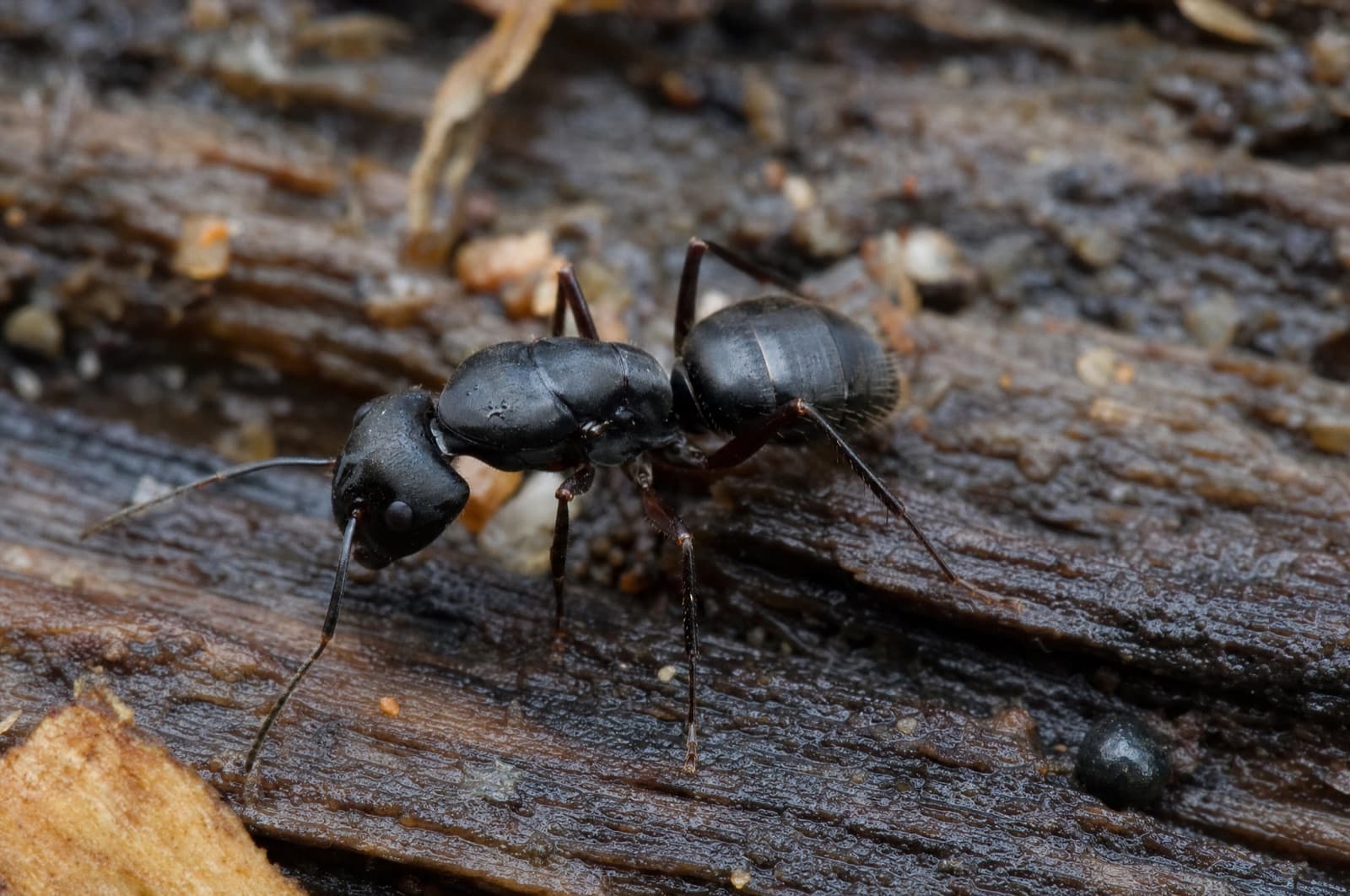
Large black or black-and-red ants, noticeably bigger than typical household ants, seen indoors, especially at night
Faint rustling sounds from within a wall, most noticeable at night in a quiet room
Winged ants emerging indoors, often in spring, from a wall or window frame
Want carpenter ant gone?
This page only answers why it's here. Every removal step for this exact species — what to seal, what to set, what actually works — lives on its own dedicated guide.
Two questions, two pages
Here: why it turned up at all — the honest answer, blame removed.
There: the step-by-step removal guide for this exact species.
Key takeaways
- Carpenter ants excavate wood for nesting; they do not eat it.
- The specific attractant is wood already softened by moisture, not wood in general.
- An indoor satellite nest usually traces back to a leak, failed flashing, or condensation.
- Damage assessment is covered at /faq-pest-damage-and-risks; removal is at /top-diy-methods/carpenter-ant.
Found carpenter ants but not sure where the moisture is?
This page is about why they're there. Locating the leak and removal steps are covered at /top-diy-methods/carpenter-ant.
Frequently asked
Sources(3)
- [1]Penn State Extension — Carpenter Ants
Carpenter ants excavate rather than eat wood, and prefer wood softened by moisture
extensionverified 2026-07-17 - [2]University of Minnesota Extension — Carpenter Ants
Indoor satellite nests are linked to moisture-damaged wood near leaks and condensation
extensionverified 2026-07-17 - [3]Ohio State University Extension — Carpenter Ants (HYG-2063)
Carpenter ant biology, nest structure, and the moisture-damaged wood connection
extensionverified 2026-07-17
Written & reviewed by
VerifiedDaniel Brady
NH-Licensed Pesticide Applicator · License #782664 (NHDAMF, RSA 430)
Daniel Brady is the New Hampshire–licensed applicator behind Anchor Pest Services, a family-owned pest control company serving the Manchester area since 2017.
Last updated Jul 2026
It's the moisture, not the wood
We look for the leak the ants found first
Inspections across southern and central New Hampshire that trace carpenter ant activity back to its moisture source.
- Family-owned in Manchester since 2017
- NH commercial applicator #782664, category F1
- We will tell you when the answer is do nothing
NH License #782664 · No obligation · We answer in person