
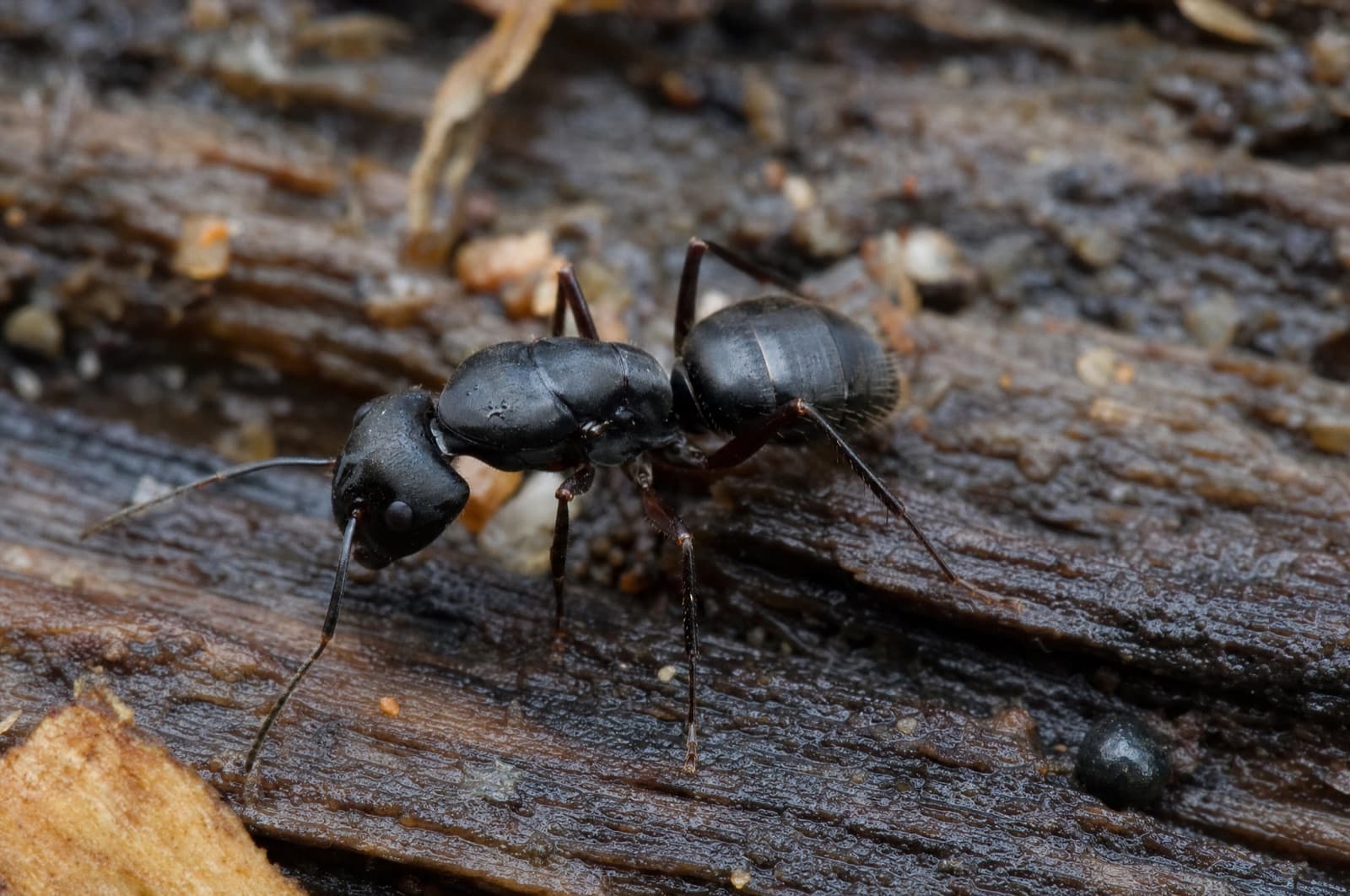
How to Get Rid of Carpenter Ants
At a glance
- Difficulty: Advanced
- Time: Ongoing — moisture prevention is continuous; a satellite-nest bait response can take weeks
- Cost: Low for prevention; a full structural case is a job for a licensed pro
- Success: Good for prevention and satellite knockdown; low for eliminating confirmed structural activity without professional help locating the parent colony
Can you DIY Carpenter Ant?
The verdict on Carpenter Ant DIY
DIY can knock down what you see — it usually can't reach what's causing it.
UNH Cooperative Extension calls carpenter ants, along with termites, the most troublesome structural pest in New Hampshire. Unlike termites, they don't eat wood — they excavate galleries for nesting — and Penn State notes damage rarely causes structural failure and typically takes years to accumulate, so this is a real but slower, less catastrophic risk than termite damage. The core DIY problem is mechanistic, not scare tactics: the parent colony (with the egg-laying queen) is often outdoors in a tree, stump, or woodpile, or hidden deep in the structure, while what you see indoors is frequently just a satellite nest. DIY bait can genuinely knock down a satellite, but the parent colony keeps producing workers that reinvade. Confirmed indoor structural activity, especially winter sightings, is UNH's own signal to call a professional.
The 5 DIY methods — honestly graded
Every approach graded for this species, in IPM order — prevention first, chemistry late. Pick a method to see how it works, the steps, and what it actually takes.
Prevention / Exclusion
Works wellThe most genuinely effective DIY lever — carpenter ants strongly prefer damp or decayed wood, so moisture control removes the reason they nest there.
Cornell's urban entomology program treats carpenter ants as an indicator species for roof leaks, clogged gutters, or poor drainage. Structural wood kept below roughly 15% moisture is generally not attractive to them, per Penn State.
Best for: Preventing an infestation before it starts, or stopping recurrence after treatment
Fix moisture sources
Repair roof and plumbing leaks, clean gutters, and correct poor drainage around the foundation.
Replace water-damaged wood
Address any wood that's already decayed or moisture-damaged before ants find it.
Keep firewood and debris away from the house
Store firewood off the ground and away from the structure; trim overhanging tree limbs that provide a bridge to the roofline.
Tools & materials
Why DIY falls short here
Not scare tactics — the specific, proportionate reasons a home attempt can stall for this species.
The undetected parent colony
DIY bait or vacuuming knocks down the visible satellite while the egg-laying queen in the parent nest — often outdoors within about 100 yards, or hidden deep in the structure — keeps producing workers that reinvade within days or weeks, per Penn State.
Repellent spray kills only foragers
Per the Illinois Department of Public Health, typically only about 10–15% of a colony's workers are outside foraging at any time — so spraying visible ants leaves the large majority of the colony untouched, and can splinter activity.
Winter indoor activity signals an existing indoor nest
UNH Extension's own guidance: large black ants seen indoors in January–February mean the nest is already inside the structure — a professional-level find, not a bait-and-wait situation.
How risky is it, really?
An honest read — most nuisance species are genuinely low risk, and we say so.
Carpenter ants are low health risk and moderate property risk. They do not sting, and bites are rare and minor. The real concern is structural: cumulative gallery excavation in moisture-damaged framing that builds up over years — reframed like carpenter bee or termite damage, as a property issue rather than a health threat.
- Slow structural weakening of damp framingOccasional
Cumulative and generally slower than termite damage; inspect moisture-prone areas (roofline, sills, decks)
Penn State Extension / UNH Cooperative Extension
- Nuisance foraging indoorsCommon
Most noticeable in spring and summer as workers search for food
UNH Cooperative Extension
- Rare, minor defensive biteRare
Not a meaningful health hazard; no sting
UNH Cooperative Extension
Confirmed Carpenter Ant Activity Indoors?
The hardest part of carpenter-ant control is finding the hidden parent colony — often outdoors in a stump or dead wood, sometimes deep in the structure. Anchor Pest Services provides thorough inspection and treatment across southern and central New Hampshire. Family-owned since 2017, NH license #782664.
Call a pro when…
- Large black ants seen indoors in winter (a UNH-flagged sign of an indoor nest)
- Visible sawdust-like frass (wood shavings) indicating an active gallery
- Bait knocks down activity temporarily but it returns
- You suspect structural wood damage and want it assessed before it worsens
General Pest Control
Carpenter ants are this hub's clearest case for calling a professional. Prevention (moisture control) is genuinely DIY-friendly, but confirmed indoor structural activity means finding the parent colony — often hidden or outdoors — which is a job for a trained inspector, not a bait cup. Homeowners' insurance generally does not cover carpenter-ant structural damage, which makes early, correct treatment worth the investment.
Keep them out
- Fix roof, gutter, and plumbing leaks promptly
- Keep firewood and debris off the ground and away from the structure
- Keep structural wood moisture below roughly 15%
- Trim tree limbs that bridge to the roofline
Carpenter ants in New Hampshire
UNH Cooperative Extension identifies four carpenter ant species in the state and calls carpenter ants, alongside termites, the most troublesome structural pest NH homeowners face. Winter sightings of large black ants indoors are a specific, extension-backed signal that the nest is already inside the structure, since carpenter ants aren't normally active indoors that time of year unless they're nesting there.
Peak season
Spring through summer for foraging; winter indoor sightings signal an existing indoor nest
First-frost anchor
Manchester first hard frost ~Oct 19 (50%) / Oct 29 (80%), NOAA 1991–2020
Make sure it's a Carpenter Ant
Two quick detours worth taking — confirm the ID, then learn what drew it in so it doesn't come back.
Frequently asked
Sources & further reading(5)
- [1]UNH Cooperative Extension — Carpenter Ants Fact Sheet
NH species count, structural pest ranking, winter-sighting indoor-nest signal, bait limitations
extensionverified 2026-07-13 - [2]Penn State Extension — Carpenter Ants
Rare structural failure, parent/satellite colony biology, moisture threshold
extensionverified 2026-07-13 - [3]University of Minnesota Extension — Carpenter Ants
Slow, cumulative damage timeline
extensionverified 2026-07-13 - [4]Cornell Blog — NYS IPM: Carpenter Ant Satellite Nest Elimination
Moisture indicator-species framing, satellite-vs-parent colony distinction
extensionverified 2026-07-13 - [5]Illinois Department of Public Health — Carpenter Ants
Only 10–15% of workers forage outside the nest at a time
govverified 2026-07-13
Written & reviewed by
VerifiedDaniel Brady
NH-Licensed Pesticide Applicator · License #782664 (NHDAMF, RSA 430)
Daniel Brady is the New Hampshire–licensed applicator behind Anchor Pest Services, a family-owned pest control company serving the Manchester area since 2017.
Last updated July 2026
Other species you can tackle
Same category — the dot shows each one's DIY verdict at a glance (green = friendly, amber = doable with care, red = call a pro).
Professional Pest Control
Confirmed Carpenter Ant Activity Indoors?
The hardest part of carpenter-ant control is finding the hidden parent colony — often outdoors in a stump or dead wood, sometimes deep in the structure. Anchor Pest Services provides thorough inspection and treatment across southern and central New Hampshire. Family-owned since 2017, NH license #782664.
- Trained to locate parent colonies, not just satellites
- NH-licensed applicators (#782664)
- Free inspection — same-day service across southern NH
NH License #782664 · No obligation · We answer in person
Your next step
- Book a NH pro
Ant Pest Control
Book now - What to do next
How to Get Rid of Carpenter Ants in NH: The Complete 2026 Treatment Guide
Read the answer - What to do next
What are the signs of carpenter ants in your house?
Read the answer - What to do next
Do Carpenter Ants Eat Wood? (No — Here's What They Actually Do)
Read the answer - What to do next
Where Do Carpenter Ants Nest? 12 Indoor & Outdoor Locations in NH Homes
Read the answer - Also relevant
Carpenter Ant — Quick ID for New Hampshire Homeowners
Read the answer