
Carpenter Ant — Quick ID for New Hampshire Homeowners
Also called Black carpenter ant
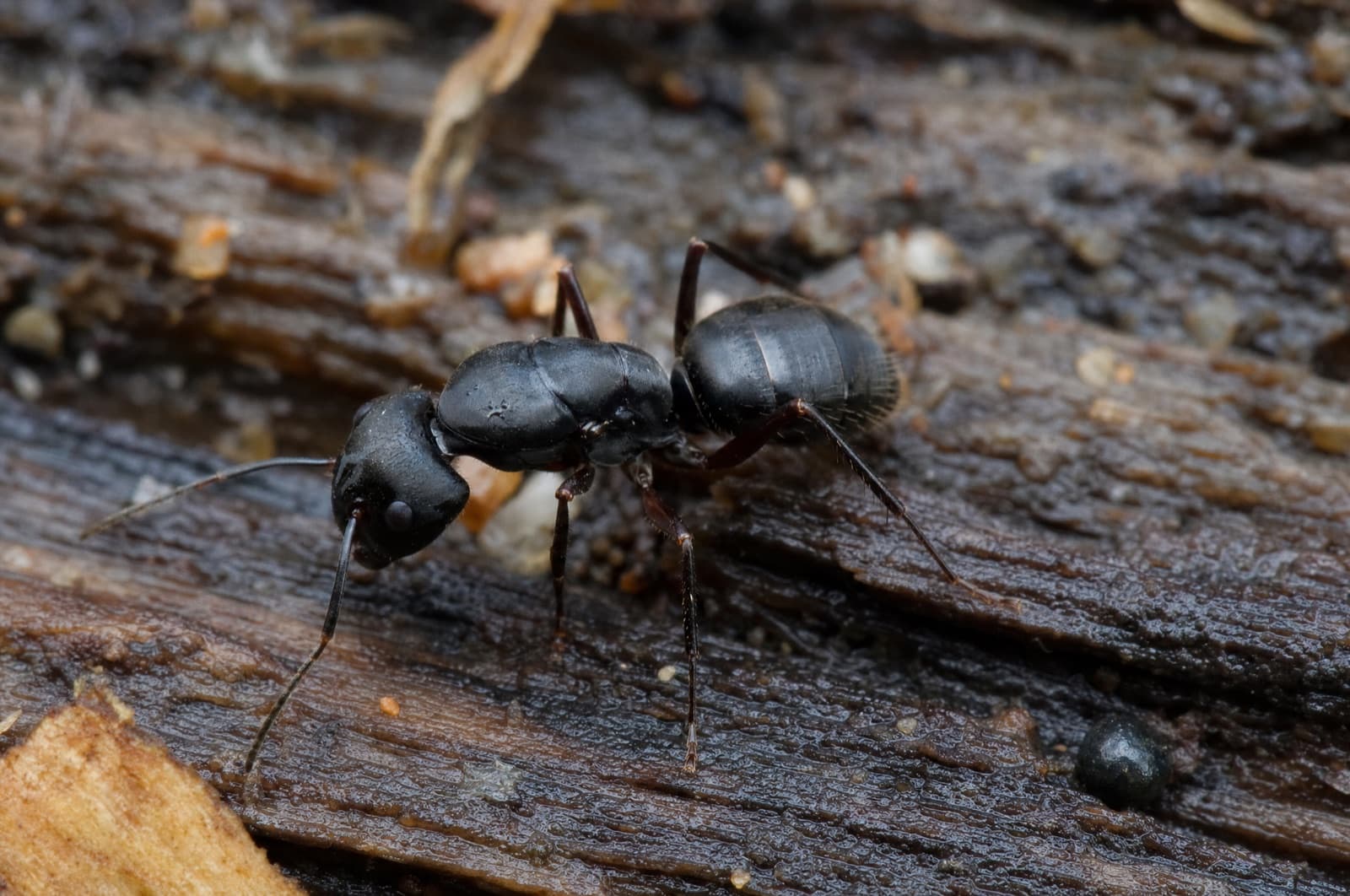
Carpenter ants are New Hampshire's largest house ants — up to 13 mm, black, with a single smoothly rounded thoracic hump. They don't eat wood; they excavate smooth galleries and push out frass (sawdust-like shavings). UNH Extension names them NH's most troublesome structural ant pest. Nail the size-and-frass ID here; treatment and the termite comparison live in the full ant guide.
- Size
- 6–13 mm
- NH's largest ant; Camponotus pennsylvanicus
- Damage tell
- Frass piles
- wood shavings + insect parts at kick-out holes
- Galleries
- Smooth, sanded-looking
- no mud inside (the termite separator)
- NH status
- Very common
- top structural ant pest in NH per UNH Extension
Is it a carpenter ant?
Carpenter ants are the largest ant you are likely to find in a New Hampshire home — big, black, and impossible to miss when they trail across a kitchen counter at night. UNH Cooperative Extension identifies them as the state's most troublesome structural ant pest, and finding frass or winged swarmers indoors means the colony has moved in.
Treat this page as the size-and-frass check. When you need treatment strategy, the termite comparison, and what indoor frass really signals, the complete Ant FAQ guide above has it.
Quick carpenter ant ID
Size and frass separate carpenter ants from every other ant in New Hampshire.
Carpenter ant
- Scientific name
- Camponotus pennsylvanicus (also C. novaeboracensis)
- Family
- Formicidae
- Size
- 6–13 mm (workers vary; queens larger)
- Coloration
- Dull black; some individuals have reddish-orange midsection
- Habitat
- Moist or decayed wood — window and door sills, roof sheathing, decks, framing near tubs and dishwashers; satellite nests indoors
- Active season
- Year-round indoors; peak foraging spring through fall; winged swarmers in spring
- Diet
- Insects, other invertebrates, honeydew from aphids, household food scraps
- Reproduction
- Winged males and queens swarm in spring; queens establish new colonies in soft wood
- Lifespan
- Workers live months; queens can live a decade or more
Very common throughout New Hampshire; primary structural ant pest in the state according to UNH Cooperative Extension.
The tells — key ID features
- Large and black with one smoothly rounded hump on the thorax (single-node waist) — the profile separates it from pavement and odorous house ants.
- Frass piles: clean wood shavings mixed with insect parts and sand below kick-out holes — carpenter ants push this out of their galleries.
- Smooth, sanded-looking gallery walls with no mud inside — the termite separator (termite galleries contain soil and mud tubes).
- Winged swarmers (alates) emerging indoors in spring strongly indicate an established nest inside the structure.
Eastern subterranean termite
How to tell — Termites have straight antennae, no waist, and pack galleries with soil; carpenter ants have elbowed antennae, a distinct waist, and leave clean frass with no mud.
Odorous house ant
How to tell — Odorous house ants are much smaller (2.4–3.3 mm) and smell like rotten coconut when crushed; carpenter ants are 6–13 mm with no distinctive odor when crushed.
Signs of a problem
Two signs pinpoint an established infestation.
Small piles of sawdust-like frass (wood shavings + insect fragments) below a sill, baseboard, or door frame
What it means — Active carpenter ant gallery above — workers are excavating and pushing out material.
Large black ants trailing at night or winged swarmers at a window in spring
What it means — Established colony; swarmers indoors in spring confirm the nest is inside the structure.
Carpenter ant control in New Hampshire
Carpenter ants are NH's most troublesome structural ant pest. Finding frass indoors or winged swarmers at a window in spring means there is an active satellite or parent nest inside the structure. Professional treatment locates the colony and eliminates it. The full ant guide covers treatment options, moisture correction, and the termite comparison.
When to call a pro
- Frass piles appear under a sill, frame, or baseboard.
- Winged swarmers emerge at a window or light fixture indoors in spring.
- Large black ants are seen regularly trailing at night.
- You need carpenter ant vs. termite confirmation before damage spreads further.
Not sure it's a carpenter ant?
A licensed NH technician can confirm the species and tell you honestly whether it's a DIY fix or a job for a pro — free inspection, same-day service across Southern New Hampshire.
Frequently asked questions
Sources(2)
- [1]UNH Cooperative Extension — Carpenter Ants
most troublesome structural ant pest in NH, frass ID, gallery description
extensionverified 2026-06-30 - [2]Anchor Pest — Ant FAQ Guide
full NH carpenter ant treatment and termite comparison
industryverified 2026-06-30
Written & reviewed by
VerifiedDaniel Brady
NH-Licensed Pesticide Applicator · License #782664 (NHDAMF, RSA 430)
Daniel Brady is the New Hampshire–licensed applicator behind Anchor Pest Services, a family-owned pest control company serving the Manchester area since 2017.
Last updated 2026-06-30

New Hampshire pest control
Dealing with carpenter ants in your home?
Anchor Pest Services identifies and handles carpenter ant problems across southern and central New Hampshire. Family-owned since 2017, NH license #782664.
- NH-licensed applicators (#782664)
- Same-day service · free inspection
- Family-owned since 2017
Your next step
- Next step
Is Spectracide Ant Shield Granules Safe for Pets?
Read the answer - What to do next
How to Get Rid of Carpenter Ants
Read the answer - Also relevant
Carpenter Ant Damage: Year-by-Year Timeline and What It Actually Looks Like
Read the answer - Also relevant
Carpenter ant frass: what it looks like, why it matters, and how to tell it from termite or beetle frass
Read the answer - Also relevant
Do Carpenter Ants Eat Wood? (No — Here's What They Actually Do)
Read the answer - Related guide
Odorous House Ant — Quick ID for New Hampshire
Read the answer