
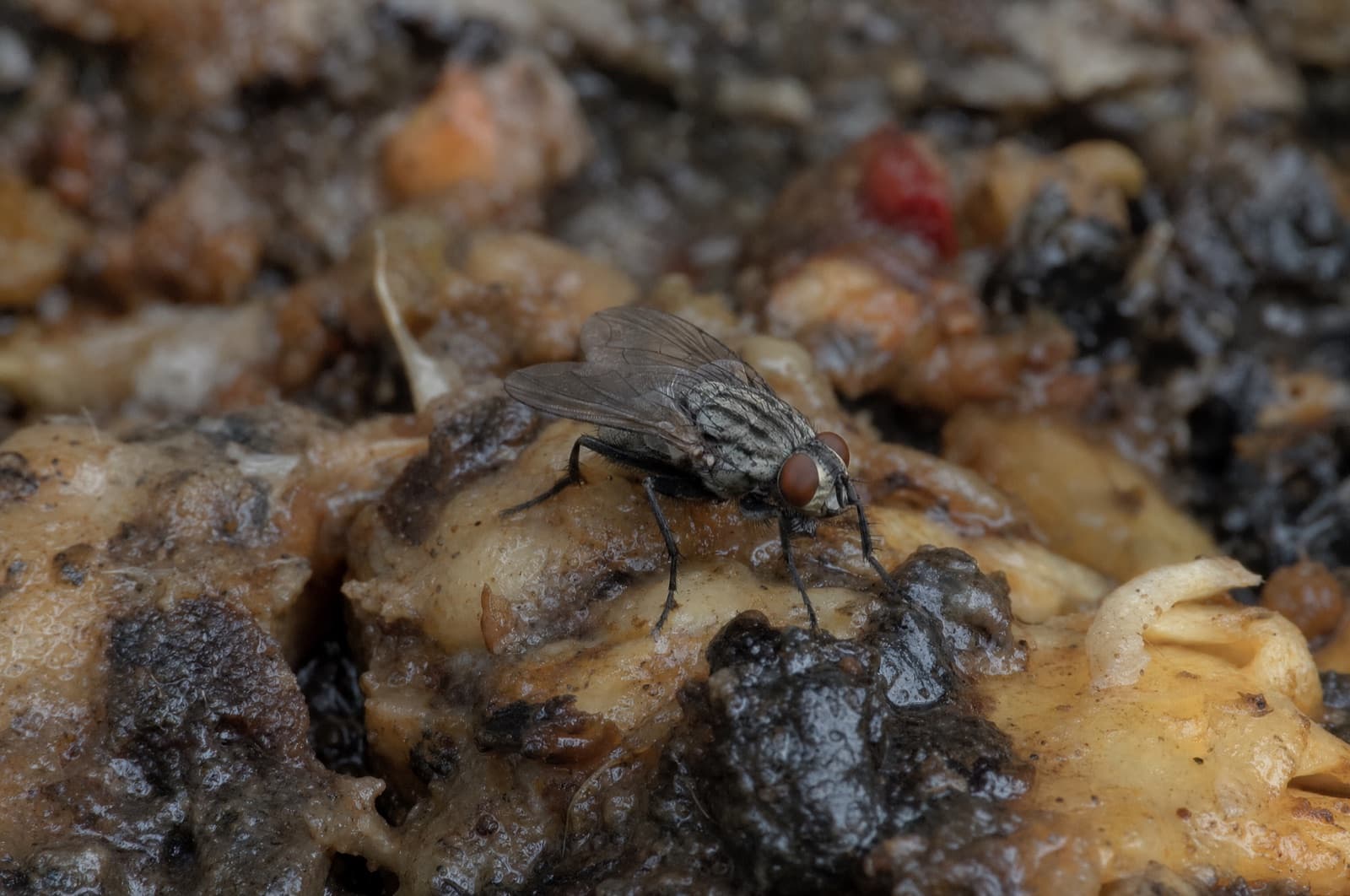
What Attracts House Flies to Your House?
At a glance
- Short answer: House flies are made in wet, rotting organic matter — trash, waste, spilled feed — so a house fly problem is a sanitation-source problem.
- The verdict: Something specific
1,500+ maggots
House fly larvae a single pound of wet manure can yield — why a small breeding source causes a big problem
Texas A&M AgriLife Extension
1.5 million larvae
How many house fly larvae 1,000 pounds of wet manure can harbor
Texas A&M AgriLife Extension
The attractant verdict
Four possible answers to why this species turned up. Three stay unlit — and that's the argument: the honest answer could have been any of them, and for this species it wasn't.
House flies are made in wet, rotting organic matter — trash, waste, spilled feed — so a house fly problem is a sanitation-source problem.
Most advice, including our own previous page, says houseflies are drawn to a home "primarily because they are searching for food, water, and shelter," grouped together as if any food source works equally well. The actual driver is much narrower: a specific breeding substrate, not food generally.
House flies (Musca domestica) breed in wet, decaying organic matter — garbage, manure, spilled animal feed, rotting vegetation — and it doesn't take much of it. Texas A&M AgriLife Extension notes that just one pound of wet manure can yield more than 1,500 maggots, and that 1,000 pounds of wet manure can harbor 1.5 million larvae. Adults are drawn to and feed on that same kind of moist organic film with sponging mouthparts, and a persistent indoor house fly problem is best explained by finding that specific breeding source — an overflowing trash can, a compost pile too close to the house, spilled pet food left to rot — rather than food or shelter in the ordinary sense.
“House flies are made in wet, rotting organic matter — trash, waste, spilled feed — so a house-fly problem is a sanitation-source problem.”
A specific breeding substrate of wet, decaying organic matter — garbage, manure, spilled feed, or rotting plant material — where a small amount can produce an outsized number of flies.
It turns 'houseflies like food' into a locatable question: where is wet, decaying organic matter accumulating. Because even a small breeding source can produce a very large number of flies, the useful search is narrow and specific rather than general kitchen cleanliness.
Calibrated from: University of Kentucky Cooperative Extension (ENTFACT-514) and Texas A&M AgriLife Extension: house fly larvae develop in wet decaying organic matter, and a small quantity of breeding material can yield an outsized number of flies.
Why it's here, in full
Why a small breeding source can cause a big problem
House flies don't need much to build a large population, which is exactly why the source is worth naming specifically rather than blaming general household food. University of Kentucky Cooperative Extension (ENTFACT-514) describes larval development in wet, decaying organic matter — garbage, manure, spoiled food, rotting plant material — and Texas A&M AgriLife Extension quantifies just how efficient that process is: a single pound of wet manure can yield more than 1,500 maggots, and 1,000 pounds can harbor 1.5 million larvae. Even without livestock involved, the same principle scales down to a household level: an overflowing trash can, a poorly managed compost pile, spilled pet food left in a damp corner, or a leaking garbage bag can all serve the same function.
That's why a persistent house fly problem tracks so closely with one specific source rather than with general kitchen cleanliness. Adults themselves feed on moist organic films using sponging mouthparts, and peer-reviewed research on filth-fly ecology documents their role in mechanically transporting pathogens between breeding sites and surfaces they land on. Finding and eliminating the specific wet, decaying material is a far more effective answer than broad household cleaning.
How to tell it's actually this species
Real signs only — a species with four honest tells gets four, and stops. Where a sign is weak on its own, we say so.
A cluster of adult house flies concentrated near a specific trash container, compost area, or animal-waste spot rather than spread evenly around the house
Small, white, worm-like larvae found in or near garbage, compost, or spilled pet food
Small dark specks (fly spots) accumulating on light fixtures, walls, or windowsills near a resting or breeding area
Could be something else: Similar specks can be mold, dirt, or other insect residue; they're suggestive of fly activity nearby but not proof on their own.
Fly activity that tracks closely with trash pickup day, worsening right before collection and easing right after
Want common housefly gone?
This page only answers why it's here. Every removal step for this exact species — what to seal, what to set, what actually works — lives on its own dedicated guide.
Two questions, two pages
Here: why it turned up at all — the honest answer, blame removed.
There: the step-by-step removal guide for this exact species.
Key takeaways
- House flies breed in wet, decaying organic matter, not in food generally.
- A small breeding source — a pound of wet manure or spoiled waste — can yield thousands of larvae.
- Activity clustering near one spot, rather than spread evenly, is the useful clue.
- Removal and sanitation steps are covered at /top-diy-methods/common-housefly.
Can't find the breeding source?
This page is about why house flies are made. Locating and managing the source is covered at /top-diy-methods/common-housefly.
Frequently asked
Sources(3)
- [1]University of Kentucky Cooperative Extension — House Flies (ENTFACT-514)
House fly larvae develop in wet, decaying organic matter such as garbage and manure
extensionverified 2026-07-17 - [2]Texas A&M AgriLife Extension — Integrated Pest Management of Flies in Texas Dairies
A small quantity of wet manure can yield an outsized number of house fly larvae
extensionverified 2026-07-17 - [3]PMC — House fly ecology and pathogen transport
House fly feeding behavior on moist organic material and mechanical pathogen transport
academicverified 2026-07-17
Written & reviewed by
VerifiedDaniel Brady
NH-Licensed Pesticide Applicator · License #782664 (NHDAMF, RSA 430)
Daniel Brady is the New Hampshire–licensed applicator behind Anchor Pest Services, a family-owned pest control company serving the Manchester area since 2017.
Last updated Jul 2026
It's the source, not the season
We trace fly problems back to the breeding site
Inspections across southern and central New Hampshire that focus on where flies are actually made.
- Family-owned in Manchester since 2017
- NH commercial applicator #782664, category F1
- We will tell you when the answer is do nothing
NH License #782664 · No obligation · We answer in person