
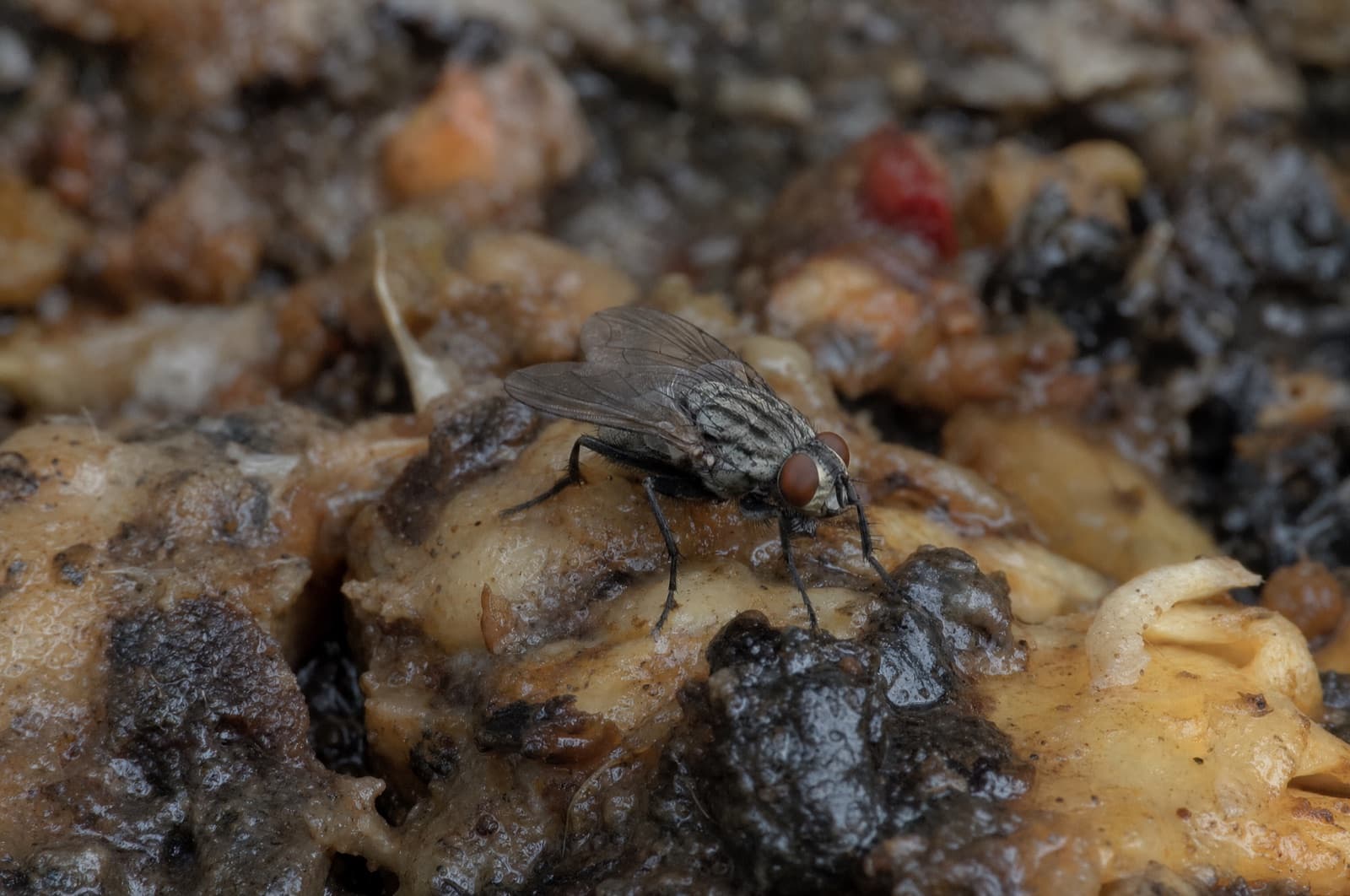
How to Get Rid of Common Houseflies
At a glance
- Difficulty: Beginner
- Time: An afternoon of cleanup, then ongoing habit
- Cost: Low — screens, lidded bins, sticky traps
- Success: High with consistent sanitation and screening
Can you DIY Common Housefly?
The verdict on Common Housefly DIY
A beginner-friendly DIY — sanitation and screens beat sprays every time.
The common housefly doesn't bite and isn't a serious health threat for a typical home, though it can mechanically carry bacteria from waste to food surfaces. Houseflies breed in garbage, pet waste, and organic filth — not on your countertops — so the fix is sealing that breeding material away, combined with tight screens to keep new adults out. Insecticide alone rarely solves an indoor infestation because it doesn't touch the breeding source.
The 5 DIY methods — honestly graded
Every approach graded for this species, in IPM order — prevention first, chemistry late. Pick a method to see how it works, the steps, and what it actually takes.
Prevention / Exclusion
Works wellSanitation and screening together are the definitive fix — this is where the effort belongs.
Houseflies breed in garbage and organic filth and enter through any unscreened gap. Removing the breeding material and physically blocking entry stops the problem at both ends.
Best for: Every case — this is the method that actually solves it
Install tight-fitting screens and door sweeps
Check screens on windows and doors for tears and gaps, and add door sweeps where needed.
Take out garbage and clean spills promptly
Use lidded bins, take garbage out regularly, and clean up spills, pet waste, and drains that can serve as breeding sites.
Tools & materials
Why DIY falls short here
Not scare tactics — the specific, proportionate reasons a home attempt can stall for this species.
Ignoring the breeding source
Houseflies breed in garbage and organic filth; insecticides alone rarely eliminate an indoor infestation without removing that source.
Open doors and unscreened windows
A single gap allows constant re-entry, undoing sanitation work indoors.
How risky is it, really?
An honest read — most nuisance species are genuinely low risk, and we say so.
Houseflies don't bite, but per UF/IFAS Featured Creatures, they are medically important for their ability to mechanically carry bacteria on their bodies and legs and deposit it on food and surfaces via regurgitation and feces. This is a real but proportionate concern for casual home exposure — good sanitation keeps the risk low.
- Mechanical contamination of food/surfacesOccasional
Via contamination, not biting — can be a factor in diarrheal illness like E. coli or Salmonella exposure in unsanitary conditions
UF/IFAS Featured Creatures
- Direct harm from a fly landing on youRare
Negligible — houseflies don't bite humans or animals
UF/IFAS Featured Creatures
Houseflies Keep Coming Back?
If sanitation and screening aren't holding, there may be a breeding source you haven't found. Anchor Pest Services offers full inspections across southern and central New Hampshire. Family-owned since 2017, NH license #782664.
Call a pro when…
- Flies persist after thorough sanitation and screening
- You suspect a hidden breeding source you can't locate
- A recurring heavy fly population despite your best efforts
General Pest Control
Most housefly problems resolve with sanitation and screening. A pro adds value if flies persist despite thorough cleanup, which can point to a hidden breeding source you haven't located.
Keep them out
- Take out garbage regularly and use lidded bins
- Repair screens and add door sweeps before summer
- Clean spills, pet waste, and drains promptly
Houseflies in New Hampshire
NH's rural and semi-rural properties near pastures, compost piles, and animal waste see the heaviest housefly pressure through the warm months, May through September. Screen repair before summer is the single most missed seasonal task — a torn screen undoes the rest of the sanitation work in one open door.
Peak season
Warm months, May through September
Make sure it's a Common Housefly
Two quick detours worth taking — confirm the ID, then learn what drew it in so it doesn't come back.
Frequently asked
Sources & further reading(3)
- [1]UF/IFAS Featured Creatures — House Fly
Mechanical pathogen transmission, biology, risk framing
extensionverified 2026-07-13 - [2]Texas A&M AgriLife Extension — Indoor Flies and Their Control
Sanitation-first control guidance
extensionverified 2026-07-13 - [3]University of Minnesota Extension — Flies (Nuisance Insects)
Screening and exclusion guidance
extensionverified 2026-07-13
Written & reviewed by
VerifiedDaniel Brady
NH-Licensed Pesticide Applicator · License #782664 (NHDAMF, RSA 430)
Daniel Brady is the New Hampshire–licensed applicator behind Anchor Pest Services, a family-owned pest control company serving the Manchester area since 2017.
Last updated July 2026
Other species you can tackle
Same category — the dot shows each one's DIY verdict at a glance (green = friendly, amber = doable with care, red = call a pro).
Professional Pest Control
Houseflies Keep Coming Back?
If sanitation and screening aren't holding, there may be a breeding source you haven't found. Anchor Pest Services offers full inspections across southern and central New Hampshire. Family-owned since 2017, NH license #782664.
- NH-licensed applicators (#782664)
- Free inspection — same-day service across southern NH
NH License #782664 · No obligation · We answer in person
Your next step
- Book a NH pro
Pest Control Services
Licensed, family-owned pest control across southern NH.
Book now - What to do next
House Flies in New Hampshire — ID, Disease Risk & Control
Read the answer - Also relevant
House Flies in New Hampshire — ID, Disease Risk & Control
Read the answer - Also relevant
Filth Fly Prevention: Sanitation Stops Flies at the Source
Read the answer