
House Flies in New Hampshire — ID, Disease Risk & Control
Also called Common fly · Filth fly
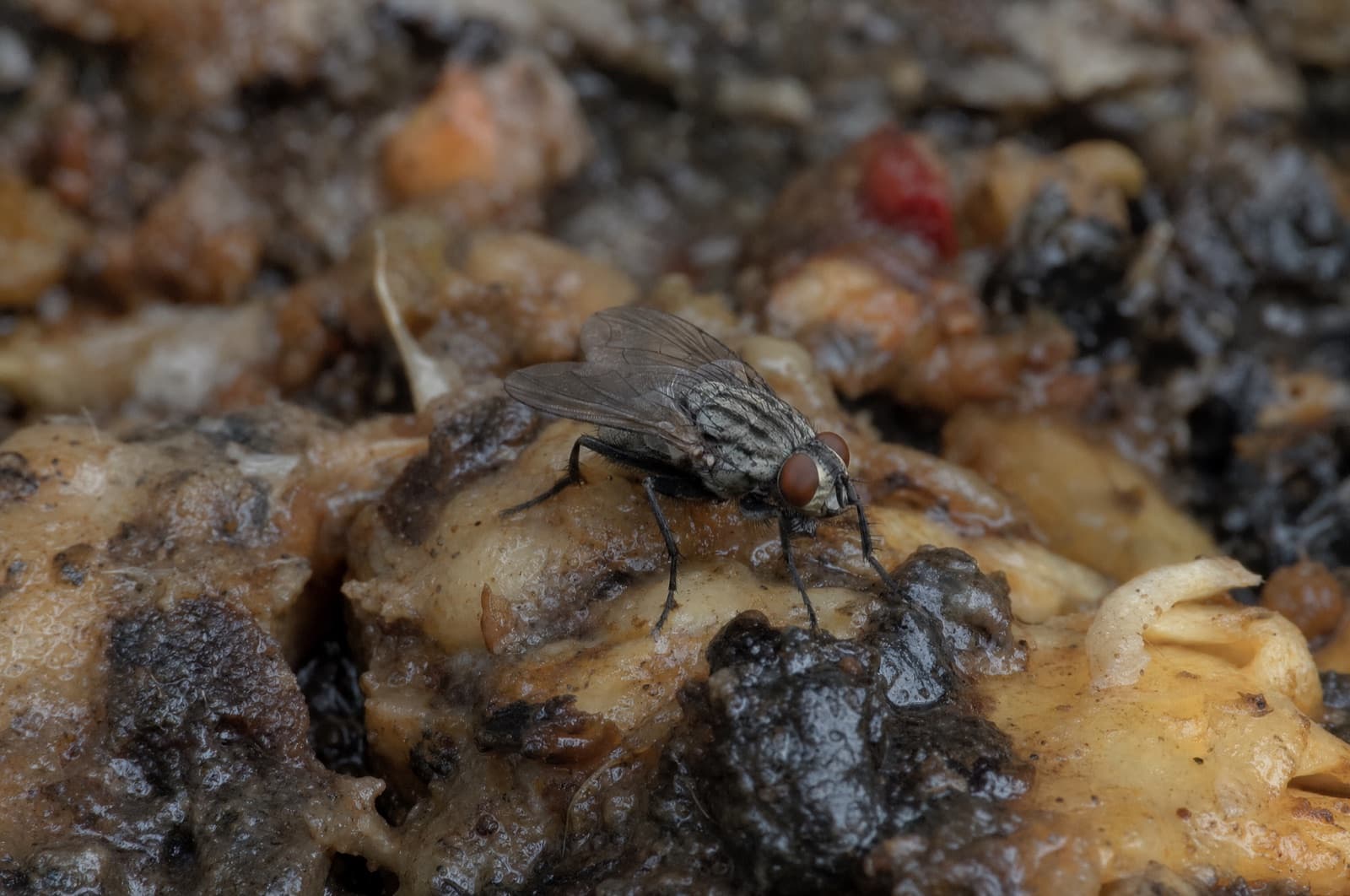
The common house fly (Musca domestica) is a true filth fly — ~1/4 inch, dull gray with four thoracic stripes, sponging mouthparts that do not bite. It breeds in garbage, manure, and decaying organic matter, and its real danger is mechanical disease transmission: it walks on filth, then on your food, depositing bacteria in a single landing. Source removal and exclusion are the lasting fixes.
- Species
- Musca domestica
- family Muscidae
- Size
- ~1/4 in (6–7 mm)
- UNH Extension
- Best tell
- Four dark longitudinal thoracic stripes
- the signature visual
- Mouthparts
- Sponging — does NOT bite
- UNH Extension
- Eggs
- Up to ~500 in a lifetime
- UF/IFAS; LSU AgCenter
- Pathogens associated
- 100+
- Khamesipour et al. 2018 systematic review, BMC Public Health; Scott et al. 2014
The fly that tastes with its feet — and spreads bacteria when it lands
The common house fly (Musca domestica) is the textbook filth fly. About 1/4 inch long, dull gray with four dark stripes on the thorax, it breeds in garbage, manure, and any decaying organic matter — and its real significance is not the buzzing. It is the fact that a single landing on your food can deposit bacteria the fly picked up from filth it walked on moments before.
A systematic review of 99 studies by Khamesipour et al. (2018) in BMC Public Health found over 100 pathogens associated with the species — bacteria, viruses, fungi, and parasites — including Salmonella, E. coli, Shigella, and Campylobacter. CDC research documents that transfer to a clean food surface can occur in under a second of contact.
The practical implication: a house fly indoors is a sanitation alarm, not just an annoyance. And the durable fix is breeding-source removal — contain garbage with tight lids, clean up pet waste and decaying matter, fit 16-mesh screens and door sweeps — not fly zappers and aerosols that only kill the adults you see while the source keeps producing more.
How to identify a common house fly
Four dark stripes on a dull gray thorax, sponging mouthparts, and red eyes identify the common house fly. The key disambiguation: it does not bite (that is a stable fly) and it has no metallic sheen (that is a blow fly) and no golden thoracic hairs (that is a cluster fly).
House fly
- Scientific name
- Musca domestica
- Family
- Muscidae
- Size
- ~1/4 in (6–7 mm)
- Coloration
- Dull gray; four dark longitudinal stripes on the thorax; yellowish-gray abdomen with dark markings
- Habitat
- Garbage, manure, pet waste, decaying organic matter, compost; any warm moist organic breeding medium.
- Active season
- Warm season outdoors (spring through fall); year-round indoors near a breeding source
- Diet
- Liquids and semi-liquids via sponging mouthparts; attracted to food, garbage, feces, and decaying matter.
- Reproduction
- Females lay batches of 75–150 eggs; up to ~500 eggs in a lifetime (UF/IFAS; LSU AgCenter).
- Lifespan
- Egg-to-adult in 7–10 days in warm conditions (UF/IFAS); adults ~2–4 weeks.
Cosmopolitan — found throughout New Hampshire and worldwide wherever humans live.
The tells — key ID features
- Four dark longitudinal stripes on a dull gray thorax — the signature tell.
- ~1/4 inch, slightly smaller than a bottle/blow fly.
- Red compound eyes.
- Sponging (not piercing) mouthparts — does not bite.
- Yellowish-gray abdomen with dark markings.
Size, to scale
~1/4 in (6–7 mm)
About the size of a pencil eraser — slightly smaller than a blow fly, larger than a fruit fly
Stable fly
How to tell — The stable fly (Stomoxys calcitrans) is nearly identical in size and gray coloring, but it has a forward-projecting bayonet-like piercing proboscis and both sexes bite — usually around the ankles. If the 'house fly' is biting you, it is a stable fly. This is the most important disambiguation in this cluster.
Cluster fly
How to tell — Cluster flies are larger, sluggish, and have golden/yellowish tangled hairs on the thorax and overlapping wings at rest. They are a fall invader, not a filth fly, and do not breed in garbage or food sources.
Flesh fly
How to tell — Flesh flies are larger than house flies, with only three thoracic stripes (not four) and a distinctive checkerboard gray-and-black abdomen. They breed in carrion, not garbage.
Blow fly / bottle fly
How to tell — Blow and bottle flies have a brilliant metallic blue/green/bronze sheen. House flies are uniformly dull gray with no metallic coloration.
Signs of a problem
House flies are a sanitation indicator — where they concentrate is a direct clue to the breeding source. These are the signs and what each one means.
Flies indoors around garbage, food prep areas, or drains
What it means — Check the trash (tight lids?), floor drains, pet waste, manure, and any decaying organic matter — one of these is the breeding source.
Maggots in garbage cans, compost, or decaying organic matter
What it means — An active breeding site — the fly population will keep growing until this is removed and cleaned.
Clusters of flies on sunny exterior walls
What it means — A nearby breeding source outdoors — manure pile, compost heap, decaying vegetation, or uncovered garbage.
Persistent flies indoors despite surface cleaning
What it means — The source is not the kitchen counter — check drains, the garbage disposal splash guard, and any area with moist decaying matter.
The real risks, calibrated
House flies are genuine disease vectors — not in an exotic-disease sense, but as mechanical carriers of common gastrointestinal pathogens from filth to food. The risk is real, sourced, and proportionate.
Mechanical disease transmission
ModerateOnset: Ongoing while flies are active
House flies walk on filth (garbage, feces, carrion), then on food and food-contact surfaces, depositing Salmonella, E. coli, Shigella, and Campylobacter — transfer can occur in under a second of contact (CDC EID; Khamesipour et al. 2018).
Food contamination via regurgitation and defecation
ModerateOnset: Ongoing while flies are active
House flies cannot eat solid food; they regurgitate digestive fluid onto food, dissolve it, and sponge it back up — leaving bacteria-laden residue on food surfaces.
Sanitation alarm signal
ModerateOnset: Presence itself
A persistent house fly problem always indicates an accessible breeding source — uncovered garbage, pet waste, drain buildup, or decaying organic matter that should be addressed regardless of fly annoyance.
DIY — what works, what backfires
House fly control is source removal first, exclusion second, and adult knockdown a distant third. Here is what works — and what wastes your time.
What actually works
- Remove and contain the breeding source: use garbage cans with tight-fitting lids, take out trash frequently, clean up pet waste promptly, and clean up any decaying organic matter — manure, compost, garden waste — near entry points.
- Fit 16-mesh window and door screens — this is the standard for excluding house flies and is confirmed effective by extension sources.
- Install door sweeps on all exterior doors to eliminate the gap at the bottom.
- Clean floor drains, garbage disposal splash guards, and sink drains regularly — these are often-overlooked indoor breeding sources.
- Use sticky fly traps or light traps indoors as a supplemental measure after addressing the source — they reduce adults but will not solve the problem on their own.
What backfires
- Don't rely on bug zappers or sprays while the breeding source remains — they only kill the adults in the room, and the source will keep producing more flies as fast as you kill them.
- Don't leave food or garbage exposed — even briefly, exposed food attracts adults and provides a laying surface.
- Don't ignore drains and compost as potential indoor sources — these are commonly overlooked and can sustain an indoor population independently of outdoor pressure.
- Don't assume window spraying is a lasting fix — it is not. Source removal is the only durable control.
House flies in New Hampshire homes
House flies are present statewide across New Hampshire through the warm season and breed indoors year-round near a reliable source — a kitchen drain, a composting area, a garbage area without tight lids, or pet waste. In Manchester, Nashua, and Concord, the peak outdoor season runs late spring through early fall. NH homes near livestock, barns, or compost areas experience heavier pressure. Indoors, a house fly problem is always a sanitation and exclusion problem — identify the breeding source and the fly population collapses.
Peak season
Late spring through fall outdoors; year-round indoors near a breeding source
You might actually have
- Stable fly (near-identical look but bites — forward bayonet proboscis)
- Cluster fly (larger, sluggish, golden thoracic hairs, overlapping wings — fall invader, not filth fly)
- Flesh fly (larger, three stripes, checkerboard abdomen)
We serve these communities
- NH-licensed applicator · #782664
- Same-day service
- Family-owned since 2017
Service Area Map
Southern New Hampshire
When to call a pro for house flies
A recurring or heavy house fly infestation usually means there is a source you have not found — an inaccessible drain defect, a hidden organic buildup, or a structural gap that is allowing steady outdoor pressure. A licensed technician locates the source and addresses both the breeding site and the entry points.
When to call a pro
- Heavy or recurring infestations despite addressing obvious sources — the source is hidden and needs professional sourcing.
- A commercial kitchen or food-service business facing a health inspection — a house fly infestation is a serious code concern.
- Indoor breeding identified in an inaccessible drain or structural space you cannot clean yourself.
- A heavy outdoor pressure situation near livestock, compost, or organic waste that is creating ongoing indoor infiltration.
Source sanitation first
The single most effective house fly prevention measure is eliminating accessible breeding media: tight-lid garbage cans, frequent trash removal, prompt pet waste cleanup, and clean drains. No amount of trapping or spraying substitutes for this.
16-mesh screens and door sweeps
Properly fitted 16-mesh screens (16 wires per inch) and tight door sweeps are the standard exclusion measures for house flies and are confirmed effective by extension entomology sources. Check that existing screens have no tears or gaps.
Manage outdoor sources near NH homes
If your home is near livestock, a composting operation, or has a garden with organic waste piles, manage those sources to reduce outdoor fly pressure — cover compost, spread manure rather than pile it, and clean up decaying vegetation.
Not sure it's a house fly?
A licensed NH technician can confirm the species and tell you honestly whether it's a DIY fix or a job for a pro — free inspection, same-day service across Southern New Hampshire.
Frequently asked questions
Sources(6)
- [1]UNH Extension — House Fly Fact Sheet
NH size, four stripes, sponging mouthparts, source-first control
extensionverified 2026-06-30 - [2]UF/IFAS — Musca domestica Biology
egg counts, life cycle, breeding sources
extensionverified 2026-06-30 - [3]
- [4]CDC EID — Fly Pathogen Transfer
transfer to food surface within a single landing
govverified 2026-06-30 - [5]Khamesipour et al. 2018 — BMC Public Health (systematic review)
100+ pathogens associated with house fly; 99 studies reviewed
academicverified 2026-06-30 - [6]UNH Cooperative Extension — Source-First Fly Control
NH sanitation-first fly guidance
extensionverified 2026-06-30
Written & reviewed by
VerifiedDaniel Brady
NH-Licensed Pesticide Applicator · License #782664 (NHDAMF, RSA 430)
Daniel Brady is the New Hampshire–licensed applicator behind Anchor Pest Services, a family-owned pest control company serving the Manchester area since 2017.
Last updated 2026-06-30

New Hampshire pest control
Dealing with house flys in your home?
Anchor Pest Services identifies and handles house fly problems across southern and central New Hampshire. Family-owned since 2017, NH license #782664.
- NH-licensed applicators (#782664)
- Same-day service · free inspection
- Family-owned since 2017
Your next step
- What to do next
Where Do Flies Go in the Winter? NH Cluster Fly Timing
Read the answer - What to do next
Chemical Fly Control: A Supplement, Not the Fix
Read the answer - What to do next
Where Do Flies Go In The Winter?
Read the answer - What to do next
Filth Fly Prevention: Sanitation Stops Flies at the Source
Read the answer - Related guide
Cluster Flies in New Hampshire — Why They're in Your House in Winter
Read the answer - Related guide
Stable Flies in New Hampshire — The Biting "House Fly"
Read the answer