
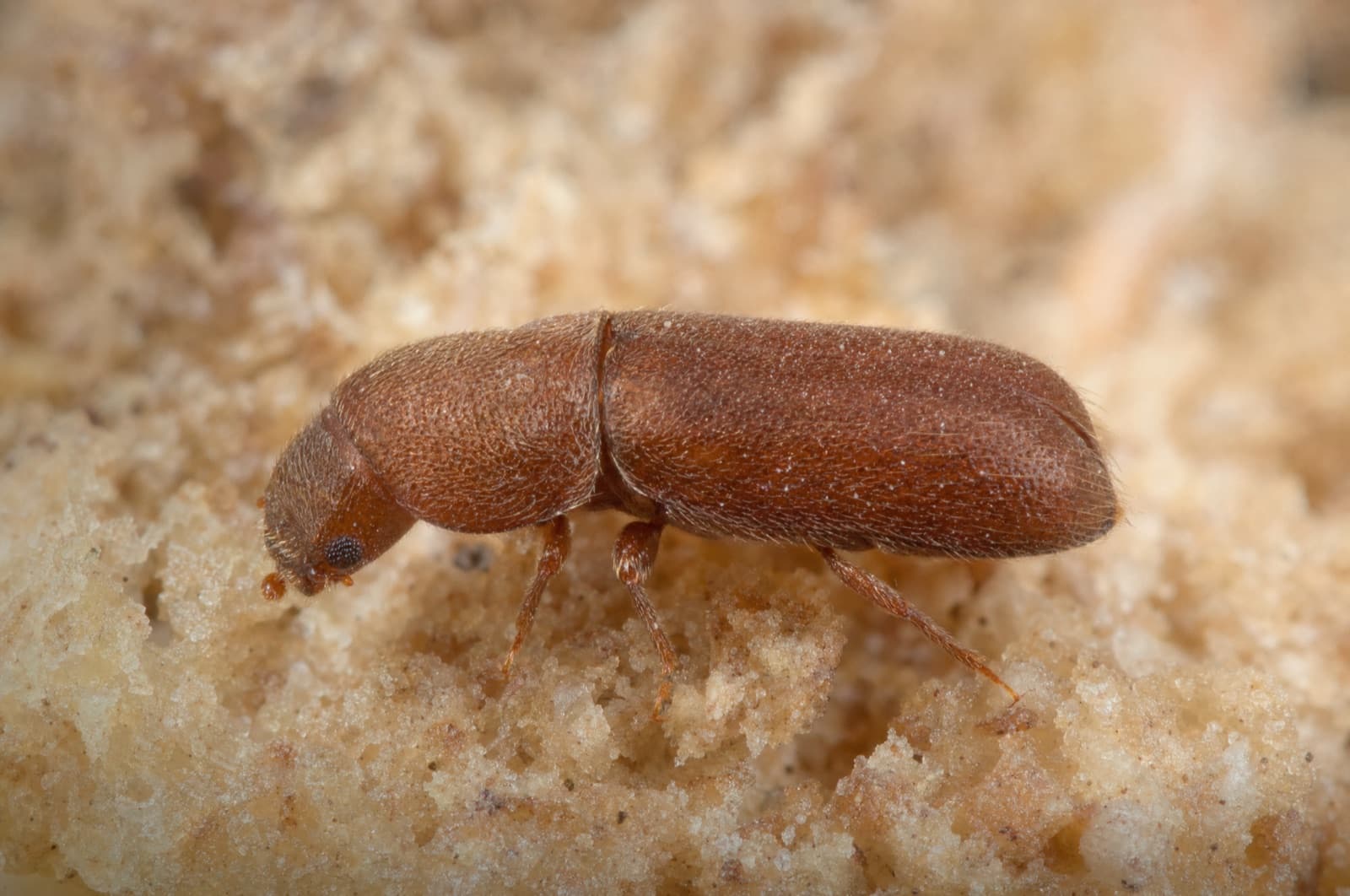
What Attracts Drugstore Beetles to Your House?
At a glance
- Short answer: Drugstore beetles aren't lured in by your kitchen. They almost always arrive already inside a product you bought.
- The verdict: You didn't attract it — you carried it in
The attractant verdict
Four possible answers to why this species turned up. Three stay unlit — and that's the argument: the honest answer could have been any of them, and for this species it wasn't.
Drugstore beetles aren't lured in by your kitchen. They almost always arrive already inside a product you bought.
Our own previous page said drugstore beetles are "mainly attracted to food sources, particularly stored products," which is close to right about the mechanism but still frames it as the beetle actively seeking out your kitchen rather than arriving inside a product already contaminated.
A dry product — cereal, spices, dried pet food, or occasionally book bindings, dried herbs, or other plant-based material — that already contained eggs or larvae before it entered the home, most often contaminated during milling, processing, or storage.
“Drugstore beetles don't seek out your kitchen. The product usually gets there first, already carrying them.”
Why it's here, in full
An even broader diet, but the same arrival story
The drugstore beetle has one of the widest documented diets of any stored-product pest — extension entomology lists cereal, dried herbs and spices, drugs, pet food, dried flowers, and even book bindings and leather among its known food sources. That breadth doesn't change the arrival mechanism, though: like the cigarette beetle, the dominant, well-documented route is a product that already contained eggs or larvae when it was purchased, typically contaminated upstream during milling or storage rather than being drawn in by anything happening in your kitchen.
Our old page's "attracted to food sources, particularly stored products" line is close to the truth about what sustains an infestation but skips the more important point: the beetle didn't go find the product. The product, already contaminated, came to it.
Flight and light are real, but secondary
Drugstore beetles can fly and are attracted to light, so a limited amount of adult movement between rooms, units, or in from outside is a genuine, documented behavior — not a claim to dismiss. But every extension source describing this species' household ecology treats that flight behavior as secondary to the anchoring mechanism: an infested product already present. If you're trying to solve a recurring problem, the more useful question is which stored item is contaminated, not whether the house is somehow drawing beetles in from outside.
How to tell it's actually this species
Real signs only — a species with four honest tells gets four, and stops. Where a sign is weak on its own, we say so.
Small, cylindrical, light-brown beetles found in or near cereal, spices, or dried pet food
Small round exit holes in cardboard packaging or book bindings, along with fine powdery frass
Beetles found in an unusually broad range of dry goods in the same cupboard, consistent with this species' very wide diet
Could be something else: A wide range of affected items points toward drugstore beetle over some more specialized pantry pests, but confirming the species is best done through /pests/drugstore-beetle.
Adult beetles seen near a window or light fixture, since this species can fly and is drawn to light
Could be something else: This shows adult mobility, not necessarily where the source product is located.
Want drugstore beetles gone?
This page only answers why it's here. Every removal step for this exact species — what to seal, what to set, what actually works — lives on its own dedicated guide.
Two questions, two pages
Here: why it turned up at all — the honest answer, blame removed.
There: the step-by-step removal guide for this exact species.
Key takeaways
- Drugstore beetles don't seek out your kitchen. The product usually gets there first, already carrying them.
- Cleanliness isn't the deciding factor here — the actual vector is what matters.
- What actually matters: food.
- If it's already inside, removal is a different question — see /top-diy-methods/drugstore-beetle.
Found drugstore beetles in stored goods?
This page is about why they showed up. Locating the infested item and removal steps are covered at /top-diy-methods/drugstore-beetle.
Frequently asked
Sources(2)
- [1]UF/IFAS Entomology — Drugstore Beetle, Stegobium paniceum (EENY-228)
Drugstore beetle's very broad diet and ability to fly and be attracted to light
extensionverified 2026-07-17 - [2]Iowa State University Extension — Cigarette and Drugstore Beetles
Infestations typically originating from an already-infested dry product brought into the home
extensionverified 2026-07-17
Written & reviewed by
VerifiedDaniel Brady
NH-Licensed Pesticide Applicator · License #782664 (NHDAMF, RSA 430)
Daniel Brady is the New Hampshire–licensed applicator behind Anchor Pest Services, a family-owned pest control company serving the Manchester area since 2017.
Last updated Jul 2026
The product usually arrives infested
Dealing with drugstore beetles at home?
Same-day inspections across southern and central New Hampshire — we'll help track down the source product, not just the beetles.
- Family-owned in Manchester since 2017
- NH commercial applicator #782664, category F1
- We will tell you when the answer is do nothing
NH License #782664 · No obligation · We answer in person