
Drugstore Beetles in New Hampshire: Signs, Hidden Sources & Control
Also called Bread beetle · Biscuit beetle
The drugstore beetle is a tiny reddish-brown pantry pest famous for eating almost anything — flour, spices, pet food, pharmaceuticals, dried flowers, and even book bindings. It's harmless to people and the home; the issue is contaminated food. Find and discard the source package, clean the shelf, and switch to airtight storage. Its unusually broad diet means the source is often something you'd never think to check.
- Adult size
- ~2–3.5 mm (about 1/10 inch), cylindrical, reddish-brown
- University of Florida IFAS; Penn State Extension
- Key ID vs. cigarette beetle
- Grooved (striated) wing covers + 3-segmented clubbed antennae
- Penn State Extension; Oklahoma State Extension
- Diet breadth
- Flour, spices, grains, drugs, book bindings, dog food, dried flowers — 'eats anything except cast iron'
- Penn State Extension; Oklahoma State Extension
- Eggs and cycle
- Up to ~75 eggs per female; life cycle generally under 2 months
- University of Florida IFAS
- Optimal conditions
- ~85°F and 60–90% relative humidity
- University of Florida IFAS
- Package damage
- 'Shot holes' from adults emerging or entering infested packages
- Insects Limited
The beetle that eats almost anything — and hides where you'd least expect
The drugstore beetle earned its name by infesting old apothecary goods — pharmaceuticals, herbal medicines, and dried botanicals. Today it has the broadest menu of any pantry pest: flour, spices, pet food, old pasta, book bindings, dried décor, vitamin supplements, and more. That extraordinary versatility is precisely what makes it hard to find.
Like the cigarette beetle it so closely resembles, it doesn't bite, sting, or damage your home. The harm is contaminated food. Extension services are unanimous: the fix is find-and-discard the source, not spray the pantry shelf.
What sets this page apart is a hidden-source checklist. Because the menu is so broad, the infestation often survives a pantry cleanout because the source was something you never thought to check: a forgotten supplement bottle in the medicine cabinet, a decorative dried-flower wreath on the wall, birdseed or dog food in the garage, or old pasta behind the appliances. Work outward from the kitchen to these overlooked spots.
To separate this beetle from the nearly identical cigarette beetle — check the wing covers: grooved (drugstore) versus smooth (cigarette), and the antennae: three-segmented club (drugstore) versus uniform saw-teeth (cigarette).
How to identify a drugstore beetle — and separate it from the cigarette beetle
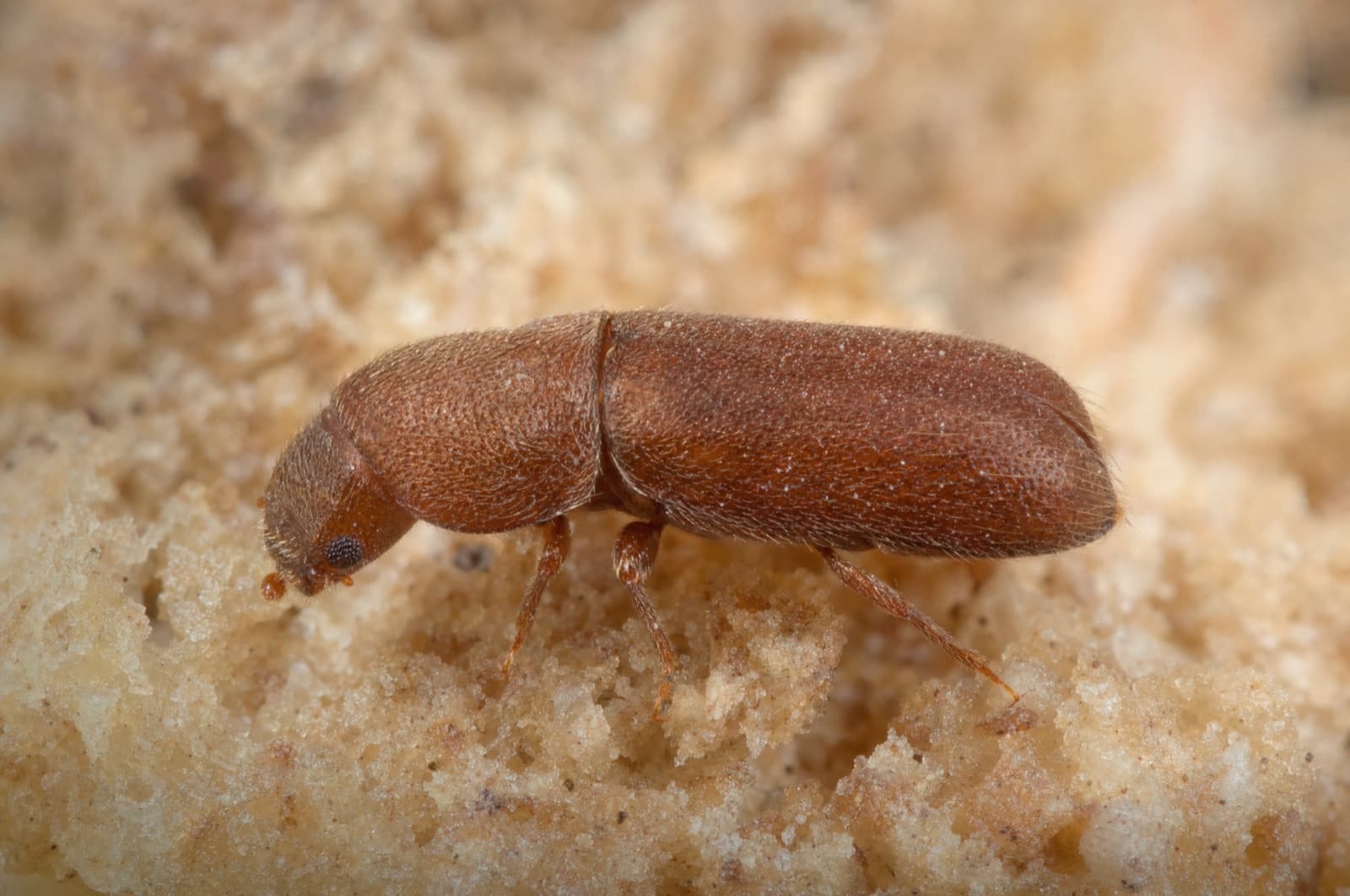
The drugstore beetle is reddish-brown, cylindrical, and humpbacked — nearly identical to the cigarette beetle at first glance. The reliable separator is the wing covers and antennae: drugstore beetle has grooved (striated) wing covers and antennae ending in a distinct three-segmented club. The cigarette beetle has smooth wing covers and uniformly saw-like antennae. Both need magnification for this ID, but the difference is clear with a hand lens.
Drugstore beetle
- Scientific name
- Stegobium paniceum
- Family
- Ptinidae (formerly Anobiidae)
- Size
- ~2–3.5 mm (approximately 1/10 inch)
- Coloration
- Reddish-brown, cylindrical, with fine silky hairs on the body
- Habitat
- Pantries, spice racks, medicine cabinets, pet food storage, libraries, museums
- Active season
- Year-round in heated NH homes
- Diet
- Flour, spices, grains, pet food, pharmaceuticals, book bindings, dried flowers, and virtually any other dry organic material
- Reproduction
- Up to ~75 eggs per female; egg-to-adult typically under 2 months
- Lifespan
- Adults approximately 13–65 days
Worldwide; more abundant in warm regions or heated buildings; documented in NH (UNH Extension)
The tells — key ID features
- Grooved (striated) wing covers — the single best separator from the cigarette beetle; visible under a hand lens.
- Antennae ending in a distinct 3-segmented club.
- Cylindrical, reddish-brown body ~2–3.5 mm with a humpbacked profile.
- Rapid skittering movement; strong flier attracted to light.
- C-shaped, creamy-white larvae (not fuzzy, unlike cigarette-beetle larvae) inside packages.
- 'Shot holes' in packaging from adults emerging or boring in.
Size, to scale
2–3.5 mm
About the size of a small pinhead or a poppy seed — nearly identical to the cigarette beetle
Cigarette beetle
How to tell — Smooth wing covers and uniformly saw-like antennae; cigarette beetle is also slightly rounder; drugstore beetle has grooved wings and a clubbed antenna.
Furniture/common furniture beetle (woodborer)
How to tell — Similar family but bores into structural wood for breeding — not a pantry food pest; antennae are shorter than its legs.
Sawtoothed grain beetle
How to tell — Flat and elongate with six conspicuous 'teeth' along the thorax; the drugstore beetle is cylindrical and humpbacked with no thoracic teeth.
Signs of a problem
These signs point you toward the source — which is often somewhere unexpected given this beetle's exceptionally broad diet.
'Shot holes' in flour, pet food, or pill bottles
What it means — Adults bored in or emerged — that container is confirmed infested.
Small reddish beetles skittering or flying near the pantry or medicine cabinet
What it means — Active adults from a nearby source; begin inspecting all dry organic goods in that area.
Larvae or fine frass inside long-stored spices or dried decorative items
What it means — Larval feeding confirmed; the host item must be found and discarded.
Beetles near fireplaces, air vents, or rooms without food
What it means — A hidden source — old stored goods, dried décor, or wall-void debris — is sustaining them away from the kitchen.
Damage to book bindings or old paper goods
What it means — Larvae feeding on paste and paper; check a home library, old magazines, or archival materials.
Beetles in rarely opened dried goods (old pasta, forgotten spices, herbal supplements)
What it means — A classic forgotten-package source; the older and less-used, the more suspect.
The real risks, calibrated
The drugstore beetle is a food and material nuisance — not a health risk. Its unusually broad diet expands the range of items at risk beyond a typical pantry pest.
Food contamination
ModerateOnset: Ongoing while infested package exists
Infested flour, spices, pet food, and grains must be discarded — eating heavily infested food is unpleasant and potentially risky.
Pharmaceutical and herbal product infestation
Low riskOnset: Over weeks
Can infest vitamin supplements, herbal remedies, and dried botanicals stored in medicine cabinets or health-food pantry areas.
Spread across the pantry
ModerateOnset: Within weeks of an unresolved source
One infested source colonizes adjacent packages; broad diet means spread can extend beyond the kitchen.
Book and collection damage
Low riskOnset: Over months
Larvae feed on book paste and paper — risk to libraries and paper archives in home environments.
Biting, stinging, or disease transmission
Low riskOnset: N/A
None — harmless to people, pets, and building structure.
DIY — what works, what backfires
The critical insight for drugstore beetle control is the hidden-source mindset: don't just clean the kitchen — work outward through the entire home, because the source may be far from the pantry.
What actually works
- Locate and discard the infested package — seal in a plastic bag and remove from the house. Don't forget the medicine cabinet, dried decorative items, garage pet food, and old pasta behind appliances.
- Vacuum and wash all shelves after removing packages to remove larvae, cast skins, and frass.
- Store all dry goods — and seldom-used items like supplements and dried décor — in airtight glass, metal, or hard rigid plastic containers.
- Inspect new groceries, dried herbs, and decorative botanical purchases before storing.
- Use pheromone traps to confirm which area of the home the beetles are coming from — they catch adults and indicate the general source zone.
- Apply the UNH salvage standard to valuable items: 130°F for 30 minutes or 0°F for four days, then repackage airtight.
What backfires
- Don't spray insecticide on food, food-contact surfaces, or inside pantry shelving — not recommended and risks contaminating food.
- Don't overlook non-food sources: supplement bottles, decorative dried wreaths, garage birdseed, and old stored goods are frequent overlooked infestations.
- Don't buy bulk quantities of dried goods — smaller purchases used within 2–4 months remove the 'forgotten package' risk.
Drugstore beetles in New Hampshire homes
UNH Cooperative Extension lists the drugstore beetle among New Hampshire's less common — but documented — pantry pests. Heated homes allow it to complete multiple generations per year regardless of the outdoor NH winter. Apply the UNH food-salvage standard for valuable goods: heat at 130°F for 30 minutes or freeze at 0°F for four days, then repackage airtight. NH homeowners should also check pet food and birdseed kept in mudrooms and garages — these secondary storage spots are frequently overlooked sources.
Peak season
Year-round in heated homes; no outdoor NH population in winter
You might actually have
- Cigarette beetle (near-twin; the smooth wing / saw antenna contrast separates them)
- Sawtoothed grain beetle (flat, elongate, six thoracic 'teeth' — very different body shape)
We serve these communities
- NH-licensed applicator · #782664
- Same-day service
- Family-owned since 2017
Service Area Map
Southern New Hampshire
When to call a pro for drugstore beetles
If beetles keep appearing after you've discarded suspect food and cleaned the pantry, a hidden source — dried décor, pet food, wall-void organic debris, or an old package in secondary storage — is sustaining them. A licensed technician can locate these overlooked sources and treat cracks and crevices with appropriate products. Anchor Pest Services (NH #782664, F1) offers General Pest Control with a free quote and same-day service.
When to call a pro
- Beetles persist for more than three weeks after a thorough pantry cleanout and airtight repackaging.
- You're finding beetles in rooms adjacent to or away from the kitchen, suggesting a hidden secondary source.
- The infestation involves a valuable book collection, archival materials, or a dried botanical collection.
- Repeated infestations recur despite regular pantry management — a structural or hidden source needs professional location.
Airtight storage for everything dry
Move all dry goods — including supplements, dried herbs, pet food, and spices — to airtight glass or metal containers. Original packaging offers no protection.
Don't forget NH mudrooms and garages
Pet food and birdseed stored in mudrooms, garages, and sheds over the long NH winter are frequent unnoticed sources. Store in sealed hard containers in a separate area.
Rotate stock and inspect new purchases
Buy small quantities and use within 2–4 months. Inspect dried décor and gift packages containing food or botanicals before storing them.
Not sure it's a drugstore beetle?
A licensed NH technician can confirm the species and tell you honestly whether it's a DIY fix or a job for a pro — free inspection, same-day service across Southern New Hampshire.
Frequently asked questions
Sources(7)
- [1]University of Florida IFAS — Drugstore Beetle (IN385)
size, grooved wings, clubbed antennae, life cycle, optimal conditions
extensionverified 2026-06-30 - [2]Penn State Extension — Drugstore Beetle
broad diet 'eats anything except cast iron', wing/antenna ID, food contamination
extensionverified 2026-06-30 - [3]Oklahoma State University Extension — Drugstore and Cigarette Beetles
egg count, feeding breadth, supplemental biology
extensionverified 2026-06-30 - [4]Natural History Museum — Bread/Biscuit Beetle Guide
larvae chew paper/cardboard/cellophane packaging
encyclopediaverified 2026-06-30 - [5]
- [6]UNH Cooperative Extension — Kitchen Pests Fact Sheet
NH presence, salvage standard (130°F/30 min or 0°F/4 days)
extensionverified 2026-06-30 - [7]UC IPM — Pantry Pests
food contamination risk, no-spray guidance, spread across pantry
extensionverified 2026-06-30
Written & reviewed by
VerifiedDaniel Brady
NH-Licensed Pesticide Applicator · License #782664 (NHDAMF, RSA 430)
Daniel Brady is the New Hampshire–licensed applicator behind Anchor Pest Services, a family-owned pest control company serving the Manchester area since 2017.
Last updated 2026-06-30

New Hampshire pest control
Dealing with drugstore beetles in your home?
Anchor Pest Services identifies and handles drugstore beetle problems across southern and central New Hampshire. Family-owned since 2017, NH license #782664.
- NH-licensed applicators (#782664)
- Same-day service · free inspection
- Family-owned since 2017
Your next step
- What to do next
How to Get Rid of Drugstore Beetles
Read the answer - What to do next
How to Get Rid of Cigarette Beetles
Read the answer - What to do next
Chemical Pantry Beetle Control: Why You Shouldn't Spray
Read the answer - Related guide
Cigarette Beetles in New Hampshire: Spices, Signs & Control
Read the answer - Related guide
Spider Beetles in New Hampshire: Not a Spider — Here's the Real ID
Read the answer