
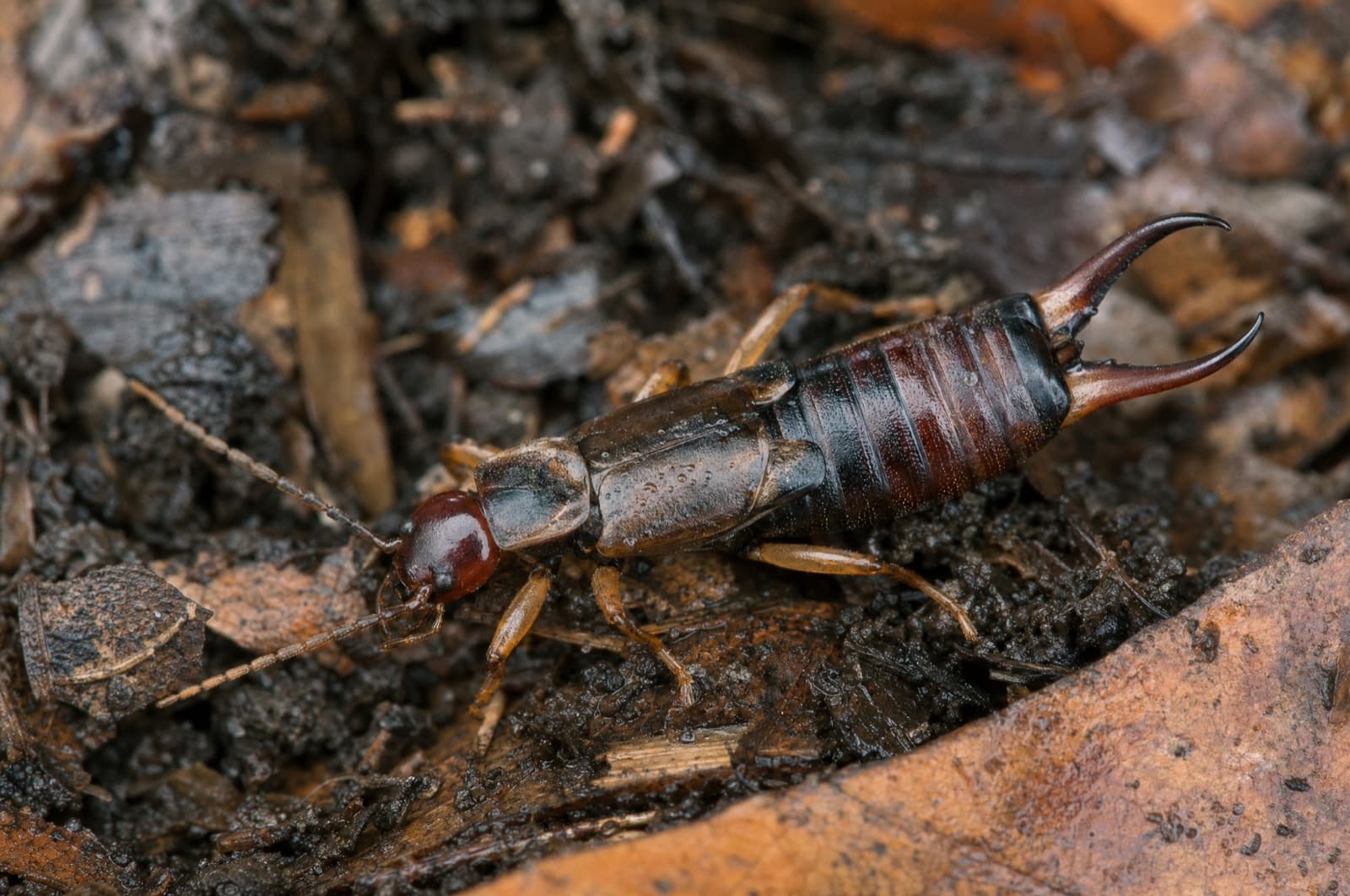
What Attracts Earwigs to Your House?
At a glance
- Short answer: Earwigs want moisture, darkness, and something to eat — nothing else is going on.
- The verdict: The usual four
The attractant verdict
Four possible answers to why this species turned up. Three stay unlit — and that's the argument: the honest answer could have been any of them, and for this species it wasn't.
This is the most common answer in this hub — an answer, not a shortfall.
Earwigs want moisture, darkness, and something to eat — nothing else is going on.
Our own previous page said earwigs are attracted ‘mainly due to moisture, shelter, and food sources’ — accurate, and we're keeping it.
Consistently damp, dark hiding spots close to the house — mulch beds against the foundation, leaf litter, stacked firewood, damp crawlspaces — combined with decaying plant matter or small insects to feed on. Earwigs are drawn to moisture and darkness far more than to anything about a structure specifically.
“Nothing about an earwig is special. It wants moisture, darkness, and something to eat — and a damp mulch bed against the foundation gives it all three.”
Why it's here, in full
Why moisture and shelter explain the whole story
Earwigs are nocturnal and strongly avoid light and dry conditions, spending the day packed into tight, damp cracks and crevices and emerging at night to feed on decaying plant matter, soft plant tissue, and small insects. A house at ground level next to mulch, dense plantings, leaf litter, or firewood offers the identical humid, dark hiding conditions they'd use anywhere outdoors, and a few individuals commonly wander in through a door threshold or foundation gap without that indicating any real indoor population. Moisture and darkness close to the foundation are what predict earwig activity, not anything about the structure itself.
How to tell it's actually this species
Real signs only — a species with four honest tells gets four, and stops. Where a sign is weak on its own, we say so.
Earwigs found in damp, dark spots like under mulch, in door thresholds, or inside sink cabinet gaps
Small, ragged, irregular holes in soft plant leaves or flower petals
Could be something else: Similar leaf damage can come from slugs, caterpillars, or other chewing insects; finding earwigs at the site is the stronger confirmation.
A number of earwigs clustering together in a single damp crack or gap during the day
Want earwigs gone?
This page only answers why it's here. Every removal step for this exact species — what to seal, what to set, what actually works — lives on its own dedicated guide.
Two questions, two pages
Here: why it turned up at all — the honest answer, blame removed.
There: the step-by-step removal guide for this exact species.
Already dealing with earwig?
This page is about why it's there. Getting rid of it is covered at /top-diy-methods/earwig.
Frequently asked
Sources(2)
- [1]UC Statewide IPM Program — Earwigs
Earwig moisture and darkness requirements and nocturnal feeding habits
extensionverified 2026-07-17 - [2]Ohioline (Ohio State University Extension) — Earwigs (HYG-2068)
Earwig habitat preference for moist, dark hiding spots near structures
extensionverified 2026-07-17
Written & reviewed by
VerifiedDaniel Brady
NH-Licensed Pesticide Applicator · License #782664 (NHDAMF, RSA 430)
Daniel Brady is the New Hampshire–licensed applicator behind Anchor Pest Services, a family-owned pest control company serving the Manchester area since 2017.
Last updated Jul 2026
Food, water, warmth, shelter — the usual four
If it's already inside, we handle the rest
Same-day inspections across southern and central New Hampshire.
- Family-owned in Manchester since 2017
- NH commercial applicator #782664, category F1
- We will tell you when the answer is do nothing
NH License #782664 · No obligation · We answer in person