
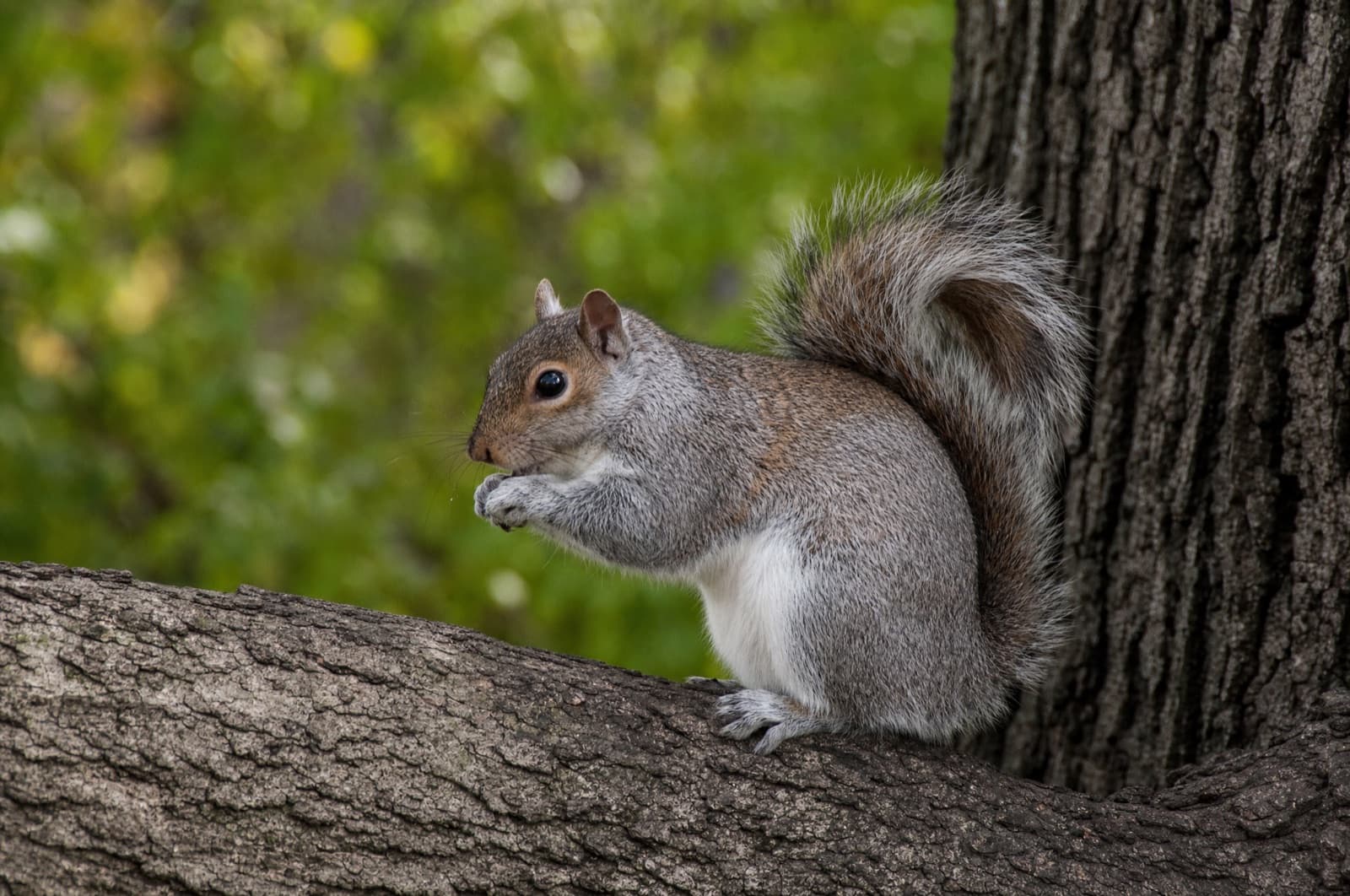
What Attracts Eastern Gray Squirrels to Your House?
At a glance
- Short answer: A squirrel in the attic is following the same instinct that sends it into a hollow tree — your attic is just a bigger, warmer, safer cavity.
- The verdict: Something specific
The attractant verdict
Four possible answers to why this species turned up. Three stay unlit — and that's the argument: the honest answer could have been any of them, and for this species it wasn't.
A squirrel in the attic is following the same instinct that sends it into a hollow tree — your attic is just a bigger, warmer, safer cavity.
Most advice, including our own previous page, lists a general set of reasons squirrels are "often drawn to homes" without naming the underlying drive. The specific, useful answer is a hard-wired nesting instinct, not a loose preference for warmth or shelter.
Gray squirrels have an innate cavity-nesting instinct: in the wild they raise young in tree cavities rather than exposed leaf nests (dreys) whenever a cavity is available, because survival is measured to be much higher in a cavity. Alabama Cooperative Extension System states plainly: "This cavity nesting instinct causes squirrels to nest in the attics of homes or secure locations in garages and barns." When natural tree cavities are scarce, an attic, garage, or barn is a superior substitute — warm, dry, and predator-free — and squirrels typically reach the roofline via an overhanging branch before chewing through soffit or fascia to get in.
“A squirrel in the attic is following the same instinct that sends it into a hollow tree — your attic is just a bigger, warmer, safer cavity.”
An enclosed, cavity-like space — an attic, soffit gap, or garage void — reached most often via a tree branch overhanging the roofline, substituting for a natural tree-cavity den where pup survival is documented to be significantly higher than in an exposed nest.
It shifts the question from 'why would a squirrel want my house' to two specific, checkable things: is a branch giving roof access, and is there a soffit or fascia gap a squirrel could exploit. That's a narrower and more useful search than general shelter-seeking.
Calibrated from: Alabama Cooperative Extension System and North Carolina State University Extension: gray squirrels have an innate cavity-nesting instinct and substitute attics and similar structures for natural tree cavities, where survival is documented to be substantially higher than in exposed leaf nests.
Why it's here, in full
It's instinct, and the attic wins on survival odds
Gray squirrels don't treat a tree cavity and a leaf nest as interchangeable options — cavities are strongly preferred whenever one is available, because young raised in a cavity survive at a much higher rate than those raised in an exposed leaf nest. Alabama Cooperative Extension System is direct about the consequence of that instinct indoors: "This cavity nesting instinct causes squirrels to nest in the attics of homes or secure locations in garages and barns." North Carolina State University Extension describes the same underlying biology.
An attic satisfies every requirement of a natural cavity and then some: it's fully enclosed, insulated against weather, dry, and difficult for predators to reach — arguably a better cavity than most hollow trees available nearby. Squirrels typically gain access by way of a tree branch that overhangs or nearly touches the roofline, then gnaw through a soffit vent, fascia gap, or other weak point to get inside. That access route is the specific, checkable condition worth naming, rather than a vague sense that the house "offers shelter."
How to tell it's actually this species
Real signs only — a species with four honest tells gets four, and stops. Where a sign is weak on its own, we say so.
Scratching, running, or rolling-nut noises from an attic or wall void, most active around dawn and dusk
A gnawed, rounded gap in soffit, fascia, or a roof vent, often near a tree branch overhanging the roofline
Shredded insulation, leaves, or fabric bundled into a nest shape in an attic corner
Chewed nuts, acorn shells, or seed hulls accumulating in one attic or garage spot
Want eastern gray squirrel gone?
This page only answers why it's here. Every removal step for this exact species — what to seal, what to set, what actually works — lives on its own dedicated guide.
Two questions, two pages
Here: why it turned up at all — the honest answer, blame removed.
There: the step-by-step removal guide for this exact species.
Key takeaways
- The driver is an innate cavity-nesting instinct, not a general preference for warmth or shelter.
- Pup survival is documented to be much higher in a cavity than in an exposed leaf nest, which is why squirrels favor attics strongly.
- Overhanging tree branches are the typical route onto a roofline before entry through soffit or fascia.
- Exclusion and entry-point repair are covered at /top-diy-methods/eastern-gray-squirrel.
Hearing a squirrel in the attic?
This page is about why it chose the spot. Exclusion and entry-point repair are covered at /top-diy-methods/eastern-gray-squirrel.
Frequently asked
Sources(2)
- [1]Alabama Cooperative Extension System — Controlling Eastern Gray Squirrel Damage
Cavity-nesting instinct causes squirrels to nest in attics, garages, and barns
extensionverified 2026-07-17 - [2]North Carolina State University Extension — Eastern Gray Squirrel
Gray squirrel cavity-nesting biology and survival advantage of cavity dens
extensionverified 2026-07-17
Written & reviewed by
VerifiedDaniel Brady
NH-Licensed Pesticide Applicator · License #782664 (NHDAMF, RSA 430)
Daniel Brady is the New Hampshire–licensed applicator behind Anchor Pest Services, a family-owned pest control company serving the Manchester area since 2017.
Last updated Jul 2026
It's the cavity, not the warmth alone
We check the branch and the entry point together
Inspections across southern and central New Hampshire for squirrel activity in attics, soffits, and garages.
- Family-owned in Manchester since 2017
- NH commercial applicator #782664, category F1
- We will tell you when the answer is do nothing
NH License #782664 · No obligation · We answer in person