
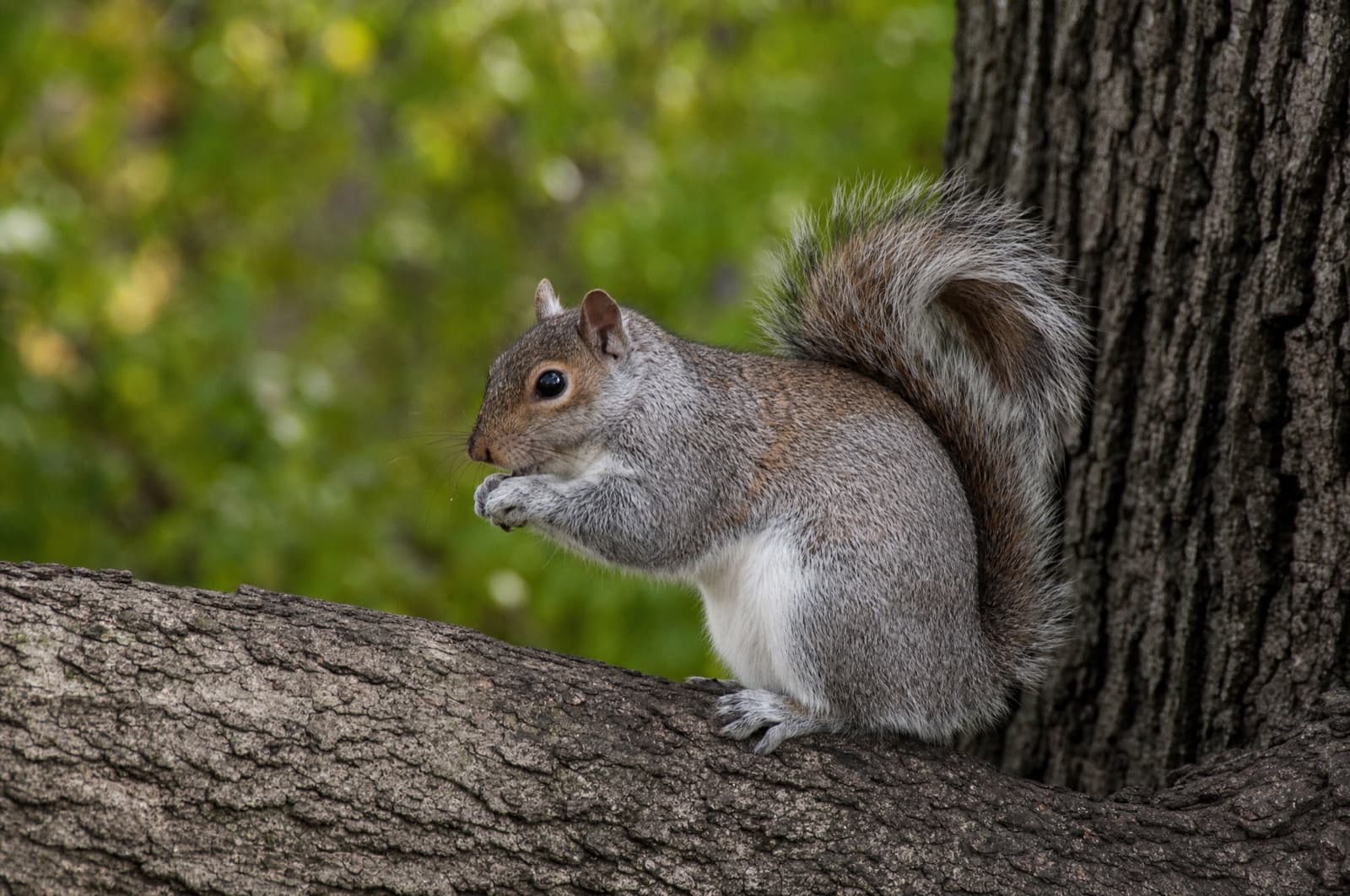
Eastern Gray Squirrel in New Hampshire — ID & Attic Control
The eastern gray squirrel is New Hampshire's most common attic invader — and the only one active during the day. Because its incisors never stop growing, it gnaws constantly: soffits, fascia, vents, and wiring are all targets. Gnawed wiring is a documented fire hazard. A proper exclusion means confirming every animal is out before sealing; trapping a squirrel inside is dangerous and can be illegal during breeding season.
- Activity pattern
- Diurnal (daytime)
- Key separator from nocturnal rats; NC Wildlife / Piedmont Wildlife Control
- Body size
- 9–12 in body + bushy tail; 1–1.5 lb
- Sciurus carolinensis adult
- Entry gap needed
- 1.5–3 inches
- Will enlarge gaps by gnawing; Indiana Wildlife Control
- Breeding seasons
- Late Jan–Apr and late Jul–Oct
- Two litters/year align with attic-intrusion spikes; Indiana Wildlife Control
- Wiring risk
- Gnawed wires = fire hazard
- Industry-cited; NFPA
- Gnawing driver
- Incisors never stop growing
- Constant gnawing required to wear down teeth; NC Wildlife / Piedmont Wildlife Control
The daytime attic invader with a fire-hazard secret
The eastern gray squirrel (Sciurus carolinensis) is New Hampshire's most familiar urban wildlife — and the creature most commonly heard thumping and scurrying in attic spaces during the morning hours. That diurnal timing is also the single fastest way to tell a squirrel problem from a rat problem: if attic noise peaks before noon on a clear day, it's almost certainly a squirrel.
What makes gray squirrels a genuine property risk is biology. Their incisors never stop growing, forcing them to gnaw constantly to keep the teeth in check. In an attic that means electrical wiring, joists, insulation vapor barriers, and roofline wood are all fair targets. Industry sources citing NFPA data attribute a significant share of house fires of unknown origin to rodents gnawing wiring — and squirrels are prime candidates in New Hampshire attics.
Gray squirrels do not hibernate, so they are a year-round issue in NH homes. Two breeding seasons (late January–April and late July–October) produce spikes in attic intrusion as young disperse and search for den sites. The practical takeaway for NH homeowners: daytime scratching above you warrants an immediate roofline inspection, a wiring check, and a quick exclusion — not a wait-and-see.
How to identify an eastern gray squirrel
The eastern gray squirrel is a medium-sized tree squirrel with a bushy tail, gray-brown coat, and — critically — daytime activity. If noise in your attic peaks in the morning and quiets by evening, think gray squirrel before anything else. Structural gnaw damage at roofline level is the companion field sign.
Eastern gray squirrel
- Scientific name
- Sciurus carolinensis
- Family
- Sciuridae
- Size
- 9–12 in body; tail adds 7–10 in; weight 1–1.5 lb
- Coloration
- Salt-and-pepper gray-brown above; lighter gray to white belly; bushy tail with white-tipped hairs giving a frosted look
- Habitat
- Hardwood and mixed forests; suburban yards with mature oaks and maples; attics, soffits, and roof cavities in human structures
- Active season
- Year-round (does NOT hibernate); most active 2–3 hours after sunrise and again in late afternoon
- Diet
- Nuts (especially acorns and hickory), seeds, fungi, buds, and bird eggs; caches food for winter because it does not hibernate
- Reproduction
- Two litters per year: late January–April and late July–October; 2–4 young per litter; pups are born blind and helpless
- Lifespan
- 1–3 years in the wild; up to 12 years in captivity
Abundant throughout all of New Hampshire; one of the most common urban and suburban mammals in the state.
The tells — key ID features
- Daytime activity — noise peaks mid-morning and late afternoon; the fastest and most reliable separator from nocturnal Norway rats and mice.
- Bushy, plume-like tail held upright or arched over the back — visible at roofline entry points and during tree-to-roof travel.
- Gray-brown coat with lighter belly; no mask, no stripes, no ringed tail (rules out raccoon, chipmunk, and ringtail).
- Ragged, gnawed entry holes in soffits, fascia, or vents — squirrels enlarge gaps by chewing, leaving irregular splintered wood edges.
- Oblong, raisin-sized droppings (~3/8 inch) in the attic; distinct from smaller mouse pellets and larger, blunter rat droppings.
- Scattered nut caches and food debris near the entry point — squirrels frequently store food close to their den site.
Size, to scale
9–12 in body + 7–10 in tail; 1–1.5 lb
About the length of a standard sheet of paper, nose to tail-base; the full tail roughly doubles apparent length
Red squirrel
How to tell — Smaller (7–8 in body), rust-red coat, white belly with a distinct dark side stripe, and a sharp territorial chatter. Also diurnal, but a separate species with a slightly different entry-gap preference.
Northern flying squirrel
How to tell — Similar gray-brown coat but strictly nocturnal — if attic noise starts after dark, flying squirrel is the likely candidate. Has a visible skin fold (patagium) along the sides used for gliding.
Roof rat
How to tell — Roof rats (Rattus rattus) are not established in New Hampshire. Daytime attic noise in NH is overwhelmingly squirrel, not roof rat. Nocturnal attic noise is more likely Norway rat or flying squirrel.
Signs of a problem
Gray squirrels leave a layered set of evidence — timing, sound, and structural damage together give a fast, confident identification.
Thumping, scurrying, or rolling sounds in the attic during morning hours
What it means — Daytime attic noise is the primary ID flag — gray squirrels are active when Norway rats are sleeping.
Chewed or enlarged holes in soffits, fascia boards, or gable vents
What it means — Squirrels enlarge gaps by gnawing; ragged, splintered wood edges distinguish gnaw damage from weathering or rot alone.
Entry holes 1.5–3 inches or larger at roofline level
What it means — A squirrel can enter a 1.5-inch gap and will gnaw it larger over time; a clean, rounded hole suggests weathering, not gnawing.
Gnawed electrical wiring or damaged wire insulation in the attic
What it means — A direct fire hazard — have an electrician inspect immediately if wire damage is found, regardless of whether the squirrel is still present.
Torn or compressed attic insulation in a corner or along an exterior wall
What it means — Indicates an active den or nesting site; may contain young during the January–April or July–October breeding seasons.
Oblong, raisin-sized droppings (~3/8 inch) scattered through attic insulation
What it means — Gray squirrel droppings are larger than mouse droppings and smaller than rat droppings; the oblong shape and scattered distribution (not latrine clusters) are characteristic.
The real risks, calibrated
Gray squirrels pose no direct threat to people under normal circumstances, but the property and safety risks from an attic infestation escalate quickly and get more expensive the longer the animals remain.
Electrical fire from gnawed wiring
HighOnset: Can occur weeks to months after entry
Squirrels gnaw wire insulation to wear down incisors; exposed conductors can arc and ignite attic insulation. Industry sources citing NFPA data link rodent wire-gnawing to a significant share of house fires of unknown cause. An electrician inspection is essential after any confirmed squirrel activity.
Structural damage — roof, soffit, and insulation
ModerateOnset: Within weeks of entry
Gnawed soffits and fascia allow water intrusion; torn insulation loses R-value; prolonged occupancy degrades the roof deck and can allow mold to establish over a season or more.
Contamination from droppings and urine
ModerateOnset: Ongoing while active
Accumulated droppings and urine saturate insulation, produce persistent odor, and can harbor Salmonella and Leptospira bacteria on contact surfaces. Heavily soiled insulation typically requires full replacement.
Trapped pups during an improper exclusion
ModerateOnset: If exclusion is attempted Jan–Apr or Jul–Oct without one-way door protocol
Sealing entry points while young are present traps pups in the attic — they die in the wall causing weeks of odor, or the mother gnaws through drywall to reach them. Exclusions during breeding season require one-way door protocols and a waiting period.
DIY — what works, what backfires
DIY exclusion is feasible for a single, clearly identified entry point, but it requires confirming every animal is out before sealing — the step most homeowners skip with costly consequences. The following guidelines mirror licensed WCO practice.
What actually works
- Confirm ALL animals have vacated before sealing — install a one-way excluder door over the entry point for 5–7 days and watch for re-entry attempts before permanently closing the gap.
- Seal entry gaps with 16-gauge or heavier galvanized hardware cloth in 1/2-inch mesh; caulk and wood alone will be gnawed through within days.
- Trim tree branches to 8 feet or more from the roofline — the standard professional recommendation to eliminate the primary squirrel access route.
- Cap all uncapped chimneys with a heavy-gauge spark-arrester chimney cap, and cover gable and soffit vents with hardware cloth secured on the interior.
- Inspect the full roofline after exclusion for secondary gaps, especially at soffit-fascia junctions, drip edges, and roof valleys where freeze-thaw damage is common in NH.
What backfires
- NEVER seal an entry point before confirming the squirrel is out — a trapped squirrel will chew through drywall, insulation, and framing to escape, or die in the wall and create a secondary odor and fly problem lasting weeks.
- Don't use mothballs, ammonia-soaked rags, ultrasonic repellers, or strobe lights — no credible field evidence supports these methods for squirrel exclusion, and some create secondary hazards.
- Don't ignore chewed wiring found in the attic — wire damage is a fire hazard regardless of whether the squirrel is still present; an electrician inspection is non-negotiable.
- Don't attempt exclusion during the January–April or July–October breeding seasons without professional guidance — you risk sealing dependent young inside.
Gray squirrels in New Hampshire attics
Across Manchester, Nashua, Concord, and southern New Hampshire, eastern gray squirrels exploit the aging soffits, rotted fascia boards, open gable vents, and uncapped chimneys common in the region's older housing stock. Fall is peak discovery season: the late-summer litter disperses just as NH nights cool toward the first hard frost (Manchester average: October 19–29, per NOAA 1991–2020 normals), pushing young squirrels to seek warm den sites. Spring intrusions follow the January–April breeding season. NH Fish & Game requires that out-of-season nuisance removal be performed by a licensed Wildlife Control Operator (WCO).
Peak season
Year-round; intrusion spikes late Jan–Apr and late Jul–Oct (breeding seasons); fall dispersal peak near NH frost dates
You might actually have
- Red squirrel (smaller, rust-colored — equally aggressive about attic entry; territorial chattering)
- Northern flying squirrel (nocturnal; enters through same gap types but heard only after dark)
- Chipmunk (ground-level; rarely in upper attic spaces)
We serve these communities
- NH-licensed applicator · #782664
- Same-day service
- Family-owned since 2017
Service Area Map
Southern New Hampshire
When to call a Wildlife Control Operator (WCO)
A licensed WCO brings the full toolkit: a roofline inspection to map all entry points (including secondary gaps), one-way excluder doors to guarantee the attic is vacant before sealing, and galvanized hardware-cloth installation that holds against re-gnawing. For multi-entry situations, suspected wiring damage, or active breeding, professional exclusion prevents the far more expensive second round of repairs.
When to call a pro
- You hear daytime attic noise but cannot locate the entry point from the ground.
- You've found chewed electrical wiring in the attic — an electrician AND a WCO are both needed.
- The intrusion is during a breeding season (Jan–Apr or Jul–Oct) and you suspect young are present.
- DIY sealing has failed — squirrels have gnawed through your repair within a week.
- The problem is in a multi-family building or rental where a licensed professional must be on record.
Keep branches 8+ feet from the roof
The most effective long-term prevention — squirrels rarely make ground-level leaps to rooflines when branches are properly trimmed away from the structure.
Cap chimneys and cover gable vents before fall
Install a heavy-gauge spark-arrester cap on every open flue and hardware-cloth covers on gable and soffit vents before October. NH's late-summer litter dispersal coincides with the first cold nights, making uncapped openings especially attractive.
Inspect the roofline every September
NH's freeze-thaw cycles open new gaps each winter. A short roofline walk-around in early fall catches new damage before squirrels find it — a 20-minute inspection can prevent a multi-thousand-dollar attic restoration.
Not sure it's a eastern gray squirrel?
A licensed NH technician can confirm the species and tell you honestly whether it's a DIY fix or a job for a pro — free inspection, same-day service across Southern New Hampshire.
Frequently asked questions
Sources(5)
- [1]Piedmont Wildlife Control — Gray Squirrels
Incisors never stop growing; constant gnawing behavior; year-round activity (no hibernation)
industryverified 2026-06-30 - [2]Indiana Wildlife Control — Squirrels in the Attic
1.5–3-inch entry gap; two breeding seasons; attic-intrusion spike timing
industryverified 2026-06-30 - [3]Faircloth Chimney Sweeps — Squirrels in the Attic
Wiring fire risk; industry-cited NFPA attribution for rodent-caused fires
industryverified 2026-06-30 - [4]Skedaddle Wildlife — Why Do Squirrels Chew Wires
Wiring gnawing behavior; fire-risk documentation and attic inspection guidance
industryverified 2026-06-30 - [5]NH Fish & Game — Wildlife Control Operators
NH WCO licensing requirement; nuisance wildlife regulations and WCO directory
govverified 2026-06-30
Written & reviewed by
VerifiedDaniel Brady
NH-Licensed Pesticide Applicator · License #782664 (NHDAMF, RSA 430)
Daniel Brady is the New Hampshire–licensed applicator behind Anchor Pest Services, a family-owned pest control company serving the Manchester area since 2017.
Last updated 2026-06-30

New Hampshire pest control
Dealing with eastern gray squirrels in your home?
Anchor Pest Services identifies and handles eastern gray squirrel problems across southern and central New Hampshire. Family-owned since 2017, NH license #782664.
- NH-licensed applicators (#782664)
- Same-day service · free inspection
- Family-owned since 2017
Your next step
- Fall guide
Fall Pest Control in New Hampshire
What matters before frost: the fall invader window, mice at the foundation, and what to seal first.
Read the answer - What to do next
How to Get Rid of Eastern Gray Squirrels
Read the answer - What to do next
Where Do Squirrels Go in the Winter? NH Timing Guide
Read the answer - What to do next
Chemical Squirrel & Small-Mammal Control: The Wrong Tool
Read the answer - Related guide
Roof Rat in New Hampshire — Or Is It a Squirrel?
Read the answer - Also relevant
Why do squirrels damage attics and insulation?
Read the answer