
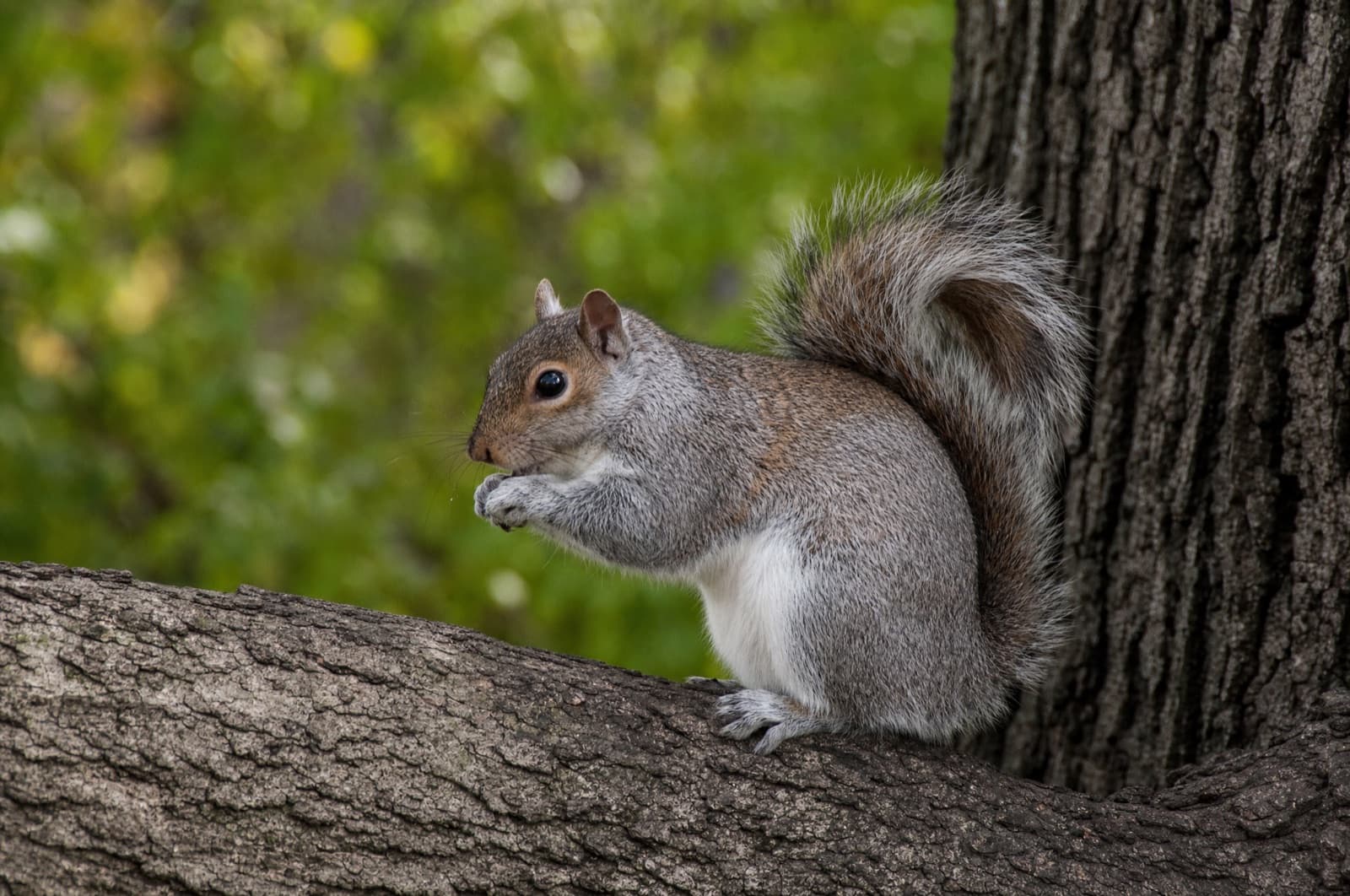
How to Get Rid of Eastern Gray Squirrels
At a glance
- Difficulty: Advanced
- Time: A weekend for tree-trimming and sealing; longer if confirming vacancy before final sealing
- Cost: Low to moderate — hardware cloth, sheet metal, pole saw
- Success: Good for exterior prevention; requires care and correct timing for an active attic entry
Can you DIY Eastern Gray Squirrel?
The verdict on Eastern Gray Squirrel DIY
Exterior exclusion is DIY-doable — but only after confirming no young are trapped inside.
Eastern gray squirrels are a NH game species, and trapping outside the regular season requires a Wildlife Control Operator license; relocation is also legally constrained, so exclusion is the recommended path. Trimming limbs, screening vents, and sealing roofline gaps are all genuinely DIY-able. The critical judgment call is confirming no dependent young are inside first — gray squirrels have two litters a year, and young can't leave on their own for 8 to 12 weeks, so sealing out a mother with pups still inside orphans them and triggers destructive chewing as she tries to get back in.
The 5 DIY methods — honestly graded
Every approach graded for this species, in IPM order — prevention first, chemistry late. Pick a method to see how it works, the steps, and what it actually takes.
Prevention / Exclusion
Works wellThe most effective DIY lever — works well when every gap is sealed and no young are trapped inside.
Gray squirrels access roofs by leaping from nearby limbs and enter through roofline gaps, vents, and chimneys. Removing the launch points and sealing entry gaps denies access before a squirrel ever gets a foothold.
Best for: Preventing entry before squirrels establish a nest
Cut off the approach
Trim tree limbs 3 to 6 feet back from the roofline — squirrels can leap gaps that look wider than that.
Screen vents and seal gaps
Screen gable, roof, and soffit vents with metal mesh (squirrels chew through plastic and soft aluminum), cap chimneys, and seal any roofline gap over 2 inches with hardware cloth or sheet metal.
CautionNever permanently seal an active entry point until you've confirmed no young are inside.
Tools & materials
Why DIY falls short here
Not scare tactics — the specific, proportionate reasons a home attempt can stall for this species.
Hidden dependent young
Sealing a mother squirrel out orphans her pups, which die in the wall or attic and triggers extreme, destructive chewing as she tries to re-enter.
Chewing power
Gray squirrels chew through plywood and soft metals to reach a nest, so a partial or flimsy seal often just gets breached again.
Licensing and relocation limits
Trapping outside the regular season requires a Wildlife Control Operator license, and NH Fish & Game will not relocate trapped animals for you — relocation itself is also legally constrained.
Multiple entry points
Incomplete sealing of secondary gaps guarantees re-entry even after the main hole is addressed.
How risky is it, really?
An honest read — most nuisance species are genuinely low risk, and we say so.
Eastern gray squirrels are chiefly a property and structural nuisance, not a disease risk. The genuine concerns are gnawed wiring (a fire hazard) and soiled attic insulation — bites are rare and only occur if a squirrel is cornered or handled directly.
- Gnawed electrical wiring (fire hazard)Occasional
Serious when it occurs — a leading cause of attic/wall fires attributed to rodent and squirrel activity
UNH Cooperative Extension / fire-safety literature
- Insulation contamination and odorCommon
From nesting material and droppings in an occupied attic space
UNH Cooperative Extension
- Bites, only if cornered or handledRare
Rabies is not a meaningful concern — NH DHHS notes small rodents are almost never found infected
NH DHHS
Not Sure If Young Are in the Attic? Get It Checked.
Sealing out a mother squirrel with pups inside creates a bigger problem than you started with. Anchor Pest Services handles confirmed-vacancy exclusion across southern and central New Hampshire. Family-owned since 2017, NH license #782664.
Call a pro when…
- An active attic or wall-void nest where you can't confirm young are absent
- Signs of chewed electrical wiring
- Repeated re-entry despite your own sealing attempts
General Pest Control
Exterior prevention — tree-trimming, vent screening, sealing — is a solid DIY project. Call a pro once squirrels are actively nesting in the attic, especially if you can't confirm whether young are present, or if gnawed wiring is a possibility.
Keep them out
- Trim tree limbs 3–6 feet back from the roofline
- Screen vents and cap chimneys with metal, not plastic
- Confirm vacancy before sealing any active entry hole
Eastern gray squirrels in New Hampshire
In New Hampshire, gray squirrels raise two litters a year — roughly February through May and August through October — and seek attic and chimney access most aggressively as cooler fall weather sets in. Timing exterior sealing for late fall or late winter, outside the core breeding windows, is the safest bet for avoiding trapped young.
Peak season
Two breeding seasons: February–May and August–October
Make sure it's a Eastern Gray Squirrel
Two quick detours worth taking — confirm the ID, then learn what drew it in so it doesn't come back.
Frequently asked
Sources & further reading(4)
- [1]NH Fish & Game — Nuisance Wildlife / Wildlife Control Operators
WCO licensing and relocation constraints for gray squirrels
govverified 2026-07-13 - [2]UNH Cooperative Extension — Nuisance Wildlife Around the Home
NH-specific exclusion guidance for squirrels
extensionverified 2026-07-13 - [3]NH DHHS — Rabies and Animal Bites
Small rodents almost never found rabies-infected
govverified 2026-07-13 - [4]Internet Center for Wildlife Damage Management — Tree Squirrel Damage Prevention and Control Methods
One-way door exclusion technique
academicverified 2026-07-13
Written & reviewed by
VerifiedDaniel Brady
NH-Licensed Pesticide Applicator · License #782664 (NHDAMF, RSA 430)
Daniel Brady is the New Hampshire–licensed applicator behind Anchor Pest Services, a family-owned pest control company serving the Manchester area since 2017.
Last updated July 2026
Professional Pest Control
Not Sure If Young Are in the Attic? Get It Checked.
Sealing out a mother squirrel with pups inside creates a bigger problem than you started with. Anchor Pest Services handles confirmed-vacancy exclusion across southern and central New Hampshire. Family-owned since 2017, NH license #782664.
- Confirmed-vacancy exclusion
- NH-licensed technicians (#782664)
- Free inspection — same-day service across southern NH
NH License #782664 · No obligation · We answer in person
Your next step
- Book a NH pro
Pest Control Services
Licensed, family-owned pest control across southern NH.
Book now - What to do next
Eastern Gray Squirrel in New Hampshire — ID & Attic Control
Read the answer - What to do next
Why do squirrels damage attics and insulation?
Read the answer - Also relevant
Eastern Gray Squirrel in New Hampshire — ID & Attic Control
Read the answer - Also relevant
Wildlife Exclusion: Evict First, Then Seal — Never Reverse
Read the answer - Also relevant
Where Do Squirrels Go in the Winter? NH Timing Guide
Read the answer