
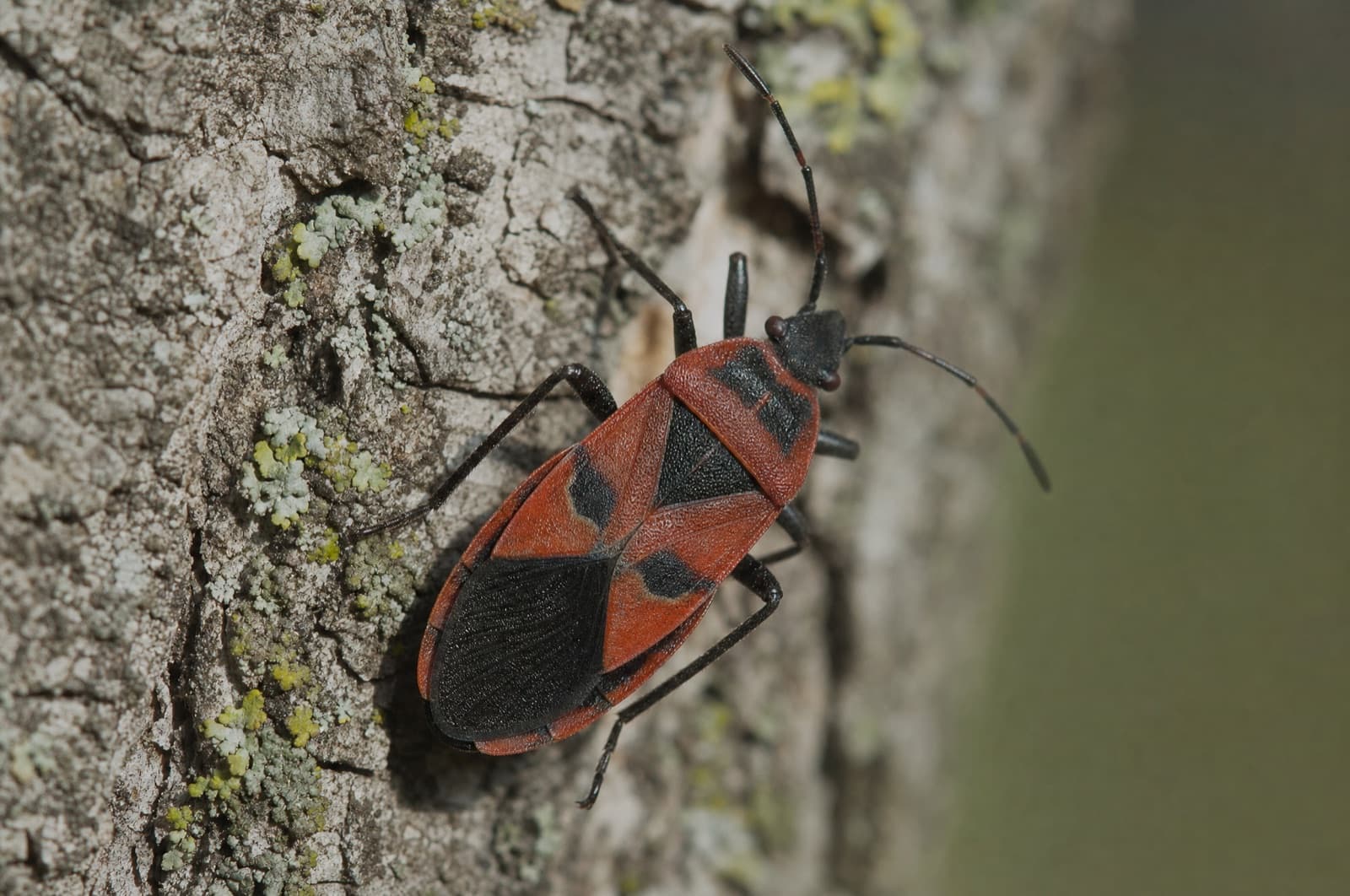
What Attracts Elm Seed Bugs to Your House?
At a glance
- Short answer: Elm seed bugs are tied to nearby elm trees — not to anything about your house.
- The verdict: Something specific
The attractant verdict
Four possible answers to why this species turned up. Three stay unlit — and that's the argument: the honest answer could have been any of them, and for this species it wasn't.
Elm seed bugs are tied to nearby elm trees — not to anything about your house.
Our own previous page said elm seed bugs are drawn to homes ‘primarily due to warmth and shelter’ — true for the overwintering behavior, but it skips the part that actually predicts which houses see them: nearby elm trees.
One or more elm trees nearby, whose developing seeds are what elm seed bugs actually feed on through late spring and early summer. As the season turns and adults seek overwintering shelter, they move toward the nearest structure — often in large numbers — and squeeze into cracks, siding gaps, and window frames, mostly on sun-exposed walls.
“Elm seed bugs don't want your house. They want the elm tree next to it — your house is just where they go to wait out winter.”
Proximity to elm trees, whose developing seeds are the species' food source through the growing season.
It explains why elm seed bug numbers vary so much house to house: a structure near a seed-bearing elm sees far more overwintering activity than one without an elm nearby, regardless of anything about the building.
Calibrated from: Colorado State University Extension, 'Elm Seed Bug: A Nuisance Pest in Colorado Homes': the insect overwinters as an adult in and around structures after feeding on developing elm seeds during the growing season.
Why it's here, in full
Why the nearby elm tree is the real story
Elm seed bugs spend the growing season feeding on the developing seeds of elm trees, and populations build up directly in proportion to how many host trees are nearby — a yard or street with mature elms will see far more activity than one without. As adults finish the season and begin looking for overwintering shelter, they move toward whatever structure is closest, gathering on sun-exposed walls before working through cracks, siding gaps, and window frames to spend winter dormant inside. They don't feed or reproduce indoors; they're simply waiting out the cold in whatever gap they found. The house is incidental — the elm tree next to it is the actual reason the bugs are in the area at all.
How to tell it's actually this species
Real signs only — a species with four honest tells gets four, and stops. Where a sign is weak on its own, we say so.
Dark brown, narrow-bodied winged insects clustering on sun-warmed exterior walls in late summer and fall
Small numbers of the same insect appearing indoors near windows through fall and winter, especially on warm days
A strong, unpleasant odor when the insects are crushed or vacuumed
Could be something else: A similarly sharp odor comes from several other overwintering nuisance insects when crushed; the presence of nearby elm trees is the stronger confirming clue for this one.
Want elm seed bugs gone?
This page only answers why it's here. Every removal step for this exact species — what to seal, what to set, what actually works — lives on its own dedicated guide.
Two questions, two pages
Here: why it turned up at all — the honest answer, blame removed.
There: the step-by-step removal guide for this exact species.
Already dealing with elm seed bug?
This page is about why it's there. Getting rid of it is covered at /top-diy-methods/elm-seed-bug.
Frequently asked
Sources(2)
- [1]Colorado State University Extension — Elm Seed Bug: A Nuisance Pest in Colorado Homes
Elm seed bugs feed on developing elm seeds and overwinter as adults in and around structures
extensionverified 2026-07-17 - [2]Utah State University Extension — Elm Seed Bug
Host-plant dependence on elm trees and fall movement into structures
extensionverified 2026-07-17
Written & reviewed by
VerifiedDaniel Brady
NH-Licensed Pesticide Applicator · License #782664 (NHDAMF, RSA 430)
Daniel Brady is the New Hampshire–licensed applicator behind Anchor Pest Services, a family-owned pest control company serving the Manchester area since 2017.
Last updated Jul 2026
Food, water, warmth, shelter — the usual four
If it's already inside, we handle the rest
Same-day inspections across southern and central New Hampshire.
- Family-owned in Manchester since 2017
- NH commercial applicator #782664, category F1
- We will tell you when the answer is do nothing
NH License #782664 · No obligation · We answer in person