
Elm Seed Bug — ID and Whether It's Really in New Hampshire
Also called ESB
The elm seed bug is a European invader now established in the western United States — but it is NOT confirmed established in New Hampshire or New England. If you have a small rusty-and-black seed bug in NH, it is almost certainly a boxelder bug. This page provides an honest range check and disambiguation.
- Adult size
- ~⅓ in (6.5–8 mm)
- Animal Diversity Web; Idaho Dept. of Agriculture
- NH presence
- NOT confirmed established in NH or New England
- USU Extension; CSU Extension
- Confirmed US range
- Idaho, Oregon, Washington, Utah, Colorado, New Mexico — all western states
- CSU Extension; PNW Pest Management Handbook
- First US detection
- Ada and Canyon counties, Idaho, July 2012
- USU Extension; Idaho Dept. of Agriculture
- NH lookalike
- Boxelder bug (much more likely in NH)
- UNH Extension
- Human health threat
- None — presents no threat to human health
- Idaho Dept. of Agriculture
The honest NH verdict: this western-US bug probably isn't here
This is the honesty page. The elm seed bug (*Arocatus melanocephalus*) is a European seed bug that arrived in the United States in 2012 and has become a significant nuisance home-invader in the Pacific Northwest, Rocky Mountain states, and parts of Canada's western provinces. Its confirmed US range is Idaho, Oregon, Washington, Utah, Colorado, and New Mexico — all western.
Honest verdict: the elm seed bug is NOT confirmed established in New Hampshire or New England. No population has been documented in the northeastern US by extension services or entomological surveys as of this writing. If you have a small, rusty-red-and-black seed bug in NH, it is far more likely to be a boxelder bug (*Boisea trivittata*) — a very common NH fall invader that shares a similar color palette but is larger and distinctly different up close.
We include this page for disambiguation and honest range correction, not to sell a treatment for a pest that is not here. If you genuinely believe you have found an elm seed bug in New Hampshire, photograph it and report it to UNH Cooperative Extension's insect identification service — that would be a notable first-state record.
How to identify the elm seed bug
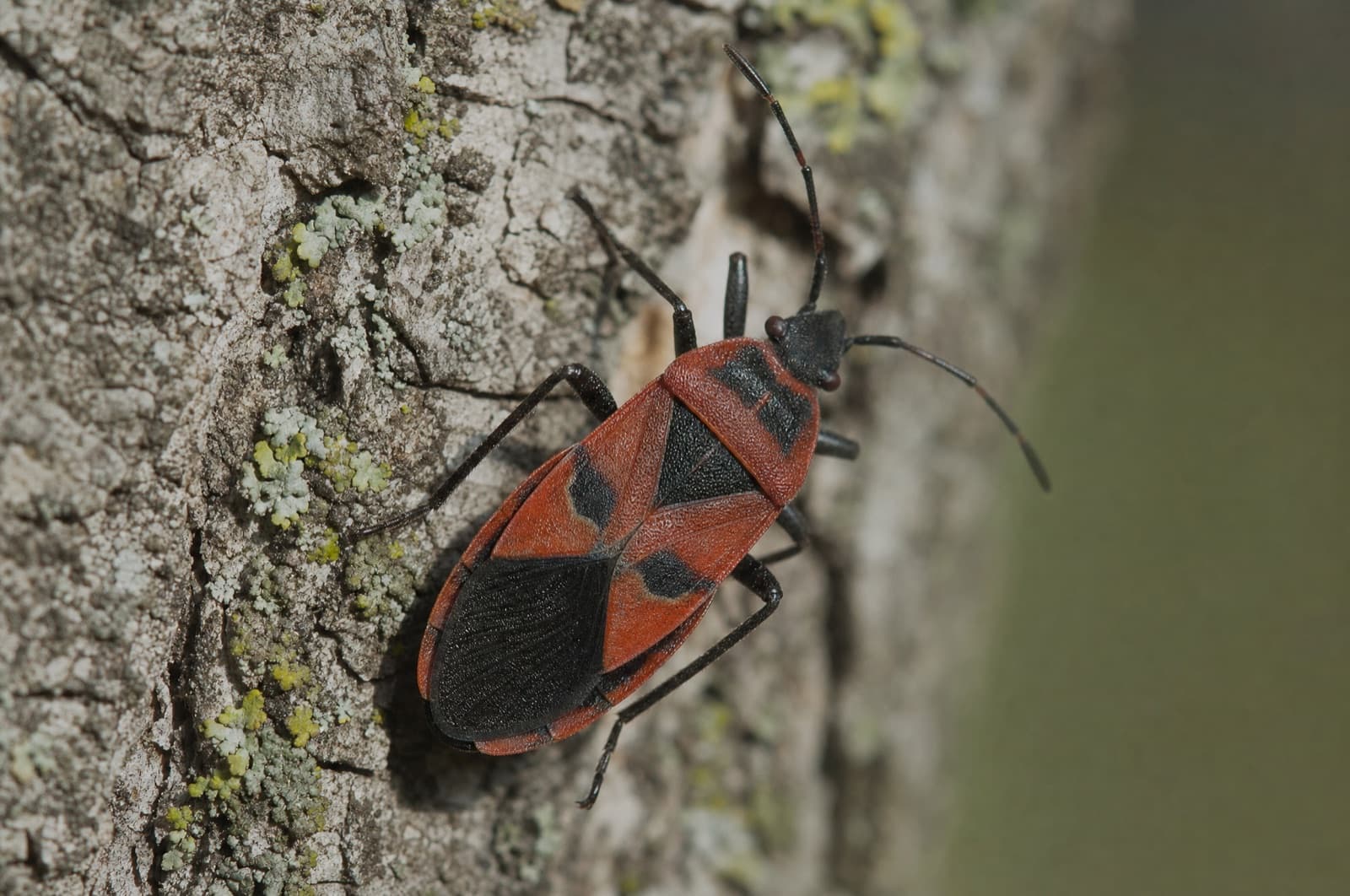
The elm seed bug is small — roughly ⅓ inch — rusty-red and black with a distinctly dark to black head. The alternating dark and white marks along the abdominal edge and the orange-red underside are characteristic. In its western-US range it is closely associated with elm trees. In NH, any similar-looking insect is almost certainly a boxelder bug.
Elm seed bug
- Scientific name
- Arocatus melanocephalus
- Family
- Lygaeidae (seed bugs)
- Size
- ~6.5–8 mm (~⅓ in)
- Coloration
- Rusty-red and black; distinctly dark/black head; alternating dark/white marks on abdominal edge; orange-red underside
- Habitat
- Elm trees (primary host), also linden and oak; invades buildings in summer in its western range — behavior not documented in NH
- Active season
- Summer nuisance in its range (unlike the fall overwinterers); overwinters as adult
- Diet
- Primarily elm seeds; also linden and oak seeds
- Reproduction
- Overwinters as adult; lays eggs on elms in spring
Native to south-central Europe and the Mediterranean; first US detection Idaho July 2012; confirmed US range is western states only (ID, OR, WA, UT, CO, NM). Not confirmed established in NH or New England.
The tells — key ID features
- Rusty-red and black coloration with a distinctly dark or black head — the main field mark.
- Small size: ~⅓ inch — noticeably smaller than a boxelder bug.
- Alternating dark and white marks along the edge of the abdomen.
- Orange-red underside visible when disturbed.
- Nymphs are reddish with a black head, superficially similar to boxelder-bug nymphs.
- Strong association with elm trees in its western-US range.
Size, to scale
~6.5–8 mm (~⅓ in)
About the length of a grain of long-grain rice — noticeably smaller than a boxelder bug (~½ in)
Boxelder bug (the NH lookalike — check this first)
How to tell — Boxelder bug is larger (~½ in), black with three distinctive bright red pronotal stripes and red wing margins. Elm seed bug is smaller, rusty-toned throughout, and lacks the three pronotal stripes. In NH, assume boxelder bug until proven otherwise.
Western conifer seed bug
How to tell — WCSB is much larger (~¾ in), elongate brown, and has distinctive leaf-shaped flares on its hind legs. No resemblance to the small, rusty elm seed bug.
Brown marmorated stink bug
How to tell — BMSB is mottled brown, much larger, shield-shaped, and has banded antennae. Not rusty-red.
Signs of a problem
The following signs describe elm-seed-bug behavior in its confirmed western-US range. In New Hampshire, these signs most likely indicate a boxelder bug.
Mass aggregations on window sills and frames, especially near elm trees, in summer
What it means — Classic ESB behavior in its western range — summer, not fall, which differs from most NH fall invaders. This pattern is NOT documented in NH.
Small rusty-red and black bugs on the exterior of a building in significant numbers
What it means — In NH, this almost certainly indicates boxelder bugs, not ESB. Photograph and compare to boxelder ID features before drawing conclusions.
Unpleasant defensive odor when bugs are disturbed or crushed
What it means — ESB releases a defensive scent — documented in its western range. Boxelder bugs and several other seed bugs do the same; odor alone does not confirm ESB.
The real risks, calibrated
In its established western-US range, the elm seed bug is a nuisance invader. In New Hampshire, the risk is essentially zero because the species is not established here.
Nuisance home invasion (in western US range only)
Low riskOnset: Summer months when adults seek shelter
In Idaho, Oregon, and adjacent states, ESB can invade homes in large numbers during summer, triggering complaints similar to those from BMSB. This behavior has not been documented in NH.
Defensive odor when disturbed
Low riskOnset: Immediately when handled or crushed
ESB releases an unpleasant odor when disturbed. Idaho Dept. of Agriculture notes it is a nuisance but presents no health risk.
Human health threat
Low riskOnset: Not applicable
Idaho Dept. of Agriculture states the elm seed bug presents no threat to human health. It does not bite, sting, or transmit disease.
DIY — what works, what backfires
In New Hampshire the primary DIY step is correct identification. If you are outside ESB's confirmed western-US range, any small rusty-red seed bug is almost certainly a boxelder bug.
What actually works
- Photograph the insect clearly and compare it to boxelder bug ID features — that is almost certainly what you have in NH.
- Report suspected NH sightings to UNH Cooperative Extension's insect identification service with a clear photograph — any confirmed first NH record would be scientifically significant.
- If you are in ESB's western US range: vacuum elm seeds from around the home foundation and seal all exterior crevices and soffits before summer.
- In the western range: seal window frames, soffit vents, and pipe penetrations before ESB invasion peaks in summer.
What backfires
- Don't assume any small rusty seed bug in NH is an elm seed bug — it is almost certainly a boxelder bug.
- Don't purchase or apply treatments for a pest that is not confirmed in your state — this wastes money and pesticides.
- Don't skip the identification step before taking action; UNH Extension can confirm the species from a clear photo.
Unidentified seed bug in your NH home? Start with a free ID
If you have an unidentified mass invasion of small seed bugs and are unsure whether it is a boxelder bug, a native seed bug, or something else, Anchor Pest Services starts with correct species identification before recommending any treatment. For a pest that is not established in NH, the right answer is honest disambiguation — not a spray.
When to call a pro
- You have a confirmed or suspected mass invasion of small, rusty-colored seed bugs and cannot determine the species.
- You are seeing seed-bug-type insects in significant numbers and want professional identification.
- A verifiable first NH elm-seed-bug sighting — worth documenting and reporting.
Seal soffits and exterior crevices
For any seed bug nuisance — ESB in its western range, or boxelder bug in NH — sealing all soffit vents, window frame gaps, and utility penetrations is the first and most effective prevention step.
Reduce elm seed litter around the home
In ESB's western range, vacuum or rake elm seeds (samaras) away from the home foundation before they attract aggregating adults.
Get the ID right first
In New Hampshire, photograph any unfamiliar seed bug and compare to boxelder bug features — or send the photo to UNH Cooperative Extension. The correct ID drives the correct response.
Not sure it's a elm seed bug?
A licensed NH technician can confirm the species and tell you honestly whether it's a DIY fix or a job for a pro — free inspection, same-day service across Southern New Hampshire.
Frequently asked questions
Sources(6)
- [1]USU Extension — Elm Seed Bug
First US detection Ada/Canyon counties Idaho July 2012; biology and range
extensionverified 2026-06-30 - [2]Colorado State University Extension — Elm Seed Bug
Confirmed US range (ID, OR, WA, UT, CO, NM); native range Europe/Mediterranean
extensionverified 2026-06-30 - [3]Idaho Department of Agriculture — Elm Seed Bug
No threat to human health; nuisance-only characterization
govverified 2026-06-30 - [4]Animal Diversity Web — Arocatus melanocephalus
Adult size ~6.5–8 mm; species description
encyclopediaverified 2026-06-30 - [5]PNW Pest Management Handbook — Elm Seed Bug
Confirmed western-US range including Canada; management in its range
extensionverified 2026-06-30 - [6]UNH Cooperative Extension — Insect & Other Arthropod Identification
NH insect identification service; reference for reporting suspected sightings
extensionverified 2026-06-30
Written & reviewed by
VerifiedDaniel Brady
NH-Licensed Pesticide Applicator · License #782664 (NHDAMF, RSA 430)
Daniel Brady is the New Hampshire–licensed applicator behind Anchor Pest Services, a family-owned pest control company serving the Manchester area since 2017.
Last updated 2026-06-30

New Hampshire pest control
Dealing with elm seed bugs in your home?
Anchor Pest Services identifies and handles elm seed bug problems across southern and central New Hampshire. Family-owned since 2017, NH license #782664.
- NH-licensed applicators (#782664)
- Same-day service · free inspection
- Family-owned since 2017
Your next step
- Fall guide
Fall Pest Control in New Hampshire
What matters before frost: the fall invader window, mice at the foundation, and what to seal first.
Read the answer - What to do next
How to Get Rid of Elm Seed Bugs
Read the answer - What to do next
How do I recognize a stink bug infestation?
Read the answer - What to do next
Where Do Bugs Go In The Winter?
Read the answer - What to do next
Box Elder Bugs in the House in Winter — NH Timing Guide
Read the answer - Related guide
Western Conifer Seed Bug in New Hampshire — ID & Control
Read the answer