
What Attracts Fire Ants to Your House?
At a glance
- Short answer: New Hampshire's fire ant is the European fire ant — and it wants food and damp ground, like any ant.
- The verdict: The usual four
The attractant verdict
Four possible answers to why this species turned up. Three stay unlit — and that's the argument: the honest answer could have been any of them, and for this species it wasn't.
This is the most common answer in this hub — an answer, not a shortfall.
New Hampshire's fire ant is the European fire ant — and it wants food and damp ground, like any ant.
Our own previous page said fire ants are attracted ‘mainly due to food, moisture, and suitable nesting areas’ — true, but it never specified which fire ant, and in a New England context that specificity matters.
Moist, often mulch- or debris-covered ground near a lawn edge, garden bed, or building foundation, combined with accessible food, since European fire ants are aggressive omnivores. They build dense, shallow, multi-queen colonies in these conditions and can form large local populations in a single yard, unlike a single-queen colony.
“The ‘fire ant’ in a New Hampshire yard is the European fire ant, not the species from the South — and it wants the same thing every ant wants: food and damp ground to nest in.”
Why it's here, in full
Why this matters: it's the European fire ant, not the southern species
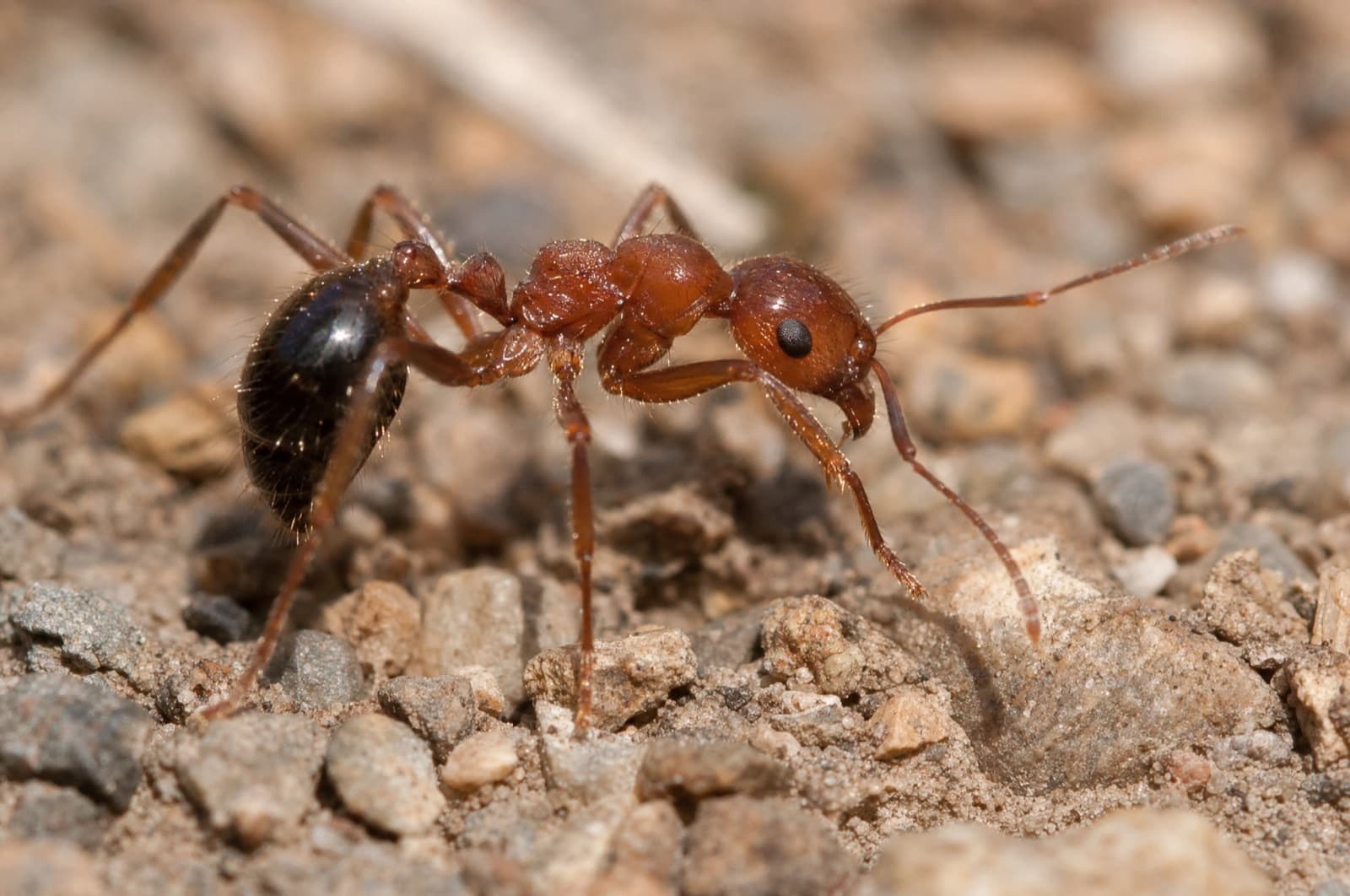
The insect people in New Hampshire call a ‘fire ant’ is the European fire ant (Myrmica rubra), an introduced species first noticed spreading here in the late 1990s and now established in scattered sites, mostly near the coast and around ponds, across Maine, New Hampshire, Massachusetts, and a few other Northeastern states. It is a different animal from the red imported fire ant (Solenopsis invicta) common across the southern United States, which is not established in New England because it cannot survive the region's winters. The European fire ant builds dense, shallow, multi-queen colonies in moist lawns and garden edges and stings aggressively when a nest is disturbed — food and damp, insulated ground are what its colonies actually need, the same ordinary combination behind most ants, just packed into a much denser, more defensive colony structure.
How to tell it's actually this species
Real signs only — a species with four honest tells gets four, and stops. Where a sign is weak on its own, we say so.
Small, loose mounds of soil in lawns or garden beds, without the tall, hard-crusted mound typical of the southern imported fire ant
Could be something else: Loose soil mounds can come from several ground-nesting insects; a painful sting from a small red ant defending the spot is the stronger confirming clue.
A cluster of small reddish-brown ants swarming out and stinging repeatedly when a nest is disturbed
Multiple separate nest mounds close together in the same patch of lawn, sometimes described as a colony ‘super-mound’
Want fire ants gone?
This page only answers why it's here. Every removal step for this exact species — what to seal, what to set, what actually works — lives on its own dedicated guide.
Two questions, two pages
Here: why it turned up at all — the honest answer, blame removed.
There: the step-by-step removal guide for this exact species.
Already dealing with fire ant?
This page is about why it's there. Getting rid of it is covered at /top-diy-methods/fire-ant.
Frequently asked
Sources(3)
- [1]University of Maine Cooperative Extension — European Fire Ant (Bulletin #2550)
European fire ant identity, cold-tolerant establishment in coastal Maine/NH/MA sites, multi-queen colony structure
extensionverified 2026-07-17 - [2]University of Florida IFAS — European Fire Ant, Myrmica rubra (EENY-410)
European fire ant biology, stings, and distribution distinct from the imported fire ant
extensionverified 2026-07-17 - [3]USDA APHIS — Imported Fire Ants
Red imported fire ant range confined to southern U.S. quarantine states, not New England
govverified 2026-07-17
Written & reviewed by
VerifiedDaniel Brady
NH-Licensed Pesticide Applicator · License #782664 (NHDAMF, RSA 430)
Daniel Brady is the New Hampshire–licensed applicator behind Anchor Pest Services, a family-owned pest control company serving the Manchester area since 2017.
Last updated Jul 2026
Food, water, warmth, shelter — the usual four
If it's already inside, we handle the rest
Same-day inspections across southern and central New Hampshire.
- Family-owned in Manchester since 2017
- NH commercial applicator #782664, category F1
- We will tell you when the answer is do nothing
NH License #782664 · No obligation · We answer in person