
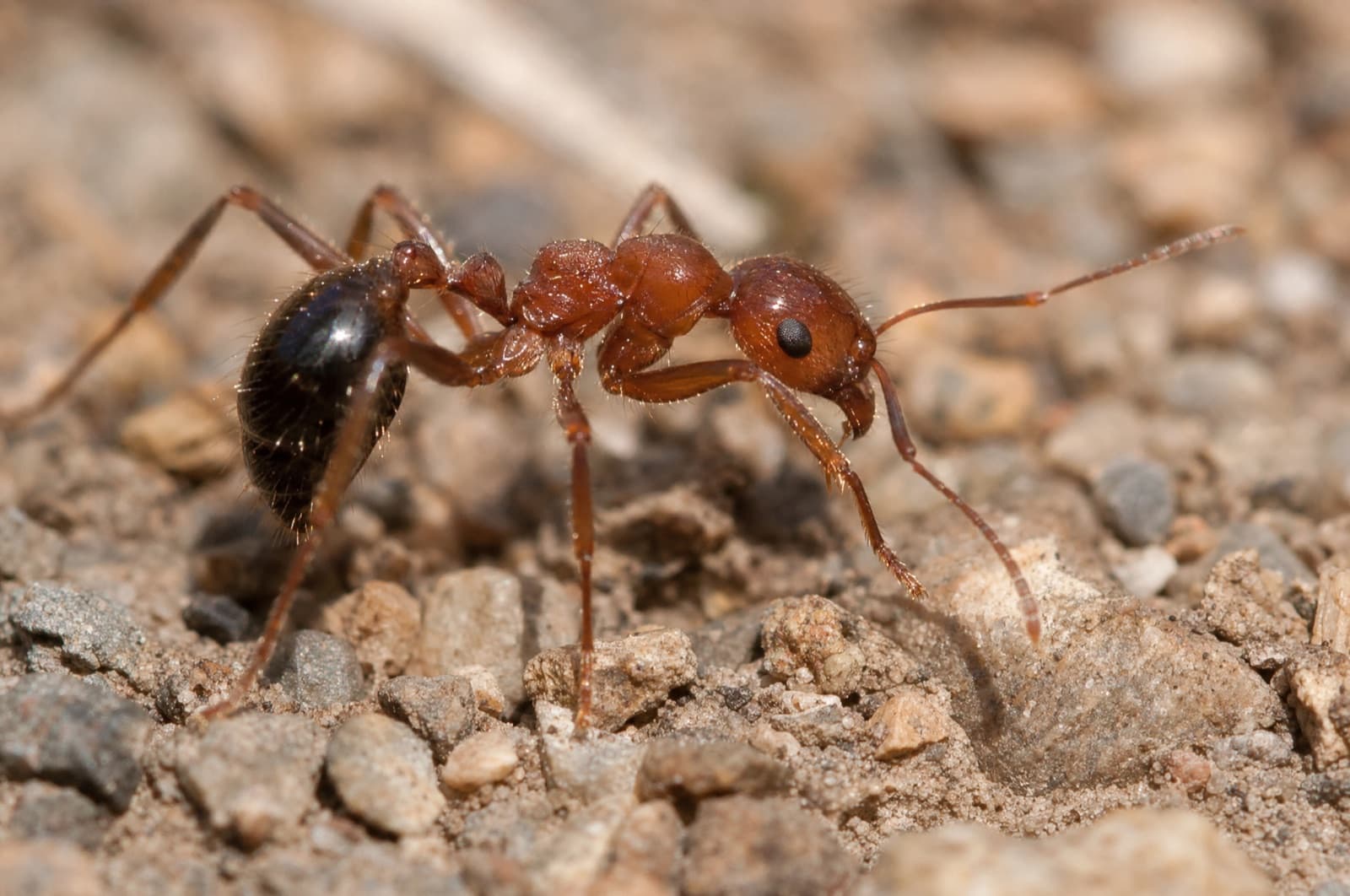
Fire Ant — Quick ID & New Hampshire Verdict
Also called Red imported fire ant · RIFA
Red imported fire ants (Solenopsis invicta) are not established in New Hampshire — our winters are far too cold. A painful ant sting in NH is almost always from a pavement ant or another native species. This is the fast identifier; for the species you actually have, see the full ant guide.
- Size
- 2–6 mm
- workers of mixed sizes in one colony; Solenopsis invicta
- NH status
- Not established
- southern U.S. species; NH winters below survival threshold
- Sting tell
- Burning sting, white pustule
- distinctive in the South; rare or absent in NH
- Mound
- Dome-shaped dirt, no central hole
- diagnostic in established range
Fire ants and New Hampshire — the honest verdict
Red imported fire ants are among the most feared ant species in the United States, known for aggressive swarming, painful stings, and dome-shaped mounds. They have spread steadily northward from the Gulf Coast — but they have not established populations in New Hampshire, and our winters currently prevent them from doing so.
This page explains what fire ants look like and delivers the NH verdict plainly. If you are dealing with stinging ants in New Hampshire, the full ant guide will help you identify what species you actually have.
Quick fire ant ID
In their established Southern range, fire ants have distinctive signs — but confirming absence in NH is the first step.
Fire ant
- Scientific name
- Solenopsis invicta
- Family
- Formicidae
- Size
- 2–6 mm (workers are polymorphic — multiple sizes within one colony)
- Coloration
- Reddish-brown head and thorax, darker abdomen
- Habitat
- Open, sunny ground in established range — lawns, roadsides, pastures, parks (in Southern states only)
- Active season
- Year-round in established range (warm Southern climates); not applicable in NH
- Diet
- Omnivorous — insects, seeds, honeydew, small vertebrates in established range
Established in the Gulf Coast states and spreading northward in the Southeast U.S.; not established in New Hampshire or New England. NH winters regularly reach temperatures well below the survival threshold for outdoor colonies.
The tells — key ID features
- Builds a loose dome-shaped dirt mound with no central entrance hole (workers enter from underground tunnels at the base).
- Aggressive swarming when the mound is disturbed — workers emerge rapidly and sting repeatedly.
- Sting delivers a burning sensation that forms a white fluid-filled pustule within 24 hours.
- Workers are polymorphic — multiple sizes (minor to major workers) within one colony.
Pavement ant
How to tell — Pavement ants are dark brown to black, build crater mounds in sidewalk cracks, and are far less aggressive — their sting (if delivered at all) does not form a pustule. They are the most common NH stinging ant.
Odorous house ant
How to tell — Odorous house ants are similar in size and do not sting; they smell like rotten coconut when crushed and trail to sweets indoors.
Signs of a problem
In the absence of NH establishment, signs here help rule fire ants out.
A dome mound of loose soil with no central entrance hole, workers swarming on disturbance, burning sting leaving white pustules
What it means — Classic fire ant signs — but in New Hampshire, confirm the ID: this description is diagnostic in the South, not here.
Stinging small ants in NH soil, pavement edges, or a foundation
What it means — Almost certainly a pavement ant or other native species — not red imported fire ants. See the ant guide for a confirmed ID.
Stinging ant ID and control in New Hampshire
If you are experiencing stinging ants in New Hampshire, the first priority is a correct species ID — red imported fire ants are not established here. The likely culprits are pavement ants or another native species, and treatment differs accordingly. The full ant guide covers NH stinging ant identification and the right treatment approach.
When to call a pro
- You want a confirmed ID on stinging ants before any treatment.
- Recurring painful ant encounters are disrupting yard or home use.
- You need to rule out a misidentified native species before more aggressive treatment.
Not sure it's a fire ant?
A licensed NH technician can confirm the species and tell you honestly whether it's a DIY fix or a job for a pro — free inspection, same-day service across Southern New Hampshire.
Frequently asked questions
Sources(2)
- [1]USDA Agricultural Research Service — Fire Ant Range
fire ant range limited to Gulf/Southeast; not established in New England
govverified 2026-06-30 - [2]Anchor Pest — Ant FAQ Guide
NH ant species identification and stinging ant alternatives
industryverified 2026-06-30
Written & reviewed by
VerifiedDaniel Brady
NH-Licensed Pesticide Applicator · License #782664 (NHDAMF, RSA 430)
Daniel Brady is the New Hampshire–licensed applicator behind Anchor Pest Services, a family-owned pest control company serving the Manchester area since 2017.
Last updated 2026-06-30

New Hampshire pest control
Dealing with fire ants in your home?
Anchor Pest Services identifies and handles fire ant problems across southern and central New Hampshire. Family-owned since 2017, NH license #782664.
- NH-licensed applicators (#782664)
- Same-day service · free inspection
- Family-owned since 2017
Your next step
- Next step
Is Raid Ant & Roach Killer Spray Safe for Pets?
Read the answer - What to do next
How to Get Rid of "Fire Ants" in New Hampshire
Read the answer - What to do next
How to Use Amdro Fire Ant Bait Granules
Read the answer - Also relevant
Can fire ants harm lawns or outdoor wiring?
Read the answer - Also relevant
Is Amdro Fire Ant Bait Granules Safe for Pets?
Read the answer - Related guide
Crazy Ant — Quick ID & New Hampshire Verdict
Read the answer