
What Attracts Flesh Flies to Your House?
At a glance
- Short answer: Flesh flies drop live maggots straight onto decaying matter — indoors, that again means carrion, waste, or a dead animal, not household mess.
- The verdict: Something specific
The attractant verdict
Four possible answers to why this species turned up. Three stay unlit — and that's the argument: the honest answer could have been any of them, and for this species it wasn't.
Flesh flies drop live maggots straight onto decaying matter — indoors, that again means carrion, waste, or a dead animal, not household mess.
Most advice, including our own previous page, says flesh flies are drawn to houses "primarily by the presence of decaying organic material, particularly dead animals and waste," which is close to correct but leaves out the detail that actually distinguishes this species from other carrion flies.
Flesh flies (family Sarcophagidae) develop on carrion, dung, and other decaying matter, the same broad category as blow flies. What sets them apart is reproductive strategy: rather than laying eggs, females larviposit — they deposit live, already-hatched larvae directly onto the substrate. Some species also use open wounds or excrement as a breeding site. Indoors, a real flesh fly presence points to the same kind of source as a blow fly problem — a dead animal in a wall, attic, or crawlspace, or exposed waste — reached and exploited unusually quickly because the larvae don't need to wait to hatch.
“Flesh flies drop live maggots straight onto decaying matter — indoors, that again means carrion, waste, or a dead animal, not household mess.”
Carrion, dung, or other decaying organic matter — most often a dead animal in a wall, attic, or crawlspace — onto which females deposit live larvae directly.
It confirms the same specific search as for blow and bottle flies (a decay source in or near the structure) while explaining why a flesh fly infestation can develop unusually fast: skipping the egg stage lets larvae start feeding immediately once deposited.
Calibrated from: University of Maine Cooperative Extension groups flesh flies with blow flies as carrion-associated species; peer-reviewed carrion-ecology literature (Nature Scitable) documents the larviparous reproduction distinctive to Sarcophagidae.
Why it's here, in full
The one detail that sets flesh flies apart
Flesh flies share the same broad attraction as blow flies — carrion, dung, and other decaying matter — but their reproductive strategy is distinct enough to be worth naming specifically. Rather than laying eggs that need time to hatch, female flesh flies larviposit: they deposit live, mobile larvae directly onto the substrate, letting the maggots begin feeding immediately. University of Maine Cooperative Extension groups flesh flies with blow flies for exactly this shared carrion-breeding biology, while noting the larviparous distinction, and peer-reviewed carrion-ecology research documents how this strategy lets Sarcophagidae exploit a fresh carcass unusually quickly compared to egg-laying species.
Indoors, that means a flesh fly problem points to the same kind of source as a blow fly problem — most often a dead rodent or bird in a wall, attic, or crawlspace, or exposed waste — but it can appear to develop faster, since there's no egg stage to wait through. The useful move is the same either way: find the decaying source rather than treat it as a general household-mess issue.
How to tell it's actually this species
Real signs only — a species with four honest tells gets four, and stops. Where a sign is weak on its own, we say so.
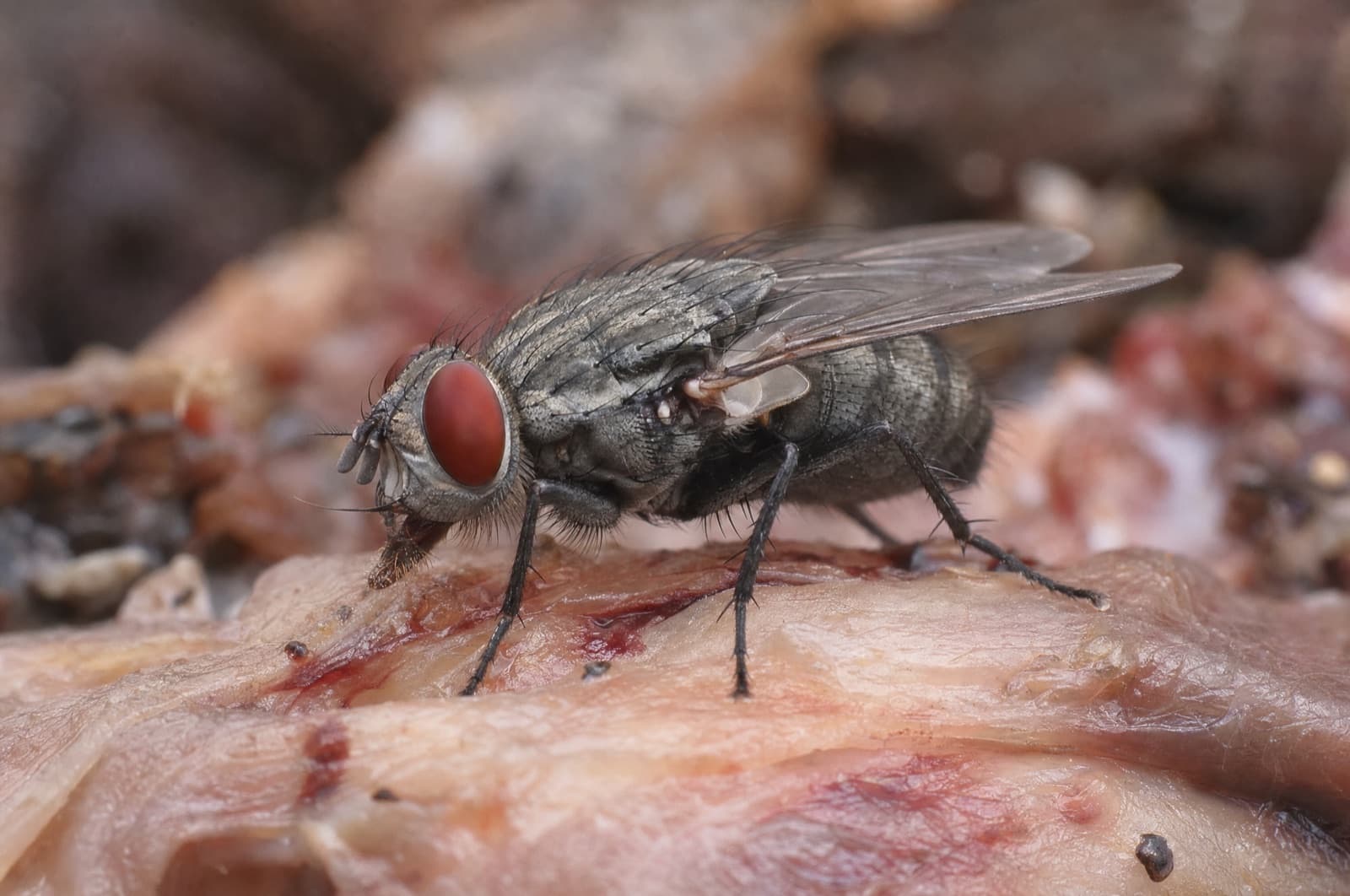
Adult flesh flies — typically gray with dark stripes and red eyes — appearing repeatedly in one room or clustering at a window
A localized bad odor that worsens over a few days, concentrated in one part of the house
Could be something else: A localized odor can also come from plumbing or mold issues; /smell-faq owns the dead-animal odor diagnostic specifically.
Larvae appearing suddenly, without a clearly visible batch of eggs first — a direct result of larviposition rather than egg-laying
Want flesh fly gone?
This page only answers why it's here. Every removal step for this exact species — what to seal, what to set, what actually works — lives on its own dedicated guide.
Two questions, two pages
Here: why it turned up at all — the honest answer, blame removed.
There: the step-by-step removal guide for this exact species.
Key takeaways
- Flesh flies are carrion-associated, like blow flies, but deposit live larvae instead of eggs.
- A real indoor presence points to a dead animal or decaying waste, not general mess.
- Skipping the egg stage means an infestation can appear to develop unusually fast.
- The odor diagnostic lives at /smell-faq; removal steps are at /top-diy-methods/flesh-fly.
Smell decay but can't find the source?
Tracing the odor is covered at /smell-faq. Once located, removal steps are at /top-diy-methods/flesh-fly.
Frequently asked
Sources(2)
- [1]University of Maine Cooperative Extension — Blow Flies and Flesh Flies
Flesh flies share carrion-breeding biology with blow flies; larviposition distinction
extensionverified 2026-07-17 - [2]Nature Scitable — The Ecology of Carrion Decomposition
Carrion-associated fly ecology, including larviparous reproduction in Sarcophagidae
academicverified 2026-07-17
Written & reviewed by
VerifiedDaniel Brady
NH-Licensed Pesticide Applicator · License #782664 (NHDAMF, RSA 430)
Daniel Brady is the New Hampshire–licensed applicator behind Anchor Pest Services, a family-owned pest control company serving the Manchester area since 2017.
Last updated Jul 2026
It's decay, not mess
We find what died, not just the flies
Inspections across southern and central New Hampshire to trace a flesh fly problem back to its actual source.
- Family-owned in Manchester since 2017
- NH commercial applicator #782664, category F1
- We will tell you when the answer is do nothing
NH License #782664 · No obligation · We answer in person