
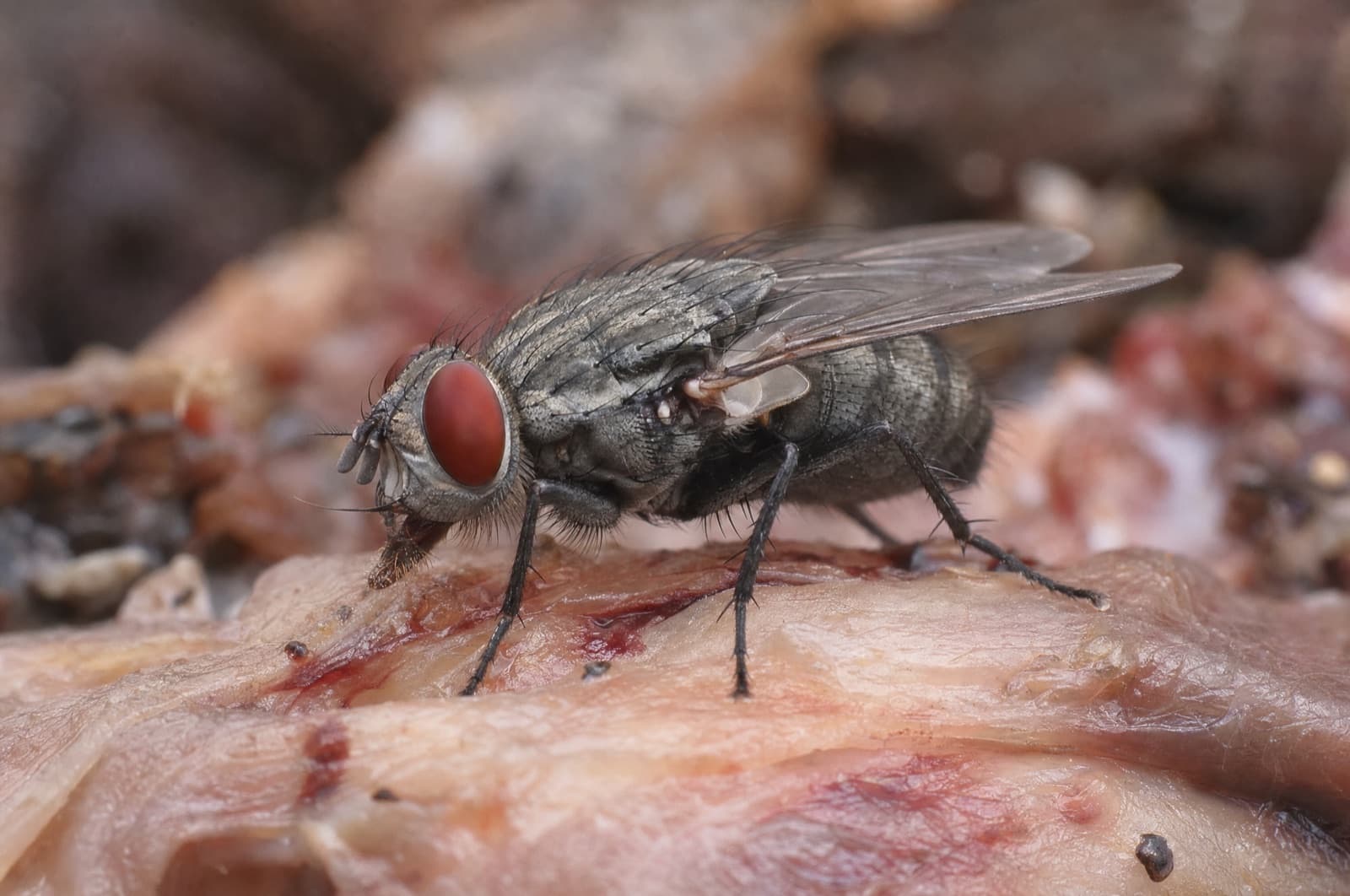
How to Get Rid of Flesh Flies
At a glance
- Difficulty: Intermediate
- Time: A few hours to locate and remove the source, longer if access is limited
- Cost: Low — gloves, bags, disinfectant
- Success: High once the source is found and removed; low from spraying alone
Can you DIY Flesh Fly?
The verdict on Flesh Fly DIY
Solvable DIY once you find the carcass — the same source-hunting job as a blow fly.
Flesh flies (Sarcophaga species) point to the same cause as blow flies: a dead animal or decaying organic matter somewhere in or near the structure. One quirk sets them apart biologically — females deposit live larvae directly onto the carcass instead of laying eggs — but it doesn't change the DIY approach. Locate and remove the source and the problem resolves. When the carcass is in a wall void or attic you can't safely reach, that's a reason to call a pro, not because flesh flies are dangerous.
The 5 DIY methods — honestly graded
Every approach graded for this species, in IPM order — prevention first, chemistry late. Pick a method to see how it works, the steps, and what it actually takes.
Prevention / Exclusion
Works wellRemoving the carcass or decaying source is the entire fix.
Flesh flies breed directly on decomposing tissue or organic decay. Removing that material eliminates the site their larvae depend on.
Best for: Every case — this is the method that actually solves it
Inspect likely sources
Check dumpsters, garbage staging areas, and structural spaces (attics, chimneys, crawlspaces, wall voids) for a dead rodent or bird.
CautionWear gloves and an N95 mask before handling a carcass.Remove, bag, and disinfect
Double-bag the carcass and dispose of it outdoors, then disinfect the area.
Exclude and screen
Seal the entry point that let the animal in, and screen windows and doors.
Tools & materials
Why DIY falls short here
Not scare tactics — the specific, proportionate reasons a home attempt can stall for this species.
Source in a wall void or attic
Structural access limits make a pro more practical than continuing to search blind.
Spraying without removing the source
Live larvae deposited directly on the carcass keep developing regardless of how many adults you spray.
How risky is it, really?
An honest read — most nuisance species are genuinely low risk, and we say so.
Both flesh fly maggots and adults are harmless to people in a home setting. The real issue is the carcass and the nuisance it creates, not disease.
- Odor and nuisance from the sourceCommon
Resolves once the carcass or decaying matter is removed
Iowa State University Extension
- Disease transmission to humansRare
Negligible in a typical home context
Iowa State University Extension
A Flesh Fly Source You Can't Access?
Wall voids and attics are hard to search safely on your own. Anchor Pest Services locates hidden sources and handles rodent exclusion across southern and central New Hampshire. Family-owned since 2017, NH license #782664.
Call a pro when…
- The source appears to be in a wall void, attic, or space you can't safely access
- Maggots or odor persist after a thorough search
- Recurring rodent entry keeps bringing in new carcasses
General Pest Control
Call a pro when the source is somewhere you genuinely can't reach — a wall void, an attic space, or a high roofline. It's an access issue, not a danger issue.
Keep them out
- Seal rodent entry points to prevent animals dying inside the structure
- Screen windows and doors to keep adults out
- Keep garbage and dumpster areas clean and covered
Flesh flies in New Hampshire homes
Like blow flies, flesh flies in NH homes usually trace back to a dead rodent that entered a wall void or attic during cooler months. Warm-season sightings more often point to outdoor decay near garbage or dumpster areas that flies are simply passing through on the way indoors.
Peak season
Warm months outdoors; fall–winter carcass sources indoors
Make sure it's a Flesh Fly
Two quick detours worth taking — confirm the ID, then learn what drew it in so it doesn't come back.
Frequently asked
Sources & further reading(2)
- [1]Iowa State University Extension — Blow and Flesh Flies
Biology, larviposition behavior, risk framing
extensionverified 2026-07-13 - [2]
Written & reviewed by
VerifiedDaniel Brady
NH-Licensed Pesticide Applicator · License #782664 (NHDAMF, RSA 430)
Daniel Brady is the New Hampshire–licensed applicator behind Anchor Pest Services, a family-owned pest control company serving the Manchester area since 2017.
Last updated July 2026
Other species you can tackle
Same category — the dot shows each one's DIY verdict at a glance (green = friendly, amber = doable with care, red = call a pro).
Professional Pest Control
A Flesh Fly Source You Can't Access?
Wall voids and attics are hard to search safely on your own. Anchor Pest Services locates hidden sources and handles rodent exclusion across southern and central New Hampshire. Family-owned since 2017, NH license #782664.
- NH-licensed applicators (#782664)
- Free inspection — same-day service across southern NH
NH License #782664 · No obligation · We answer in person
Your next step
- What to do next
Flesh Flies in New Hampshire — ID, Signs & Control
Read the answer - What to do next
Blow Flies in New Hampshire — ID, Signs & How to Get Rid of Them
Read the answer - Related guide
How to Get Rid of Blow Flies
Read the answer - Also relevant
Chemical Fly Control: A Supplement, Not the Fix
Read the answer - Related guide
What Attracts Blow Flies to Your House?
Read the answer