
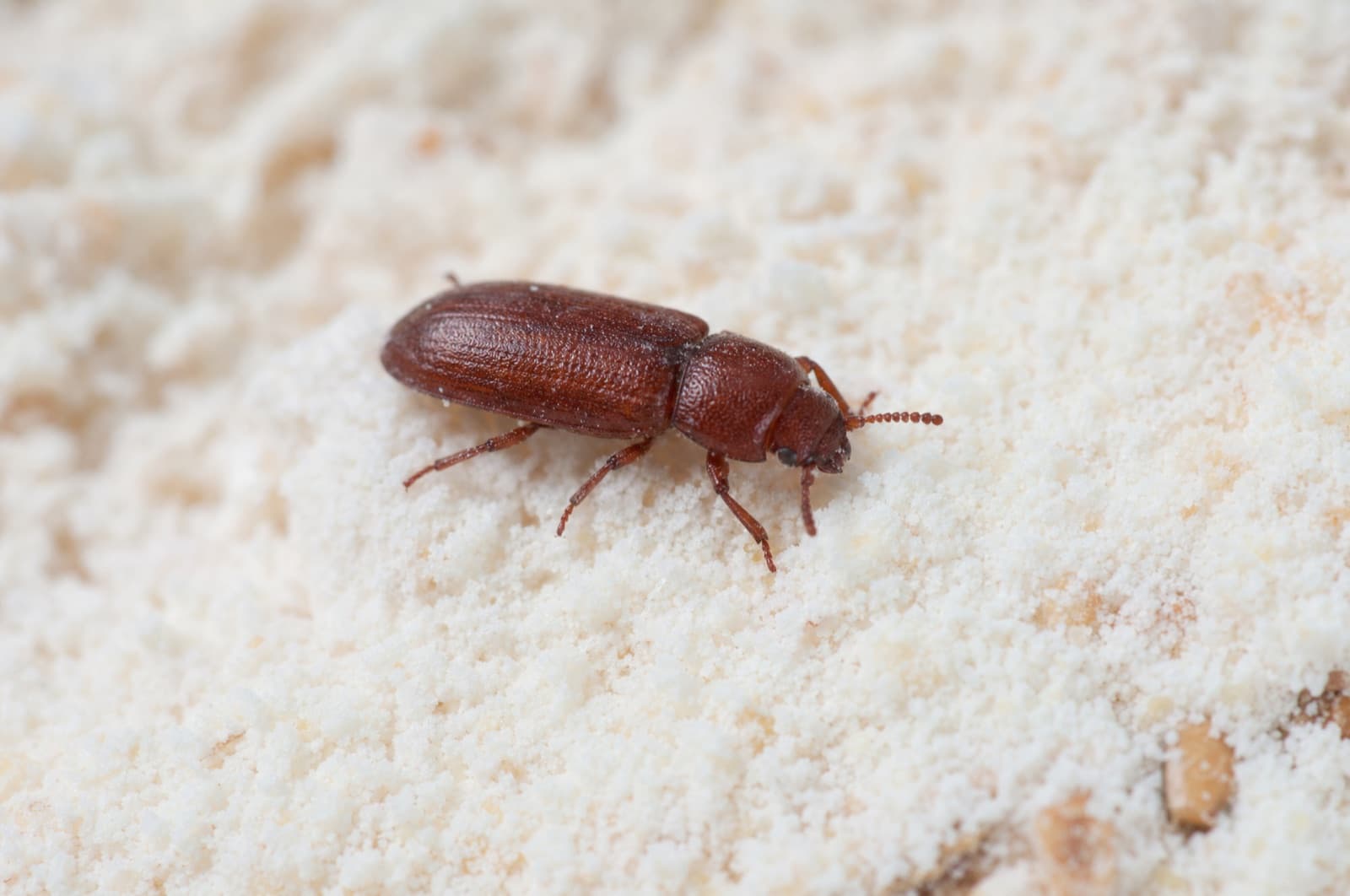
What Attracts Flour Beetles to Your House?
At a glance
- Short answer: Flour beetles can't even attack whole grain. They arrive already inside milled flour, cereal, or damaged grain, not lured in by your pantry.
- The verdict: You didn't attract it — you carried it in
The attractant verdict
Four possible answers to why this species turned up. Three stay unlit — and that's the argument: the honest answer could have been any of them, and for this species it wasn't.
Flour beetles can't even attack whole grain. They arrive already inside milled flour, cereal, or damaged grain, not lured in by your pantry.
Our own previous page said flour beetles are "attracted to homes primarily because they seek food sources, specifically stored grain products," language that implies the beetle is searching your pantry rather than arriving already inside the product.
A bag or box of flour, cereal, or milled grain that already contained eggs or larvae, typically because the product was contaminated during milling or packaging before it reached the store shelf, let alone your pantry.
“Flour beetles can't even break into whole grain on their own. Whatever brought them in had to already be milled, damaged, or dusty — and already infested.”
Why it's here, in full
They physically cannot attack whole grain
This is the detail that makes the carried-in story unusually solid for flour beetles: Purdue Extension entomology states plainly that both the red and confused flour beetle "cannot feed on whole grain," and instead depend on broken kernels or grain dust generated during handling and milling. That means an infestation cannot start with clean, whole grain sitting in a pantry — it requires milled flour, cereal, or already-damaged grain, and if that product carries eggs or larvae, they were present before or during milling, not something the beetle sought out afterward.
Our old page's "seek food sources, specifically stored grain products" framing is technically directionally right but skips the more useful, more specific fact: this species needs the grain already broken down, which happens upstream of your kitchen, not because of it.
Light attraction differs between the two species — worth naming honestly
UF/IFAS entomology and Purdue Extension both note that the confused flour beetle can fly and is drawn to light, while the red flour beetle crawls toward light but is, at best, a weak and infrequent flier. That's a real distinction worth stating plainly rather than flattening into one blanket claim about flour beetles and light. Either way, this flight behavior explains some adult movement between rooms or from a nearby infested space — it doesn't change the underlying point that the beetles need milled or damaged grain to feed on, and that product most often arrives already carrying them.
How to tell it's actually this species
Real signs only — a species with four honest tells gets four, and stops. Where a sign is weak on its own, we say so.
Small, reddish-brown beetles found in flour, cereal, cornmeal, or other milled grain products
A grayish or clumped appearance to flour or meal, sometimes with a faint odor
Fine granular debris or beetle casts inside a package of milled grain product
Could be something else: Similar debris can appear with several other pantry pests; confirming the species is covered at /pests/flour-beetle.
Adult beetles seen near a window, consistent with the confused flour beetle's attraction to light
Could be something else: Light attraction varies between the two flour beetle species and doesn't by itself confirm the infested product's location.
Want flour beetles gone?
This page only answers why it's here. Every removal step for this exact species — what to seal, what to set, what actually works — lives on its own dedicated guide.
Two questions, two pages
Here: why it turned up at all — the honest answer, blame removed.
There: the step-by-step removal guide for this exact species.
Key takeaways
- Flour beetles can't even break into whole grain on their own. Whatever brought them in had to already be milled, damaged, or dusty — and already infested.
- Cleanliness isn't the deciding factor here — the actual vector is what matters.
- What actually matters: food.
- If it's already inside, removal is a different question — see /top-diy-methods/flour-beetle.
Found flour beetles in stored grain products?
This page is about why they showed up. Locating the infested product and removal steps are covered at /top-diy-methods/flour-beetle.
Frequently asked
Sources(2)
- [1]Purdue Extension Entomology — Red and Confused Flour Beetles (E-224)
Flour beetles' inability to feed on whole grain and their differing light-attraction behavior
extensionverified 2026-07-17 - [2]UF/IFAS Entomology — Confused and Red Flour Beetle (EENY-289)
Species-specific flight and light-attraction behavior in flour beetles
extensionverified 2026-07-17
Written & reviewed by
VerifiedDaniel Brady
NH-Licensed Pesticide Applicator · License #782664 (NHDAMF, RSA 430)
Daniel Brady is the New Hampshire–licensed applicator behind Anchor Pest Services, a family-owned pest control company serving the Manchester area since 2017.
Last updated Jul 2026
They can't break into whole grain on their own
Dealing with flour beetles in your pantry?
Same-day inspections across southern and central New Hampshire — we'll help pinpoint the source product.
- Family-owned in Manchester since 2017
- NH commercial applicator #782664, category F1
- We will tell you when the answer is do nothing
NH License #782664 · No obligation · We answer in person