
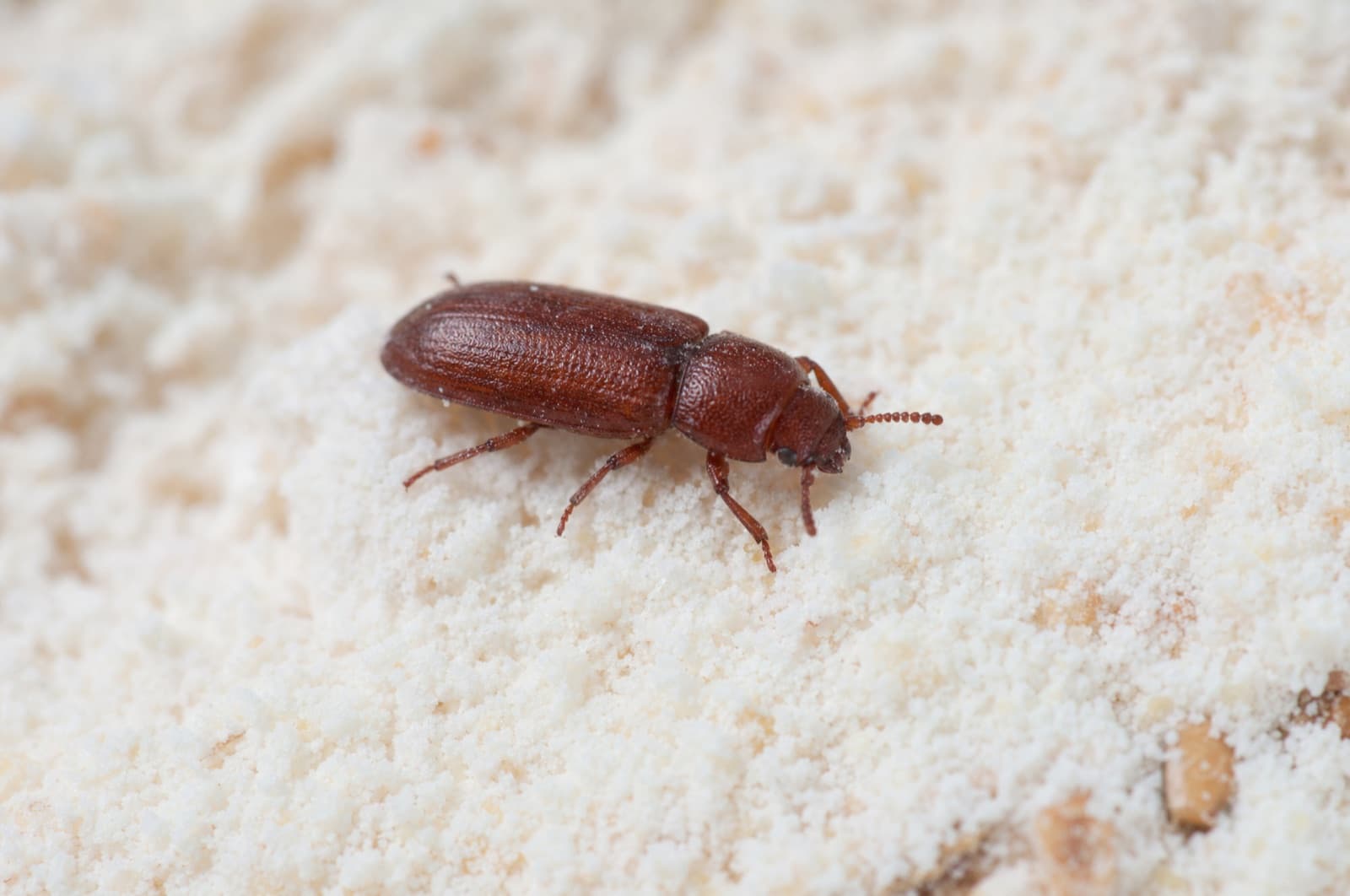
How to Get Rid of Flour Beetles
At a glance
- Difficulty: Beginner
- Time: A few hours to inspect and deep-clean pantry shelves; ongoing airtight storage habit
- Cost: Low — airtight containers and a vacuum
- Success: High once the source is found and shelf seams are cleaned; low if flour dust residue in cracks is left behind
Can you DIY Flour Beetle?
The verdict on Flour Beetle DIY
A beginner-friendly DIY — the fix is finding and discarding contaminated milled goods, not spraying.
The red flour beetle (Tribolium castaneum) and confused flour beetle (T. confusum) are near-identical in habits, and in New Hampshire the confused flour beetle is the one you're more likely to encounter, since it predominates in northern climates. Both attack only damaged or already-milled grain products — flour, cereal, dried fruit, spices, chocolate, pet food, dried flowers — not whole, sound kernels. Because the infestation lives in the food, sanitation solves it: find and discard the contaminated item, clean flour dust from shelf seams, and store dry goods airtight.
The 5 DIY methods — honestly graded
Every approach graded for this species, in IPM order — prevention first, chemistry late. Pick a method to see how it works, the steps, and what it actually takes.
Prevention / Exclusion
Works wellAirtight storage and shelf-seam cleaning together close both entry points: new introductions and dust-reservoir survivors.
Flour beetles need already-damaged or milled grain to attack, and can persist in flour dust accumulated in cabinet cracks even after the original bag is gone. Rigid storage plus dust removal closes both.
Best for: Stopping introductions and dust-reservoir survivors
Buy smaller quantities and rotate stock
Purchase milled grain products in amounts you'll use up within a few months, and use older stock first.
TipBulk-bin flour and cereal are common sources — inspect before buying if possible.Switch to airtight rigid containers
Store flour, cereal, spices, dried fruit, and pet food in glass or hard-plastic containers with tight lids.
Clean flour dust from shelf seams
Vacuum and wipe cabinet cracks and shelf corners where flour dust accumulates — this dust alone can sustain a hidden population.
CautionSkipping this step is the most common reason flour beetles "come back" after a pantry clean-out.
Tools & materials
Why DIY falls short here
Not scare tactics — the specific, proportionate reasons a home attempt can stall for this species.
Flour-dust reservoirs
Accumulated flour dust in cabinet cracks and shelf seams can sustain a population even after you discard the obvious infested bag, so people who only remove the bag see the problem return.
Multiple infested items overlooked
Cereal, spices, dried fruit, chocolate, and pet food can all host flour beetles, so checking only the flour canister misses other sources.
Slow-building populations
Sightings often lag behind the original infestation, so by the time you notice beetles, the population has had time to spread to dust reservoirs and other packages.
How risky is it, really?
An honest read — most nuisance species are genuinely low risk, and we say so.
Flour beetles are a nuisance/contamination pest — no bite, sting, or disease. The only real harm is spoiled milled goods, and they only attack already-damaged or milled product, not whole sound kernels.
- Contamination of flour, cereal, and other milled goodsCommon
The main real-world harm — discard contaminated items or clean out dust reservoirs
NC State Extension
- Health or property harm to people or petsRare
No bite, sting, or disease association
University of Minnesota Extension
Flour Beetles Won't Go Away?
A recurring infestation usually means a dust reservoir or unfound source. Anchor Pest Services offers inspection and sanitation guidance across southern and central New Hampshire. Family-owned since 2017, NH license #782664.
Call a pro when…
- Beetles reappear weeks after a thorough shelf clean-out
- You suspect flour dust reservoirs deep in cabinet joints you can't fully access
- You want a professional inspection to rule out a broader stored-product issue
General Pest Control
You almost never need a pro for flour beetles — this is a find-and-clean job. The exception is dust-reservoir infestations that keep resurfacing despite a real clean-out.
Keep them out
- Store flour, cereal, and other milled goods airtight
- Buy smaller quantities and rotate stock
- Clean flour dust from shelf seams regularly
Flour beetles in New Hampshire
UNH Cooperative Extension's Kitchen Pests fact sheet names the confused flour beetle specifically among New Hampshire's stored-product kitchen pests — fitting, since this species predominates in northern climates while the near-identical red flour beetle dominates warmer southern states. Either way, the two are graded and controlled identically here. As UNH's guidance implies, there's no seasonal frost trigger: heated NH homes let them persist year-round, so inspection and airtight storage matter in every season.
Peak season
Year-round indoors — no seasonal die-off
Make sure it's a Flour Beetle
Two quick detours worth taking — confirm the ID, then learn what drew it in so it doesn't come back.
Frequently asked
Sources & further reading(3)
- [1]NC State Extension — Common Pantry Pests and Their Management
Damaged/milled grain diet, sanitation control, red vs. confused distribution
extensionverified 2026-07-13 - [2]University of Minnesota Extension — Pantry Pests: Insects Found in Stored Food
Heat/freeze treatment, airtight storage guidance
extensionverified 2026-07-13 - [3]UNH Cooperative Extension — Kitchen Pests [fact sheet]
Confused flour beetle listed among New Hampshire kitchen stored-product pests; sanitation-based control
extensionverified 2026-07-22
Written & reviewed by
VerifiedDaniel Brady
NH-Licensed Pesticide Applicator · License #782664 (NHDAMF, RSA 430)
Daniel Brady is the New Hampshire–licensed applicator behind Anchor Pest Services, a family-owned pest control company serving the Manchester area since 2017.
Last updated July 2026
Other species you can tackle
Same category — the dot shows each one's DIY verdict at a glance (green = friendly, amber = doable with care, red = call a pro).
Professional Pest Control
Flour Beetles Won't Go Away?
A recurring infestation usually means a dust reservoir or unfound source. Anchor Pest Services offers inspection and sanitation guidance across southern and central New Hampshire. Family-owned since 2017, NH license #782664.
- Source-tracing inspection
- NH-licensed applicators (#782664)
- Free inspection — same-day service across southern NH
NH License #782664 · No obligation · We answer in person
Your next step
- What to do next
Flour Beetles in New Hampshire: Why Your Flour Smells Off & Control
Read the answer - What to do next
Can beetles damage wood, grain, or stored goods?
Read the answer - Also relevant
Chemical Pantry Beetle Control: Why You Shouldn't Spray
Read the answer - Also relevant
Natural Pantry Beetle Control: What Actually Works in NH
Read the answer