
Flour Beetles in New Hampshire: Why Your Flour Smells Off & Control
Also called Bran bug · Flour weevil (a misnomer — not a weevil)
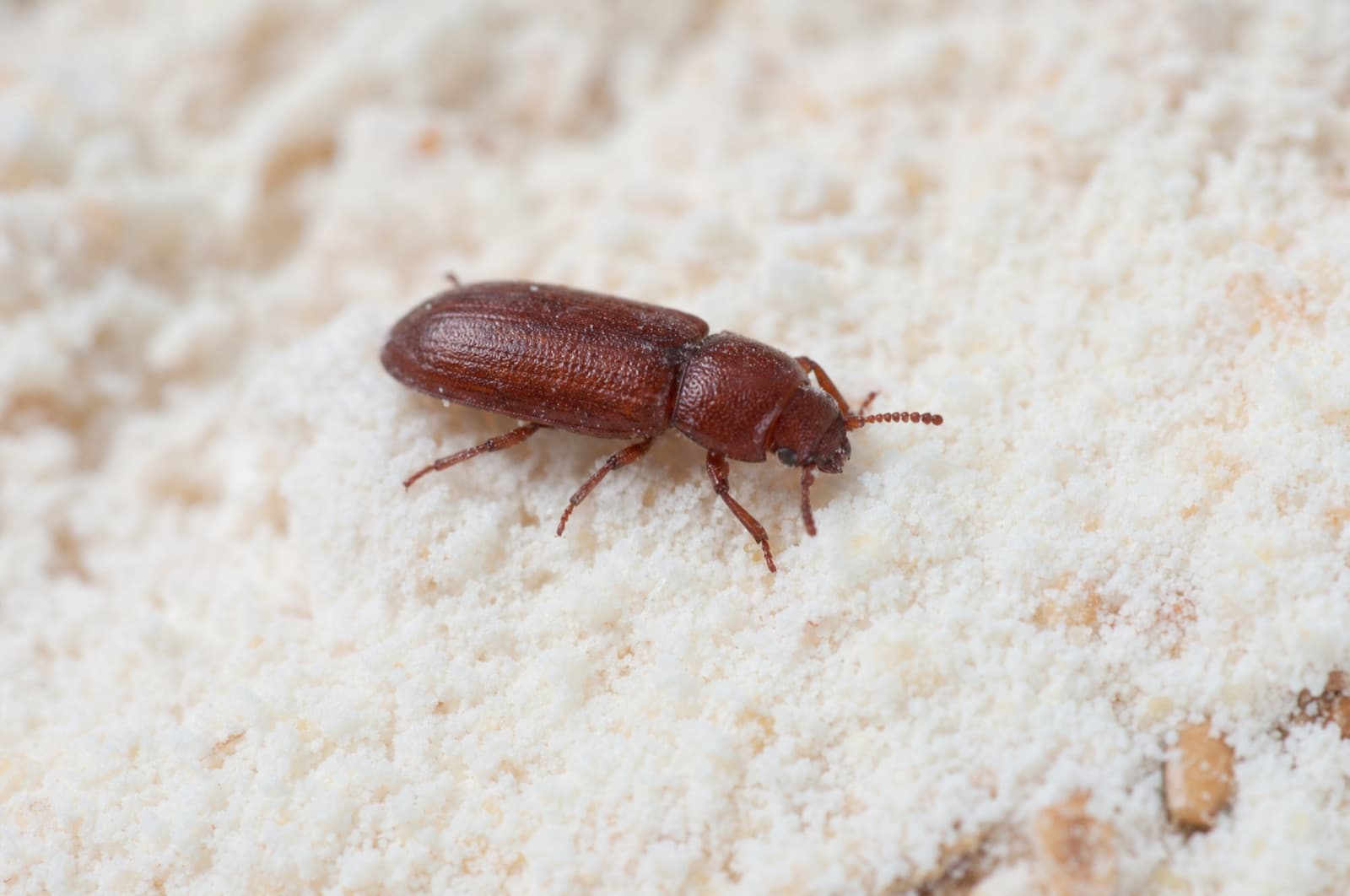
Red and confused flour beetles are the small reddish-brown beetles most often found in opened flour, cereal, and baking mixes. They can't chew whole grain — they feed on milled, broken, or already-damaged product — and they don't bite or harm your home. When crowded, they secrete benzoquinones that taint flour with a sharp odor and a pinkish tinge. Discard infested flour, clean cabinet cracks, and store all milled grain airtight.
- Adult size
- ~3–4 mm (about 1/8 inch), flattened, reddish-brown
- University of Florida IFAS; Penn State Extension
- Two species
- Red flour beetle (Tribolium castaneum) vs. confused flour beetle (T. confusum); antennal club distinguishes them
- University of Florida IFAS
- Flight
- Red flour beetle can fly; confused flour beetle cannot
- University of Florida IFAS
- Diet
- Milled/broken grain and 'fines' — NOT intact whole kernels
- Penn State Extension
- Pink flour / off odor
- Crowded beetles secrete benzoquinones that taint flour with a sharp odor and pinkish cast
- Penn State Extension; IPM World/UMN
- Biting or structural damage
- None — not a weevil, no snout, does not bite or harm the home
- UF IFAS; standard extension guidance
The 'weevils' in your flour — and why they're not weevils
If you've ever found small reddish-brown beetles in a bag of flour or a box of cereal, you've met one of two flour beetles — the red flour beetle (Tribolium castaneum) or its near-twin, the confused flour beetle (Tribolium confusum). UNH Cooperative Extension lists the confused flour beetle as one of the most common pantry pests in New Hampshire kitchens, particularly because it tolerates cooler conditions better than its red cousin.
Two things make these beetles stand out from other pantry pests. First, they can't attack whole, undamaged grain — they feed on milled products, broken kernels, and the fine dusty 'fines' that accumulate in cabinet cracks. So the hunt always starts with flour, cereal, and baking mixes, not rice or whole-grain bins. Second, when crowded, they release defensive benzoquinone compounds that give infested flour a distinctly sharp, chemical odor and a faint pinkish cast — a uniquely diagnostic sign people often mistake for mold.
These are not weevils. True weevils have a long snout (rostrum) for boring into whole grain; flour beetles are flat, elongate darkling beetles with no snout. The fix for either is the same: discard the source, vacuum cabinet cracks, and store milled grain airtight.
How to identify flour beetles — and separate them from weevils and sawtoothed grain beetles
Flour beetles are small (3–4 mm), flat, and uniformly reddish-brown — no snout, no thoracic teeth, no hump. The two species are separated by the antennal club: red flour beetle has an abrupt 3-segmented club; confused flour beetle has a gradual 4-segmented club (and can't fly). Under magnification both are unmistakably flat and elongate compared to the humpbacked cigarette and drugstore beetles or the toothed sawtoothed grain beetle.
Flour beetle (red and confused)
- Scientific name
- Tribolium castaneum (red flour beetle); Tribolium confusum (confused flour beetle)
- Family
- Tenebrionidae
- Size
- ~3–4 mm (about 1/8 inch)
- Coloration
- Uniform rust-red to reddish-brown; flattened
- Habitat
- Flour, cereal, baking mixes; cabinet cracks and spilled-food debris
- Active season
- Year-round in heated NH homes
- Diet
- Milled grain products — flour, cereal, baking mixes, broken kernels; also spices, dried fruit, and chocolate
- Reproduction
- Multiple (approximately 4–5) generations per year possible in warm homes
- Lifespan
- Adults long-lived, sometimes over three years
Worldwide in heated environments; confused flour beetle tolerates cooler climates and is especially common in NH (UNH Extension)
The tells — key ID features
- Small, flattened, uniformly reddish-brown body ~3–4 mm — no hump, no thoracic teeth, no snout.
- Found in or near milled grain — flour, cake mix, cereal, baking powder.
- Antennal club shape separates the two species: abrupt 3-segment (red) vs. gradual 4-segment (confused).
- Red flour beetle can fly; confused flour beetle is flightless.
- Sharp, pungent odor plus a pinkish discoloration of flour when population is high.
- Tiny, slender, creamy-white larvae with two dark points at the tail end.
Size, to scale
3–4 mm
About the size of a short grain of rice or a sesame seed
Sawtoothed grain beetle
How to tell — Similar size but clearly flat with six distinct 'teeth' on each side of the thorax; flour beetles are plain-edged with no thoracic projections.
Cigarette and drugstore beetles
How to tell — Those are humpbacked and oval; flour beetles are flat and elongate — a very different silhouette in profile.
Rice or granary weevil
How to tell — Weevils have a prominent elongated snout (rostrum); flour beetles are flat and snout-free. Weevils also attack whole undamaged grain; flour beetles cannot.
Signs of a problem
Flour beetles often reveal themselves through a characteristic combination of signs — use the quinone chemistry as the decisive early warning.
Small reddish beetles in opened flour or cereal containers
What it means — An active source package — the one you found them in, plus any others that shared the same shelf.
A sharp, 'off' or chemical odor in stored flour
What it means — Benzoquinone secretions from crowded beetles — a diagnostic sign that flour is infested even before you see beetles.
A pinkish or faintly discolored cast to heavily infested flour
What it means — Large beetle population; the flour is contaminated beyond salvage — discard it.
Beetles in cabinet cracks and spilled-food debris
What it means — A debris reservoir of 'fines' in cracks is sustaining the population even after visible packages are removed.
Red flour beetles flying near windows
What it means — Dispersal from a source — red flour beetles can fly and will move to new packages; the confused species cannot fly.
Clumped or 'dusty' cereal or pancake mix
What it means — Larval feeding and frass have bound the product into clumps — discard it.
The real risks, calibrated
Flour beetles are a food-loss pest — not a health threat. The benzoquinone chemistry creates a uniquely distinctive set of signs, but the remedy is straightforward.
Food contamination and spoilage
ModerateOnset: Ongoing while infested package remains
Quinones impart a foul taste and chemical odor and can promote mold growth in infested flour — product is unusable and must be discarded.
Pinkish, tainted flour
ModerateOnset: With large populations
Heavily infested flour becomes noticeably discolored; any flour with this sign should be discarded without attempting to sift or bake with it.
Spread to neighboring packages
ModerateOnset: Within weeks of an unresolved source
One infested container colonizes adjacent bags and boxes of milled grain on the same shelf.
Possible mold issues if eaten
Low riskOnset: With heavily contaminated product
The quinone-promoted mold in heavily infested flour poses additional risk; do not bake with questionable flour.
Biting, stinging, or disease
Low riskOnset: N/A
None — flour beetles do not bite or sting people or pets and do not damage structural materials.
DIY — what works, what backfires
Flour-beetle control is source removal plus sanitation of the 'fines' in cabinet cracks — the hidden reservoir most people miss.
What actually works
- Discard all infested flour, cereal, baking mixes, and any other milled grain product that shows beetles, larvae, off-odor, or discoloration — seal in a bag and remove from the house.
- Vacuum and wash cabinet cracks, corners, and spilled-food debris where 'fines' collect, particularly the back and bottom corners and shelf edges.
- Store all milled grain products in airtight glass, metal, or hard rigid plastic containers.
- Freeze or heat-treat any milled product you want to salvage before the infestation was noticed: 0°F for four days or 130°F for 30 minutes.
- Clean behind and under appliances — spilled flour in these areas is a hidden reservoir.
- Don't combine old flour with new; if you've had beetles, start fresh.
What backfires
- Don't spray insecticide on food, food-preparation surfaces, or inside pantry shelving.
- Don't ignore spilled flour in cabinet cracks — even tiny amounts of 'fines' can sustain a population after you've removed all visible packages.
- Don't bake with flour that smells off or has a pinkish cast — the quinone contamination and possible mold make it unfit for consumption.
Flour beetles in New Hampshire kitchens
The confused flour beetle is one of the most common pantry pests UNH Cooperative Extension identifies for New Hampshire homes — and it tolerates NH's cooler indoor conditions better than the red species. Both breed year-round in heated homes, completing multiple generations even through the long NH winter. The UNH salvage standard applies: heat suspect milled grain at 130°F for 30 minutes or freeze at 0°F for four days, then repackage airtight. Don't combine old and new flour — a very common way to reintroduce flour beetles.
Peak season
Year-round in heated NH homes; no outdoor population survives NH winters
You might actually have
- Sawtoothed grain beetle (flat with six thoracic 'teeth'; also common in NH per UNH Extension — NH's #1 kitchen pest overall)
- Indian meal moth (silk webbing in grain, not beetles; moths visible at dusk)
We serve these communities
- NH-licensed applicator · #782664
- Same-day service
- Family-owned since 2017
Service Area Map
Southern New Hampshire
When to call a pro for flour beetles
If beetles persist after discarding infested products and deep-cleaning the cabinet, accumulated fines in inaccessible cracks or behind appliances are sustaining them. A licensed technician can locate and treat these harborage points. Anchor Pest Services (NH #782664, F1) offers General Pest Control with a free quote and same-day service.
When to call a pro
- Beetles persist more than three weeks after discarding all suspected flour/cereal and cleaning the shelves.
- Beetles keep appearing in cracks and crevices despite repeated vacuuming.
- You're finding beetles in multiple cabinets or rooms simultaneously.
- A recurring infestation suggests a structural harborage (deep cabinet cracks, behind built-ins) that requires professional treatment.
Airtight containers for all milled grain
Transfer flour, cereal, cake mixes, and other milled grain to airtight glass or metal containers immediately after purchase. Original paper or soft-plastic packaging is inadequate.
Wipe up flour spills in cracks
The fine flour dust that accumulates in cabinet cracks and corners is the hidden reservoir that sustains beetles after you remove visible infested packages. Regular cleaning of these areas is essential.
Rotate and date baking supplies
Keep 2–4 months of milled grain on hand. Dating packages when purchased and using oldest stock first reduces the chance of forgotten infested goods. NH's long winters make this especially relevant — baking supplies can sit untouched for months.
Not sure it's a flour beetle (red and confused)?
A licensed NH technician can confirm the species and tell you honestly whether it's a DIY fix or a job for a pro — free inspection, same-day service across Southern New Hampshire.
Frequently asked questions
Sources(7)
- [1]University of Florida IFAS — Red and Confused Flour Beetles (IN566)
size, two species, antennal club, flight differences, diet on milled grain
extensionverified 2026-06-30 - [2]Penn State Extension — Confused and Red Flour Beetle
quinone odor and pink tinge, diet on fines not whole grain
extensionverified 2026-06-30 - [3]IPM World/UMN — Red Flour Beetle and Confused Flour Beetle
quinone chemistry, pinkish flour sign
academicverified 2026-06-30 - [4]
- [5]The Pied Piper — Flour Beetles
no bite/sting/disease, structural damage absent
industryverified 2026-06-30 - [6]UNH Cooperative Extension — Kitchen Pests Fact Sheet
NH presence of confused flour beetle, salvage standard
extensionverified 2026-06-30 - [7]
Written & reviewed by
VerifiedDaniel Brady
NH-Licensed Pesticide Applicator · License #782664 (NHDAMF, RSA 430)
Daniel Brady is the New Hampshire–licensed applicator behind Anchor Pest Services, a family-owned pest control company serving the Manchester area since 2017.
Last updated 2026-06-30

New Hampshire pest control
Dealing with flour beetle (red and confused)s in your home?
Anchor Pest Services identifies and handles flour beetle (red and confused) problems across southern and central New Hampshire. Family-owned since 2017, NH license #782664.
- NH-licensed applicators (#782664)
- Same-day service · free inspection
- Family-owned since 2017
Your next step
- What to do next
How to Get Rid of Flour Beetles
Read the answer - What to do next
Chemical Pantry Beetle Control: Why You Shouldn't Spray
Read the answer - What to do next
Natural Pantry Beetle Control: What Actually Works in NH
Read the answer - Related guide
Sawtoothed Grain Beetle: New Hampshire's #1 Kitchen Pest
Read the answer - Related guide
Drugstore Beetles in New Hampshire: Signs, Hidden Sources & Control
Read the answer