
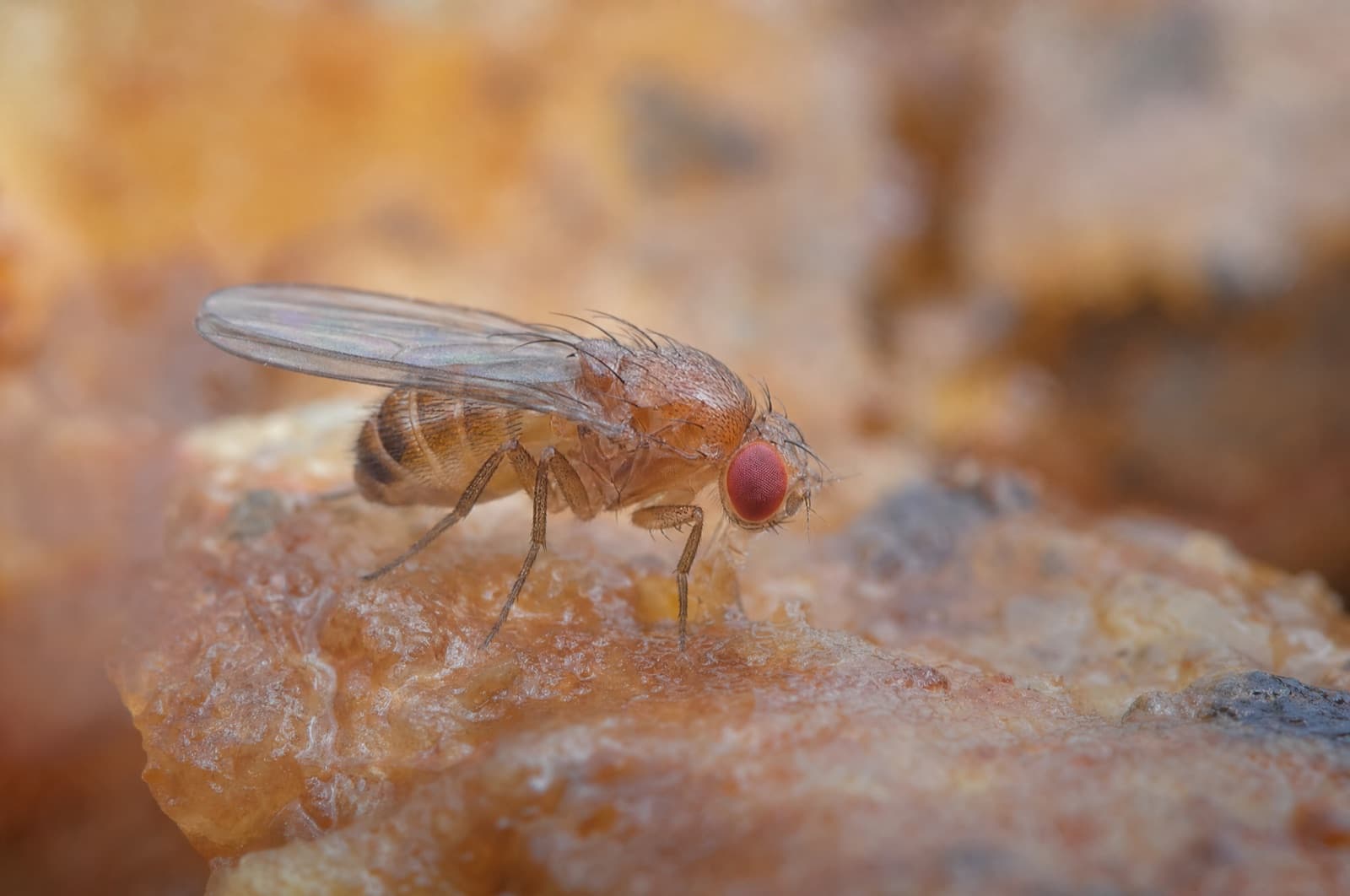
What Attracts Fruit Flies to Your House?
At a glance
- Short answer: Fruit flies aren't after fruit so much as the yeast fermenting on it — that fermentation smell is the real magnet.
- The verdict: Something specific
The attractant verdict
Four possible answers to why this species turned up. Three stay unlit — and that's the argument: the honest answer could have been any of them, and for this species it wasn't.
Fruit flies aren't after fruit so much as the yeast fermenting on it — that fermentation smell is the real magnet.
Most advice, including our own previous page, says fruit flies are drawn "mainly by the presence of ripe or decaying fruits and vegetables," which points at the right object but the wrong cue. The fruit isn't really the attractant — what's growing on it is.
The common vinegar fly (Drosophila melanogaster) is drawn to overripe and fermenting fruit for feeding, mating, and egg-laying, but peer-reviewed research shows the attraction is driven largely by volatile compounds released by yeast fermenting on the fruit's surface, not by the fruit itself. Yeast also supports larval development directly. That's why fruit flies show up just as reliably around fermenting residue in a drain, a used mop, a recycling bin with sticky residue, or a nearly empty wine or juice bottle as they do around fruit on a counter — anywhere yeast is actively fermenting sugars.
“Fruit flies aren't after fruit so much as the yeast fermenting on it — that fermentation smell is the real magnet.”
Volatile compounds released by yeast fermenting sugars — on overripe fruit, but equally in a drain, a recycling bin, a mop, or the residue in an empty bottle.
It explains why removing fruit from a counter sometimes doesn't solve the problem: the actual source can be a fermenting residue somewhere else entirely, and finding it requires thinking about yeast and fermentation rather than fruit specifically.
Calibrated from: Peer-reviewed chemical-ecology research (Functional Ecology, Wiley; Journal of Pest Science, Springer): Drosophila attraction is mediated largely by yeast volatiles released during fermentation, and yeast supports larval development.
Why it's here, in full
Why removing the fruit bowl doesn't always work
The common fruit fly's attraction is more precise than "ripe fruit" suggests, and that precision explains a familiar frustration: fruit flies that persist after every piece of fruit has been thrown out or refrigerated. Peer-reviewed research published in the Functional Ecology shows that Drosophila attraction to fermenting fruit is driven largely by volatile compounds released by yeast during fermentation, rather than by the fruit's own odor, and a related study in the Journal of Pest Science confirms yeast also supports larval development directly.
That means the real cue is fermenting sugar with active yeast, which shows up in plenty of places besides a fruit bowl: a kitchen drain with a thin coating of organic residue, a garbage disposal that isn't run often enough, a recycling bin that held sugary drinks, a used mop left damp, or the last inch of liquid in a wine or juice bottle. Any of those can sustain a fruit fly population on its own, which is why the problem sometimes seems to have no obvious food source once the counter is clear — the source was never really the fruit, it was the fermentation happening on or near it.
How to tell it's actually this species
Real signs only — a species with four honest tells gets four, and stops. Where a sign is weak on its own, we say so.
Tiny flies, about an eighth of an inch, with a noticeably tan or reddish body, hovering persistently around a specific spot rather than the whole kitchen
A faint fermented or vinegary smell near a drain, garbage disposal, or recycling bin
Small larvae or pupal casings visible near a drain opening or in residue at the bottom of a bin
Flies persisting after all visible fruit has been removed or refrigerated
Want fruit fly gone?
This page only answers why it's here. Every removal step for this exact species — what to seal, what to set, what actually works — lives on its own dedicated guide.
Two questions, two pages
Here: why it turned up at all — the honest answer, blame removed.
There: the step-by-step removal guide for this exact species.
Key takeaways
- Fruit flies respond mainly to yeast fermentation volatiles, not to fruit odor itself.
- Drains, recycling bins, mops, and empty bottles can all sustain a population.
- A problem that persists after fruit is removed usually means the fermenting source is elsewhere.
- Removal and trap options are covered at /top-diy-methods/fruit-fly.
No fruit around, but still seeing them?
This page is about why fruit flies show up. Finding the fermenting source and removal steps are covered at /top-diy-methods/fruit-fly.
Frequently asked
Sources(2)
- [1]Functional Ecology (Wiley) — Yeast volatiles and Drosophila attraction
Fruit fly attraction to fermenting fruit is mediated largely by yeast volatile compounds
academicverified 2026-07-17 - [2]Journal of Pest Science (Springer) — Yeast and Drosophila larval development
Yeast supports fruit fly larval development in fermenting substrates
academicverified 2026-07-17
Written & reviewed by
VerifiedDaniel Brady
NH-Licensed Pesticide Applicator · License #782664 (NHDAMF, RSA 430)
Daniel Brady is the New Hampshire–licensed applicator behind Anchor Pest Services, a family-owned pest control company serving the Manchester area since 2017.
Last updated Jul 2026
It's the ferment, not the fruit
We trace fruit fly problems to the actual source
Inspections across southern and central New Hampshire that look past the fruit bowl for the real fermentation source.
- Family-owned in Manchester since 2017
- NH commercial applicator #782664, category F1
- We will tell you when the answer is do nothing
NH License #782664 · No obligation · We answer in person