
Fruit Flies in New Hampshire — ID, Where They Come From & Control
Also called Vinegar fly · Pomace fly · Drosophila
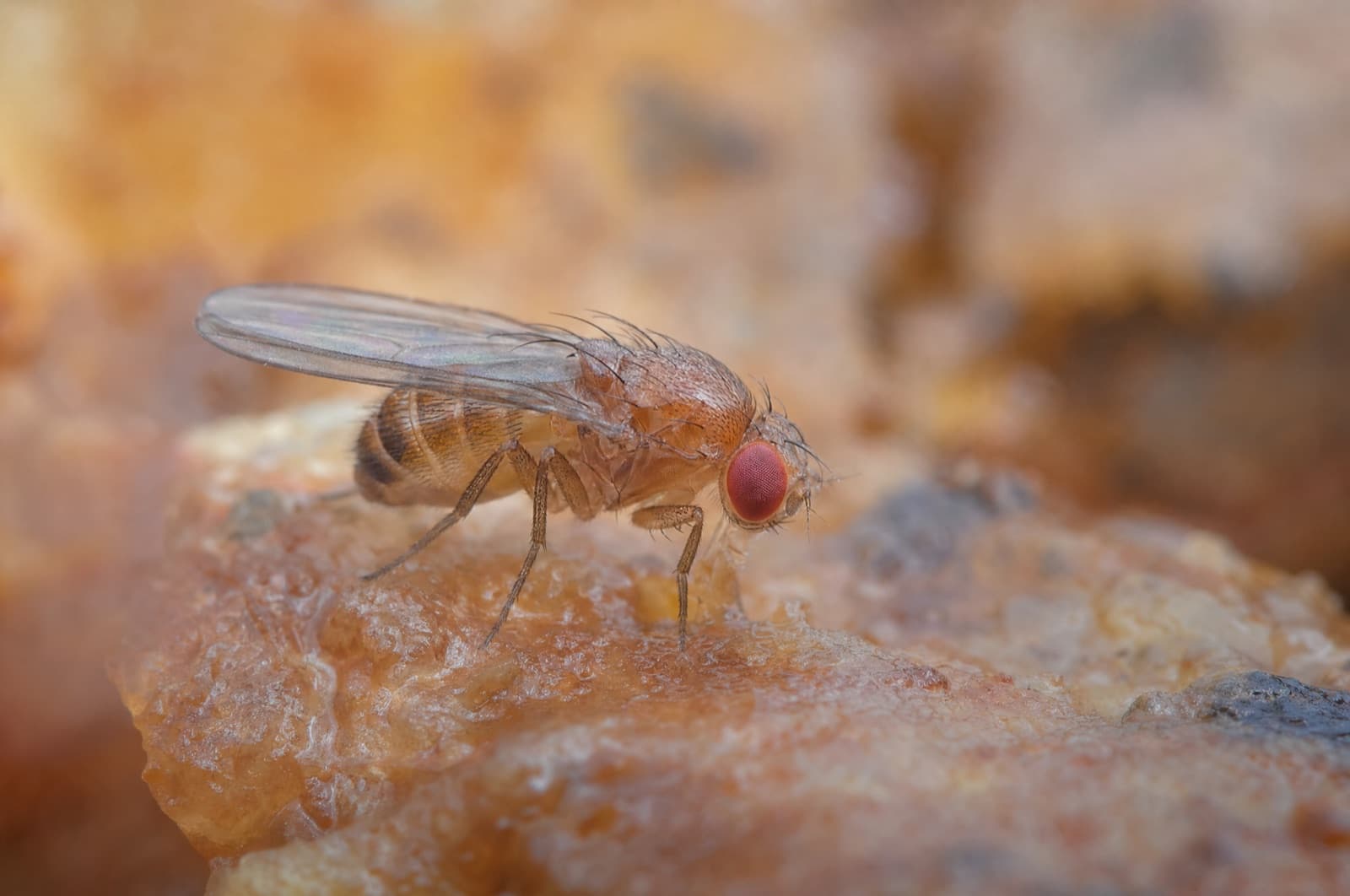
Fruit flies (Drosophila melanogaster) are ~1/8-inch tan/brown flies with red eyes that hover around fermenting produce, spills, recycling, and drains. They do not appear spontaneously — they find fermenting sugars by odor. The lasting fix is sanitation and source removal; UNH Extension stresses that trapping is 'nowhere near as effective' as cleaning up the fermenting source.
- Species
- Drosophila melanogaster
- family Drosophilidae; also called vinegar fly or pomace fly
- Size
- ~1/8 in (~3 mm)
- UNH Extension
- Best tell
- Red eyes; tan body; hovers at fruit or fermenting liquids
- UNH Extension
- Breeds in
- Fermenting produce, spills, drains, recycling, compost
- UNH Extension
- Eggs
- Up to ~2,000 on moist fermenting material
- UNH Extension
- Cycle
- 1–2 weeks
- UNH Extension; ~8–10 days at 25°C (Arizona State)
Fruit flies don't appear from nowhere — they find your fermenting food by smell
Fruit flies (Drosophila melanogaster, family Drosophilidae) are the small hovering flies people first notice around overripe fruit, spilled juice, open recycling bins, or compost. UNH Extension notes they 'locate food by its odor' — they are not spontaneously generating in your kitchen; they are following a scent trail from fermenting sugars.
The sources are broader than most people realize. Yes, overripe bananas and open wine bottles attract them. But UNH Extension specifically identifies organic slime inside drain traps, compost buckets, and wet mops as equally viable indoor breeding sites. This explains a common mystery: fruit flies at the kitchen sink in January with no fruit out at all. The breeding source is the drain, not the counter.
That changes the control approach entirely. Vinegar traps catch adults, but UNH Extension stresses that trapping is 'nowhere near as effective' as sanitation. Remove or refrigerate overripe produce, clean spills and drains, rinse recyclables, and empty compost buckets. The fruit fly population collapses without its fermenting substrate. Traps are a supplement — never the primary control.
How to identify a fruit fly
Three features identify a fruit fly: red eyes, tan/brown body, and hovering behavior around fermenting food or liquids. The red eyes are visible to the naked eye in good light and distinguish fruit flies from fungus gnats (dark body, no red eyes, near plants) and phorid flies (humped, scuttles). The small-fly decoder in one line: hovers at fruit + red eyes = fruit fly.
Fruit fly
- Scientific name
- Drosophila melanogaster
- Family
- Drosophilidae
- Size
- ~1/8 in (~3 mm)
- Coloration
- Tan/brown body; bright red eyes in most common species; transversely striped abdomen
- Habitat
- Fermenting produce, spills, recycling bins, compost, organic slime in drains.
- Active season
- Late summer through fall outdoors; year-round indoors near a fermenting source
- Diet
- Larvae feed on yeasts growing on fermenting organic material; adults feed on the same.
- Reproduction
- Female lays up to ~2,000 eggs on moist fermenting material (UNH Extension); two breaks in the leading wing edge near the body.
- Lifespan
- Cycle approximately 1–2 weeks (UNH Extension); ~8–10 days at 25°C.
Cosmopolitan — found throughout New Hampshire and worldwide; peaks outdoors in late summer, breeds indoors year-round near a source.
The tells — key ID features
- Bright red eyes (in most common species) — the quickest tell from a few inches away.
- Tan or light-brown body; smooth (not fuzzy).
- Hovers around fruit, fermenting liquids, spills, and recycling — not scuttling, not sitting on walls.
- ~1/8 inch; smooth appearance distinguishes it from the fuzzy drain fly.
- Two breaks in the leading wing edge near the body (visible under magnification).
Size, to scale
~1/8 in (~3 mm)
About the size of a pinhead with wings — smaller than a sesame seed
Fungus gnat
How to tell — Fungus gnats are dark brown/black, not tan; have long legs and long antennae; and are found near overwatered houseplant soil, not near food or fruit. No red eyes. This is the most common mix-up. If the tiny dark fly is near your plants, it is a fungus gnat; if it is hovering at the fruit bowl with a tan body and red eyes, it is a fruit fly.
Phorid fly
How to tell — Phorid flies have a humped thorax in side profile and run/scuttle across surfaces rather than hovering. No red eyes. Both can use drain biofilm as a breeding source, but phorids do not hover at fruit and have the distinctive hump.
Drain fly
How to tell — Drain flies are fuzzy with broad moth-like wings held tent-like, and sit motionless on walls near drains. Completely different appearance from the smooth, hovering fruit fly.
Signs of a problem
Fruit flies are a sanitation indicator. Where they concentrate tells you exactly what the fermenting source is. These are the signs and what each one means.
Tiny tan flies hovering over a fruit bowl, recycling bin, or open compost
What it means — Fermenting source right there — that specific item or container is the breeding site or at minimum the attractant.
Fruit flies at the kitchen sink in winter with no fruit out
What it means — Breeding in the drain trap — UNH Extension specifically identifies organic slime inside drains as a fruit fly source; clean the drain, not the counter.
A cloud of tiny flies rising from the trash can or compost bucket when you move it
What it means — That container is actively breeding them; clean it, rinse it, and move it outside or to a cooler location.
Fruit flies persist after you throw out all the fruit
What it means — The source is not the fruit — check drains, recycling bin residue, spills under the refrigerator or stove, and any container with fermenting residue.
The real risks, calibrated
Fruit flies are primarily a nuisance pest. Their risk is low to moderate and context-dependent.
Nuisance
Low riskOnset: Ongoing while present
Fruit flies are annoying and trigger food anxiety, but in a typical home setting they present low direct health risk.
Bacteria transfer from rot to food
ModerateOnset: In food-handling settings
Peer-reviewed research documents that fruit flies can carry Salmonella, Listeria, and E. coli from rotting matter to food surfaces. This is a moderate concern in food-service settings and a low concern in typical home kitchens.
Health-code concern in food-service settings
ModerateOnset: On inspection
A fruit fly infestation in a NH restaurant or commercial kitchen can trigger health-code violations until the source is corrected.
DIY — what works, what backfires
Fruit fly control is sanitation and source removal — find and eliminate the fermenting substrate. Traps are a supplement, not a solution. Here is what works.
What actually works
- Remove or refrigerate overripe produce immediately — this eliminates the most obvious breeding and feeding source.
- Clean spills thoroughly, especially under and behind the refrigerator, stove, and dishwasher where fermenting residue accumulates.
- Rinse recyclables before placing them in the bin — residue from bottles, cans, and jars is a significant fruit fly source.
- Clean drains: scrub floor and sink drains with a stiff brush and follow with a bacterial or enzyme drain gel — UNH Extension identifies drains as an overlooked fruit fly source.
- Empty and clean compost buckets frequently; keep them covered with a tight-fitting lid.
- Use a cider-vinegar funnel trap (a small glass with vinegar covered in plastic wrap with small holes) as a supplement to catch adults — not as a primary control.
What backfires
- Don't rely on traps as the primary fix — UNH Extension stresses that trapping is 'nowhere near as effective' as sanitation; traps reduce adults but do not address the fermenting breeding source.
- Don't ignore the drain as a possible source — especially in winter when there is no fruit out; a drain with organic buildup can sustain a fruit fly population independently.
- Don't spray aerosol insecticide as a primary control — it kills visible adults but the source keeps producing them.
- Don't expect flies to go away on their own — without removing the fermenting substrate, they will continue to breed as long as the source exists.
Fruit flies in New Hampshire homes
UNH Extension notes that fruit flies appear mid-to-late summer and 'disappear with the arrival of cold weather in fall' outdoors — but they breed indoors year-round in NH homes near a fermentation source. A summer spike in outdoor pressure is followed by year-round indoor populations wherever fermenting food, spills, or drain biofilm gives them a substrate. Manchester and Nashua kitchens with composting setups, recycling bins that go unrinsed, or floor drains with organic buildup can sustain fruit fly populations through the coldest NH winters.
Peak season
Late summer–fall outdoors; year-round indoors near a fermenting source
You might actually have
- Fungus gnats (dark, long-legged, near houseplants — most common mix-up with fruit flies)
- Drain flies (fuzzy, moth-like, on walls near drains — different look entirely)
- Phorid flies (humped back, scuttles — doesn't hover)
We serve these communities
- NH-licensed applicator · #782664
- Same-day service
- Family-owned since 2017
Service Area Map
Southern New Hampshire
When to call a pro for fruit flies
If fruit flies persist despite thorough source removal, the source is hidden — often a drain defect, a leak under an appliance, or a fermentation source you have not found. A licensed technician can locate and address hidden sources.
When to call a pro
- Persistent infestation despite thorough sanitation — the source is hidden and needs professional locating.
- A restaurant or commercial kitchen with a fruit fly problem facing a health inspection.
- A sourceless swarm pointing to a drain defect or subsurface organic accumulation.
- Large-scale infestation in a home with extensive composting, fermentation, or brewing activities.
Refrigerate produce promptly
The single most effective fruit fly prevention measure in NH homes: keep fruit in the refrigerator and do not leave overripe produce on the counter, especially during the late-summer peak season when outdoor pressure is highest.
Weekly drain maintenance
Scrub kitchen and bathroom drains weekly with a stiff brush and use a bacterial or enzyme drain gel monthly to prevent the organic buildup that sustains indoor fruit fly populations year-round.
Rinse recyclables before binning
Rinsing bottles, cans, and juice cartons before placing them in the recycling bin eliminates a significant fruit fly source — fermentation begins within hours of residue sitting in a warm bin.
Not sure it's a fruit fly?
A licensed NH technician can confirm the species and tell you honestly whether it's a DIY fix or a job for a pro — free inspection, same-day service across Southern New Hampshire.
Frequently asked questions
Sources(5)
- [1]UNH Extension — Fruit Flies (Resource000535)
NH size, 2,000 eggs, drains as indoor source, sanitation beats trapping
extensionverified 2026-06-30 - [2]Texas A&M AgriLife Extension — Indoor Flies and Their Control
identification and control overview
extensionverified 2026-06-30 - [3]Arizona State University — Drosophila Development
life cycle ~8–10 days at 25°C
academicverified 2026-06-30 - [4]ScienceDirect — Fruit Flies as Bacterial Vectors
Salmonella, Listeria, E. coli transfer by fruit flies
academicverified 2026-06-30 - [5]UNH Cooperative Extension — Small-Fly Sanitation-First Guidance
NH sanitation-first fly guidance
extensionverified 2026-06-30
Written & reviewed by
VerifiedDaniel Brady
NH-Licensed Pesticide Applicator · License #782664 (NHDAMF, RSA 430)
Daniel Brady is the New Hampshire–licensed applicator behind Anchor Pest Services, a family-owned pest control company serving the Manchester area since 2017.
Last updated 2026-06-30

New Hampshire pest control
Dealing with fruit flys in your home?
Anchor Pest Services identifies and handles fruit fly problems across southern and central New Hampshire. Family-owned since 2017, NH license #782664.
- NH-licensed applicators (#782664)
- Same-day service · free inspection
- Family-owned since 2017
Your next step
- What to do next
How to Get Rid of Fruit Flies
Read the answer - What to do next
How to Use Fruit Fly Trap (T2503) by Terro
Read the answer - What to do next
Where Do Flies Go in the Winter? NH Cluster Fly Timing
Read the answer - What to do next
Where Do Flies Go In The Winter?
Read the answer - What to do next
Chemical Fly Control: A Supplement, Not the Fix
Read the answer