
What Attracts Fungus Gnats to Your House?
At a glance
- Short answer: Fungus gnats are drawn to overwatered potting soil — not your house.
- The verdict: Something specific
The attractant verdict
Four possible answers to why this species turned up. Three stay unlit — and that's the argument: the honest answer could have been any of them, and for this species it wasn't.
Fungus gnats are drawn to overwatered potting soil — not your house.
Our own previous page said fungus gnats are attracted to ‘certain conditions that are often found in homes’ without naming the one condition that actually matters — overwatered soil.
Potting soil that stays consistently moist from overwatering, which supports the fungi and decaying organic matter that fungus gnat larvae actually feed on. Adults are weak fliers that rarely travel far from the pot they emerged from, so a persistent indoor population almost always traces back to one or more overwatered houseplants.
“Fungus gnats don't want your house. They want a houseplant that's been watered a little too generously — everything else follows from that.”
Consistently moist potting soil, which supports the fungi and organic decay that fungus gnat larvae feed on.
It narrows the source to a specific, findable object — an overwatered pot — rather than the house in general, and explains why gnats can be a persistent problem in one room with houseplants while the rest of the house has none.
Calibrated from: UC Statewide IPM Program, Pest Notes 7448, 'Fungus Gnats': larvae 'primarily feed on fungi and organic matter in soil, but also chew roots,' and populations build up in overly moist potting media.
Why it's here, in full
Why an overwatered houseplant is the actual source
Fungus gnat larvae live in the top inch or two of potting soil and feed on fungi and decaying organic matter that builds up when soil is kept too consistently moist, and they'll also chew on fine plant roots when population density is high. Adult gnats are weak, short-range fliers, so a swarm hovering near a window is almost always coming from a pot within a few feet, not migrating in from outside or breeding anywhere else in the house. That's why fungus gnats can be a persistent, specific problem in one room with houseplants while the rest of a home has none at all — the source is a single overwatered container, not the structure.
How to tell it's actually this species
Real signs only — a species with four honest tells gets four, and stops. Where a sign is weak on its own, we say so.
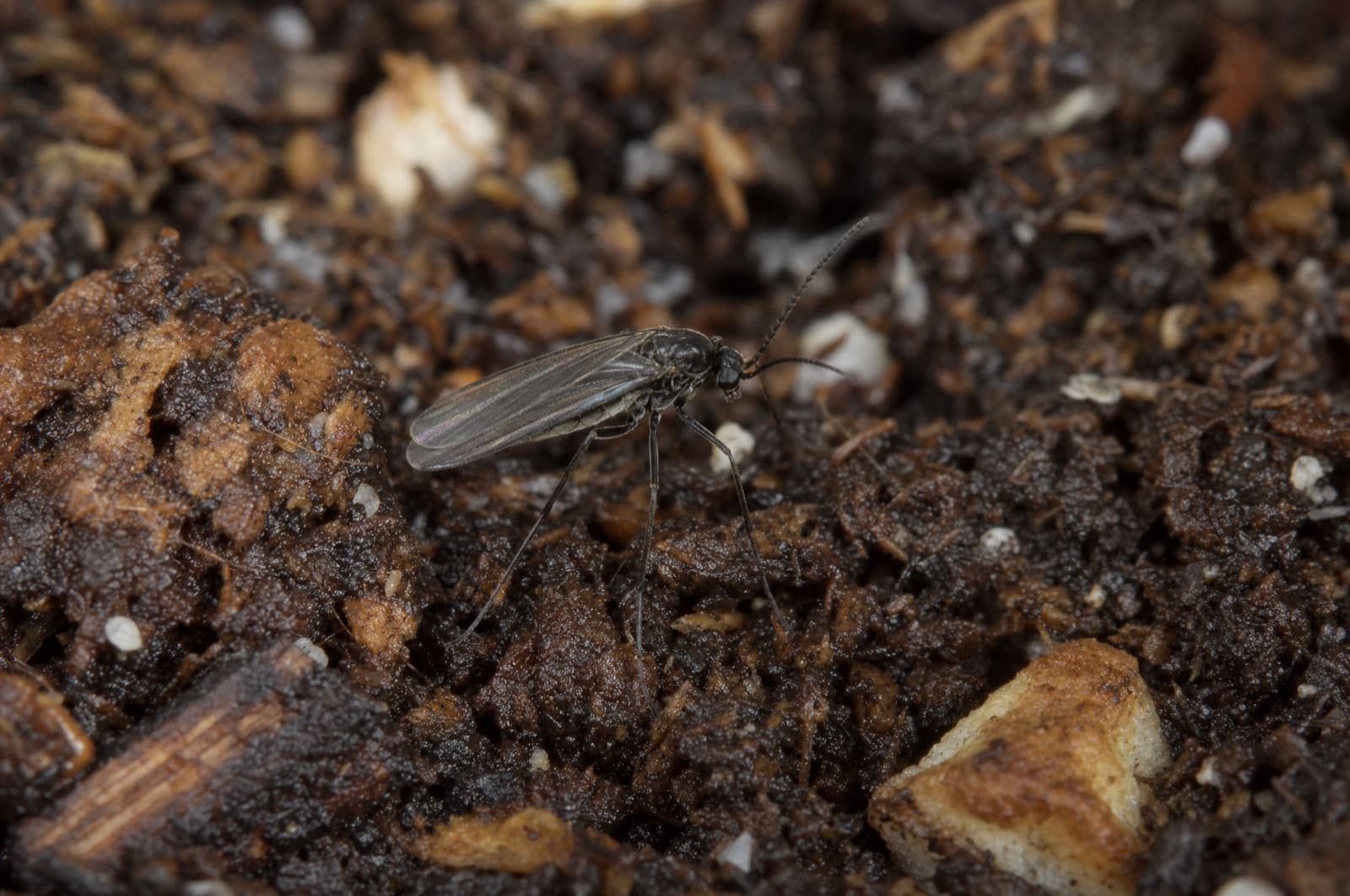
Small, dark, weak-flying gnats hovering near houseplant soil or a nearby window
Visibly soggy or consistently damp potting soil in one or more houseplant containers
Slowed plant growth or root damage in a frequently overwatered pot
Could be something else: Root damage and slow growth can have several causes; finding gnats around the same pot is the stronger confirming clue.
Want fungus gnats gone?
This page only answers why it's here. Every removal step for this exact species — what to seal, what to set, what actually works — lives on its own dedicated guide.
Two questions, two pages
Here: why it turned up at all — the honest answer, blame removed.
There: the step-by-step removal guide for this exact species.
Already dealing with fungus gnat?
This page is about why it's there. Getting rid of it is covered at /top-diy-methods/fungus-gnat.
Frequently asked
Sources(2)
- [1]UC Statewide IPM Program — Fungus Gnats (Pest Notes 7448)
Fungus gnat larvae feed on fungi and organic matter in moist potting soil
extensionverified 2026-07-17 - [2]University of Maryland Extension — Fungus Gnats
Overwatering as the primary cause of indoor fungus gnat populations
extensionverified 2026-07-17
Written & reviewed by
VerifiedDaniel Brady
NH-Licensed Pesticide Applicator · License #782664 (NHDAMF, RSA 430)
Daniel Brady is the New Hampshire–licensed applicator behind Anchor Pest Services, a family-owned pest control company serving the Manchester area since 2017.
Last updated Jul 2026
Food, water, warmth, shelter — the usual four
If it's already inside, we handle the rest
Same-day inspections across southern and central New Hampshire.
- Family-owned in Manchester since 2017
- NH commercial applicator #782664, category F1
- We will tell you when the answer is do nothing
NH License #782664 · No obligation · We answer in person