
Fungus Gnats in New Hampshire — ID, Signs & How to Get Rid of Them
Also called Dark-winged fungus gnat · Houseplant gnat
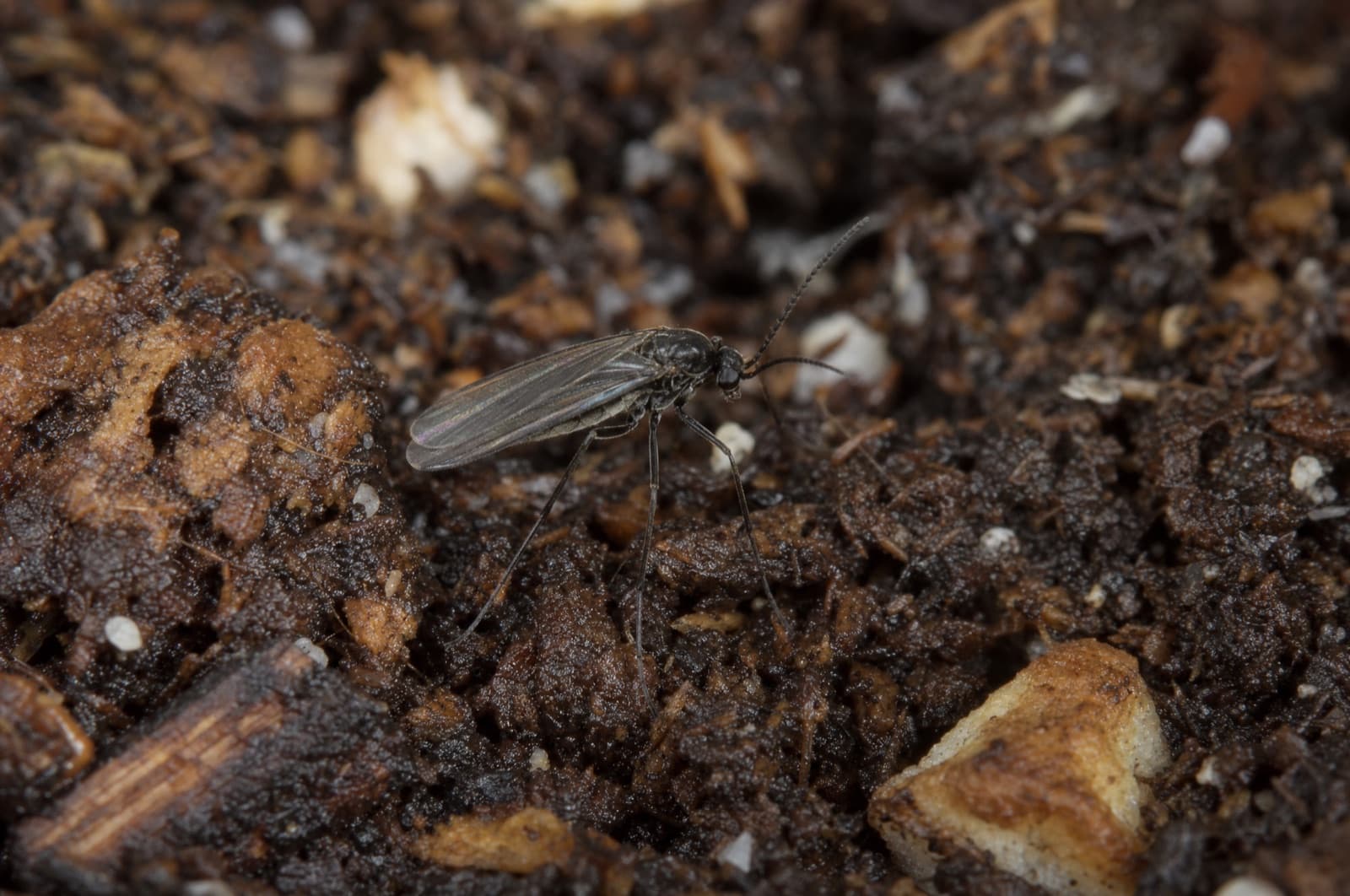
Fungus gnats are dark, delicate, mosquito-like flies with long legs that hover weakly near overwatered houseplants. Their larvae breed in the top 2–3 inches of damp, organic-rich potting soil — not in kitchen drains or food. The fix is drying out the soil: larvae cannot survive dry conditions. Adults are harmless; the only real harm is larval root damage to seedlings.
- Families
- Sciaridae / Mycetophilidae
- dark-winged fungus gnats; Bradysia spp.
- Size
- 1/16–1/8 in (2–4 mm)
- UC IPM
- Best tell
- Delicate, long legs and long antennae; near overwatered houseplants
- the defining habitat clue
- Breeds in
- Damp houseplant/potting soil (top 2–3 in)
- not in kitchen or drains
- Eggs
- Up to ~200
- Colorado State Extension
- Cycle
- ~20 days
- University of Maine Extension
Think you have fruit flies near your plants? These are fungus gnats.
Fungus gnats are the small flies people most often misidentify as fruit flies — and the mistake sends them chasing the wrong solution. Fungus gnats (families Sciaridae and Mycetophilidae, most commonly Bradysia spp.) are dark, delicate, and mosquito-like with long legs and long antennae. They hover weakly near overwatered houseplants, not near fruit or garbage, because that is where their larvae develop: in the top 2–3 inches of damp, organic-rich potting soil.
The larvae feed on fungi, algae, decaying plant matter, and roots. Heavy infestations can damage seedling root systems, but adult fungus gnats are harmless — they do not bite, do not contaminate food the way filth flies do, and pose no human health risk.
The breeding-source-first fix is elegant in its simplicity: let the top 1–2 inches of soil dry out between waterings. Fungus gnat larvae cannot survive dry conditions. No chemical is needed in most cases — reducing soil moisture is both the diagnosis and the cure. Before you do anything else, Colorado State Extension documents an extension-verified method to confirm larvae are actually in the soil: a potato-slice test.
How to identify a fungus gnat
Four features identify a fungus gnat: dark body, long legs with long antennae, weak erratic flight near potted plants, and absence of the red eyes that identify fruit flies. They look like tiny dark mosquitoes hovering near your houseplants — no other common small fly fits that description.
Fungus gnat
- Scientific name
- Family Sciaridae (Bradysia spp.) and Mycetophilidae
- Family
- Sciaridae / Mycetophilidae
- Size
- 1/16–1/8 in (2–4 mm)
- Coloration
- Dark brown to black; delicate build; long dark legs and long antennae
- Habitat
- Damp, organic-rich potting soil; the top 2–3 inches where fungi, algae, and roots are accessible to larvae.
- Active season
- Year-round indoors
- Diet
- Larvae feed on fungi, algae, decaying organic matter, and plant roots; adults feed minimally.
- Reproduction
- Female lays up to ~200 eggs in damp soil (Colorado State Extension); cycle approximately 20 days (University of Maine Extension).
- Lifespan
- Adults live approximately 7–10 days (Colorado State Extension).
Found throughout New Hampshire and worldwide wherever houseplants are grown indoors; a year-round indoor presence.
The tells — key ID features
- Delicate, mosquito-like body with long legs — the signature appearance; nothing else in this cluster looks like this.
- Dark brown/black, 1/16–1/8 inch.
- Long antennae, longer than the head — distinguishes fungus gnats from shore flies.
- Weak, short, erratic flights near potted plants; does not hover over food or scuttle across surfaces.
- A Y-shaped wing vein near the wing tip is visible under magnification (Wisconsin Horticulture Extension).
Size, to scale
1/16–1/8 in (2–4 mm)
A tiny dark mosquito-like speck — roughly the size of a sesame seed or smaller
Fruit fly
How to tell — The most common mix-up. Fruit flies are tan/brown (not dark), have red eyes in most specimens, and hover around fermenting food and liquids — not near potted plants. No red eyes on a fungus gnat. If the tiny dark fly is near your plants, it is a fungus gnat; if it has red eyes and is at the fruit bowl, it is a fruit fly.
Drain fly
How to tell — Drain flies are fuzzy, moth-like, and sit motionless on walls near drains. Fungus gnats are not fuzzy and do not rest on walls; they hover weakly near plant soil.
Phorid fly
How to tell — Phorid flies have a distinctive humped thorax in side profile and scuttle rapidly across surfaces rather than hovering. Both can appear in similar indoor locations, but phorids are tied to decaying organic matter in drains or structural voids, not houseplant soil.
Shore fly
How to tell — Shore flies (Ephydridae) are stouter, have short bristle-like antennae (shorter than the fungus gnat's long antennae), and are more associated with algae on wet surfaces. The long antennae of fungus gnats are the key separator.
Signs of a problem
Fungus gnat signs center on the potted plant — that is where the source is, and that is where the evidence appears.
Tiny dark flies rising from a potted plant when you water it
What it means — Larvae are in that soil — the disturbance of watering dislodges adults and stirs larval activity.
Gnats hovering near windows close to houseplants
What it means — Emerging adults seeking light to exit; trace back to the plant nearest the window.
Wilting or stunted seedlings or houseplants despite adequate water
What it means — Possible larval root feeding — heavy infestations damage root systems, especially of seedlings.
Potato-slice test: larvae visible on a raw potato slice placed in the soil for 1–2 days
What it means — Confirmed larvae in that soil; Colorado State Extension documents this as a reliable extension-verified test.
The real risks, calibrated
Adult fungus gnats are harmless — anti-fearmonger framing applies. The only real concern is larval damage to plant roots.
Nuisance
Low riskOnset: Ongoing while present
Adults do not bite humans or pets, do not contaminate food, and pose no direct human health risk. The annoyance is the primary concern.
Larval root damage to seedlings and houseplants
Low riskOnset: With heavy or persistent infestations
Fungus gnat larvae feed in the top soil layer and can damage fine root hairs and seedling root systems, causing wilting and stunted growth. Most established houseplants tolerate light infestation; seedlings and sensitive plants are more vulnerable.
Soil-borne plant pathogen movement
Low riskOnset: Uncommon
University of Maine Extension notes that larvae can move some soil-borne plant pathogens as they feed. This is a low-probability concern under normal houseplant conditions.
DIY — what works, what backfires
Fungus gnat control is about soil moisture, not sprays. The larvae live in the top 2–3 inches of damp soil — deny them that moisture and the infestation ends. Here is the extension-recommended approach.
What actually works
- Let the top 1–2 inches of potting soil dry out between waterings — fungus gnat larvae cannot survive dry conditions; this single step resolves most infestations without any chemical treatment.
- Confirm larvae with the potato-slice test: press a quarter-inch slice of raw potato into the soil, leave it for 1–2 days, then lift it and inspect the underside for larvae. Colorado State Extension documents this as a reliable confirmation method.
- Use yellow sticky cards placed at soil level near infested pots to capture adult fungus gnats and monitor population levels.
- Apply Bti (Bacillus thuringiensis israelensis) as a soil drench — this naturally occurring bacterial insecticide targets fly larvae in the soil and is safe for humans, pets, and beneficial soil organisms.
- Apply beneficial nematodes (Steinernema feltiae) to the soil as a biological control — they parasitize fungus gnat larvae and are safe for indoor use.
- Use sterile, well-draining potting mix when repotting — high-quality sterile mixes contain fewer fungi and less organic decomposition that larvae feed on.
- Quarantine new plants for 1–2 weeks before placing them near existing plants — fungus gnats often enter homes on plants purchased from nurseries.
What backfires
- Don't overwater — the single most important prevention measure; overwatered soil is the essential condition for fungus gnat development.
- Don't spray adult fungus gnats with aerosol insecticide — it kills visible adults but has no effect on larvae in the soil; the population will recover as long as the moist breeding soil is present.
- Don't treat the kitchen — fungus gnats are not a kitchen or food pest; vinegar traps and kitchen sanitation do nothing for a soil-breeding fungus gnat problem.
- Don't use chemical drain cleaners in the hope of addressing gnats near a sink — if the gnats are truly near a drain (not a plant), the pest is likely a drain fly, not a fungus gnat.
Fungus gnats in New Hampshire homes
Fungus gnats are a year-round indoor problem in NH because heated homes keep potting soil warm and damp regardless of the season. They are independent of outdoor weather — a fungus gnat infestation in a Manchester home in February is just as likely as one in July, because the heated interior maintains the conditions larvae need. Any NH household with multiple houseplants, especially those that tend toward overwatering, can develop a persistent fungus gnat population. University of Maine Extension notes the larvae complete their cycle in approximately 20 days in typical indoor conditions.
Peak season
Year-round indoors in NH heated homes regardless of outdoor temperature
You might actually have
- Fruit flies (tan body, red eyes, hovers at fruit — the most common mix-up with fungus gnats)
- Drain flies (fuzzy, moth-like, on walls near drains)
- Phorid flies (humped back, scuttles)
We serve these communities
- NH-licensed applicator · #782664
- Same-day service
- Family-owned since 2017
Service Area Map
Southern New Hampshire
When to call a pro for fungus gnats
Most fungus gnat infestations resolve with soil-drying and the interventions above. Professional help is appropriate when the infestation is large-scale, affects a greenhouse or extensive plant collection, or persists despite consistent soil management.
When to call a pro
- Greenhouse-scale or large indoor-garden infestations that are not responding to soil moisture management.
- A persistent infestation in a home with an extensive plant collection where reducing watering alone is not sufficient.
- Infestation accompanied by plant decline suggesting significant root damage — a more aggressive intervention may be warranted.
Water management is everything
Allow the top 1–2 inches of potting soil to dry completely between waterings. This one practice prevents the overwhelming majority of fungus gnat infestations. Bottom-watering (filling a saucer and allowing the pot to absorb water from below) keeps the top soil layer dry while still hydrating the root zone.
Use sterile, well-draining potting mix
Sterile commercial potting mixes support fewer fungi and decomposing organics at the surface than garden soil or heavily amended mixes. Adding perlite or coarse sand to existing mix improves drainage and reduces the moisture retention that fungus gnats require.
Quarantine new plants before introducing them to existing collections
Fungus gnats commonly enter NH homes on nursery plants. Keeping a new plant isolated for 1–2 weeks — and checking the soil with the potato-slice test — prevents introducing an infestation to your existing plants.
Not sure it's a fungus gnat?
A licensed NH technician can confirm the species and tell you honestly whether it's a DIY fix or a job for a pro — free inspection, same-day service across Southern New Hampshire.
Frequently asked questions
Sources(5)
- [1]UC IPM — Fungus Gnats
size, biology, soil-moisture as the primary control lever
extensionverified 2026-06-30 - [2]Colorado State Extension — Fungus Gnats as Houseplant and Indoor Pests
egg count (~200), adult lifespan 7–10 days, potato-slice test
extensionverified 2026-06-30 - [3]Wisconsin Horticulture Extension — Fungus Gnats on Houseplants
Y-shaped wing vein ID, biology overview
extensionverified 2026-06-30 - [4]University of Maine Extension — Fungus Gnats
~20-day cycle, plant-pathogen movement note
extensionverified 2026-06-30 - [5]UNH Cooperative Extension — Indoor Small-Fly Guidance
NH source-first small-fly control guidance
extensionverified 2026-06-30
Written & reviewed by
VerifiedDaniel Brady
NH-Licensed Pesticide Applicator · License #782664 (NHDAMF, RSA 430)
Daniel Brady is the New Hampshire–licensed applicator behind Anchor Pest Services, a family-owned pest control company serving the Manchester area since 2017.
Last updated 2026-06-30

New Hampshire pest control
Dealing with fungus gnats in your home?
Anchor Pest Services identifies and handles fungus gnat problems across southern and central New Hampshire. Family-owned since 2017, NH license #782664.
- NH-licensed applicators (#782664)
- Same-day service · free inspection
- Family-owned since 2017
Your next step
- What to do next
How to Get Rid of Fungus Gnats
Read the answer - What to do next
How to Use Fruit Fly Trap (T2503) by Terro
Read the answer - What to do next
How to Use Flying Insect Killer Aerosol by Black Flag
Read the answer - Also relevant
Do Indoor Leaves Get Pests Too?
Read the answer - Related guide
Fruit Flies in New Hampshire — ID, Where They Come From & Control
Read the answer