
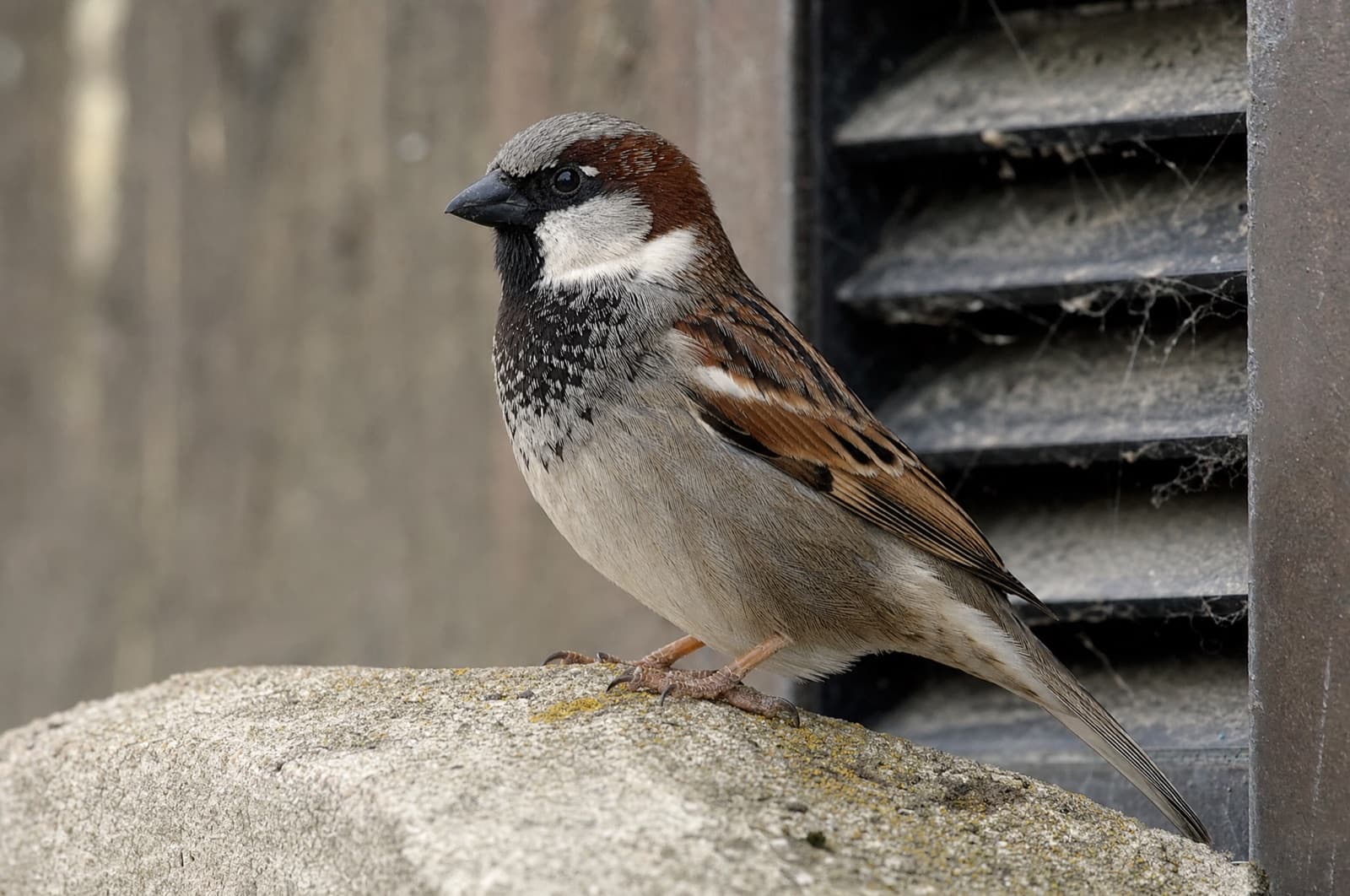
What Attracts House Sparrows to Your House?
At a glance
- Short answer: Food and shelter — nothing about house sparrows is special
- The verdict: The usual four
The attractant verdict
Four possible answers to why this species turned up. Three stay unlit — and that's the argument: the honest answer could have been any of them, and for this species it wasn't.
This is the most common answer in this hub — an answer, not a shortfall.
Food and shelter — nothing about house sparrows is special
Our own old page described house sparrows as drawn in by "specific conditions that make your house an appealing place" — vague framing that implies something unusual is going on, when the underlying reasons are ordinary.
A ledge, eave gap, vent, or sign face that works as a nest cavity, plus a nearby food source such as birdseed, spilled grain, or scraps. House sparrows nest almost exclusively on and around structures rather than in trees, so any building offering both draws them.
“Food and shelter — the same two things that explain most birds around a house. Nothing about a house sparrow is special, and that's the honest answer.”
Why it's here, in full
Why there's no special story here
House sparrows are one of the few birds that nest almost exclusively in and on human structures rather than in trees — eaves, wall vents, sign faces, and gaps under siding all work as substitutes for the cavities their ancestors used. Add a nearby food source, whether that's spilled birdseed, pet food left outside, or scraps around a dumpster, and a building has everything a sparrow needs.
That's the whole explanation. It isn't about a house being unusually inviting; it's two ordinary needs, food and a sheltered nook, both available in the same place. Where either one is missing, sparrows nest elsewhere.
How to tell it's actually this species
Real signs only — a species with four honest tells gets four, and stops. Where a sign is weak on its own, we say so.
Loose nesting material — grass, feathers, and litter — visible in an eave, vent, or light fixture
Frequent chirping and small birds gathering around a specific ledge or gap in the building
Droppings accumulating below a roosting or nesting spot
Could be something else: Bird droppings alone don't identify the species — pigeons and starlings leave similar accumulations in the same kinds of locations.
Feathers collecting near vents, eaves, or under overhangs
Want house sparrow gone?
This page only answers why it's here. Every removal step for this exact species — what to seal, what to set, what actually works — lives on its own dedicated guide.
Two questions, two pages
Here: why it turned up at all — the honest answer, blame removed.
There: the step-by-step removal guide for this exact species.
Key takeaways
- House sparrows are drawn by food and nesting shelter, not by anything unique to a particular house.
- They nest almost exclusively on structures — eaves, vents, and signs — rather than in trees.
- Droppings and feathers are common signs but don't confirm the species by themselves.
- Removal and exclusion steps live at /top-diy-methods/house-sparrow.
Want it gone, not just explained?
This page is about why house sparrows show up. Removing an active nest is covered at /top-diy-methods/house-sparrow.
Frequently asked
Sources(2)
- [1]Iowa State University Extension — Nuisance Birds: Damage Management
Nuisance birds around structures are drawn by accessible food and nesting or roosting sites on buildings
extensionverified 2026-07-17 - [2]New Mexico State University Extension — Controlling Nuisance Birds
House sparrows nest in eaves and crevices of buildings and forage on spilled grain and food scraps
extensionverified 2026-07-17
Written & reviewed by
VerifiedDaniel Brady
NH-Licensed Pesticide Applicator · License #782664 (NHDAMF, RSA 430)
Daniel Brady is the New Hampshire–licensed applicator behind Anchor Pest Services, a family-owned pest control company serving the Manchester area since 2017.
Last updated Jul 2026
Food and shelter — nothing unusual here
If sparrows have already moved in, we handle the rest
Same-day inspections across southern and central New Hampshire.
- Family-owned in Manchester since 2017
- NH commercial applicator #782664, category F1
- We will tell you when the answer is do nothing
NH License #782664 · No obligation · We answer in person