
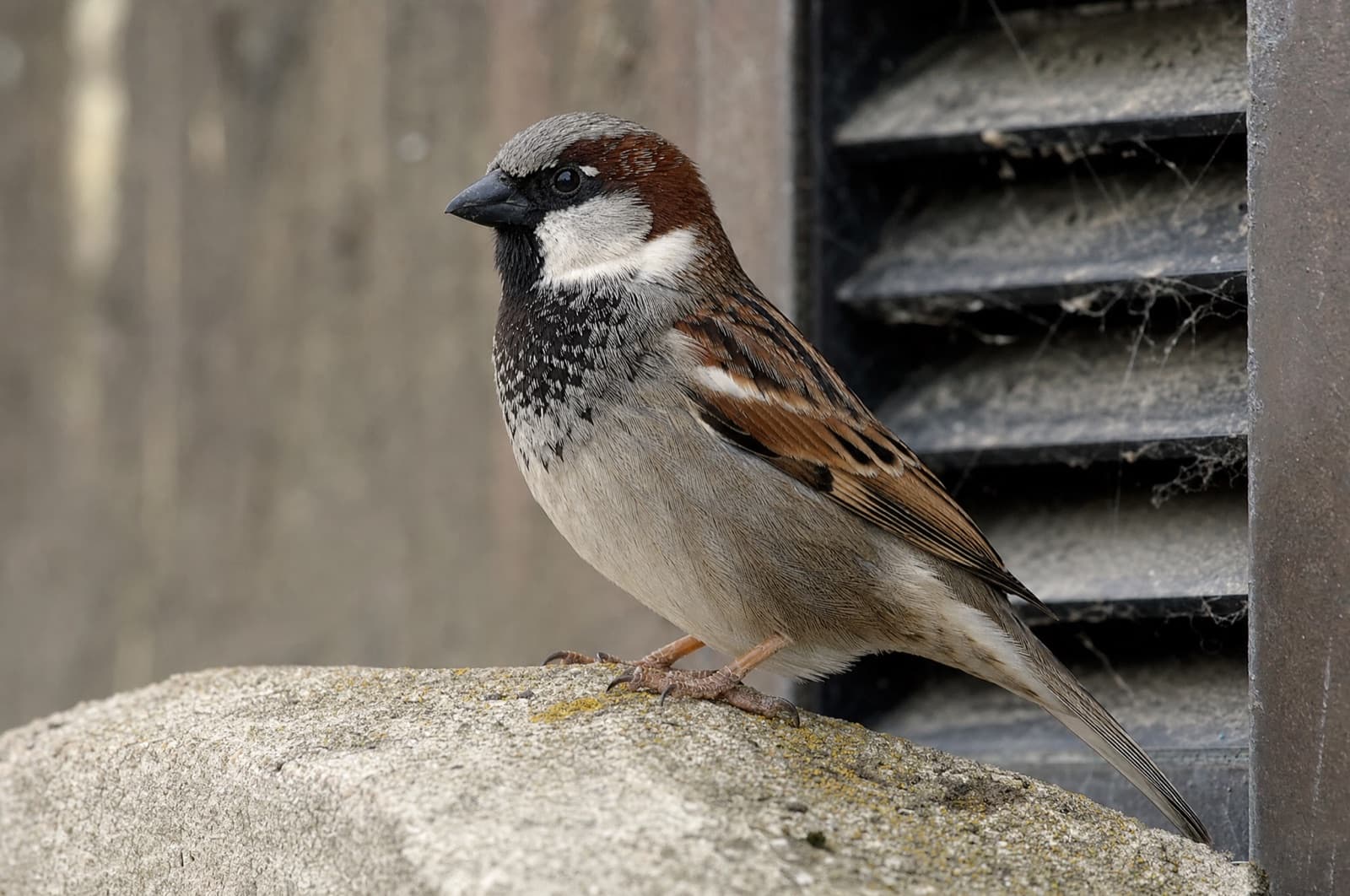
House Sparrow in New Hampshire — ID, Signs & Control
Also called English sparrow
The house sparrow is a non-native weaverbird (not a true sparrow) that is not protected by the Migratory Bird Treaty Act. It stuffs vents, building cavities, and nest boxes with messy nests and displaces protected native species. The male's black bib is the clearest field mark separating it from protected native sparrows. Exclusion comes first; confirm ID before removing any nest.
- Size
- ~6 in, ~1 oz
- Stocky build; stout conical bill
- MBTA status
- Not protected
- USFWS 2020 Federal Register — non-native introduced species exempt
- Family
- Passeridae (weaverbird)
- NOT the same family as native sparrows (Emberizidae/Passerellidae)
- Introduced
- 1800s from Europe
- Multiple introductions to East Coast cities; now continent-wide
- Broods per year
- Multiple
- 1–8 eggs per clutch; ~26 days egg to fledge (Avian Report)
- Key field mark
- Male's black bib
- Clearest separation from protected native sparrows — no native sparrow has a solid black bib
The non-native weaverbird in your vents — not a true sparrow
The house sparrow (Passer domesticus) is one of the most common birds at New Hampshire buildings — and one of the most frequently misidentified. Despite its name, it is not a true sparrow at all. Native sparrows belong to the family Passerellidae (formerly Emberizidae); the house sparrow belongs to Passeridae, the Old World weaverbirds. That taxonomic distinction carries a legal consequence: native sparrows are protected by the Migratory Bird Treaty Act, while the house sparrow is not.
The USFWS 2020 Federal Register ruling makes this explicit: the MBTA does not apply to non-native, human-introduced species. Passer domesticus is on that list alongside the European starling. Native sparrows — song sparrows, white-throated sparrows, chipping sparrows — are not, and disturbing their nests is a federal violation.
This means careful identification before any nest removal is not just good practice; it is legally required. The male house sparrow's solid black bib is the single most reliable field mark to separate it from all protected native sparrows. Female and juvenile house sparrows are plainer and require more care in identification. When in doubt, do not touch the nest.
How to identify a house sparrow
The male house sparrow is distinctive; the female and juvenile are plain and require more care. The stout, conical seed-cracking bill, chunky body, and ground-hopping behavior near buildings are consistent across sexes and ages.
House sparrow
- Scientific name
- Passer domesticus
- Family
- Passeridae (Old World weaverbirds — NOT the same family as native sparrows)
- Size
- ~6 inches; approximately 1 oz
- Coloration
- Male: gray crown, solid black bib, chestnut nape, white cheeks, streaked brown back. Female/juvenile: plain buff-brown above, dirty white below, pale buff eye stripe.
- Habitat
- Building vents, eave gaps, signage, streetlights, barn eaves, nest boxes — any enclosed cavity near human structures.
- Active season
- Year-round; nesting March–August; multiple broods per season
- Diet
- Primarily grains, seeds, and bread scraps; thrives on food waste near humans. Stout bill crushes seeds.
- Reproduction
- 1–8 eggs per clutch; multiple broods per season; approximately 26 days from egg to fledgling (Avian Report).
- Lifespan
- Wild average 1–3 years; up to 13 years recorded
One of the most abundant birds in the world; common across all of New Hampshire year-round wherever human habitation exists.
The tells — key ID features
- Male has a solid black bib on the throat and breast — no native sparrow has this mark.
- Stout, conical, seed-cracking bill — heavier and more curved than native sparrow bills.
- Chunky body with a short tail; tame ground-hopping near buildings and sidewalks.
- Bulky, dome-shaped or messy cavity nests stuffed with grass, feathers, paper, and string.
- Constant chirping flocks near building eaves, parking lots, and fast-food restaurants.
- Female and juvenile are plain buff-brown — look for the pale eyebrow stripe and heavy bill.
Size, to scale
~6 inches
About the size of a ping-pong ball in the body — noticeably smaller than a European starling (8–9 in)
Native song sparrow
How to tell — Song sparrows are heavily streaked on breast and flanks with a central breast spot; they have a thinner bill and prefer vegetation edges. Song sparrows are fully protected under the MBTA. House sparrow females lack the heavy streaking.
Native white-throated sparrow
How to tell — White-throated sparrows have a distinct white throat patch, yellow lores (in front of eye), and bold head stripes. Protected under the MBTA. The house sparrow female is much plainer with no white throat.
Female house finch
How to tell — Female house finches have a heavily streaked breast and a more curved, seed-cracking bill; they lack the plain buff-brown cap of the female house sparrow. House finches are protected under the MBTA.
Juvenile European starling
How to tell — Juvenile starlings are plain gray-brown like female house sparrows but are much larger (8–9 in vs 6 in) with a long, pointed bill. Starlings also walk and strut; house sparrows hop.
Signs of a problem
House sparrows announce their presence through persistent chirping, messy nests in unexpected places, and the eviction of native birds from nest boxes.
Bulky, messy nests — grass, feathers, string, paper — stuffed into a dryer vent, bathroom vent, or eave gap
What it means — Active or recent house sparrow nesting; a fire and blockage hazard requiring vent inspection and clearing.
Constant, repetitive 'cheep cheep' chirping from inside a building cavity, vent, or eave
What it means — Breeding pair in residence; young may be present.
Native bluebirds or tree swallows abandoning a nest box they previously used
What it means — House sparrows may be actively taking over; if sparrow nesting material is inside, the nest box has been claimed.
Dropping accumulations on ledges and pavement below nesting or roosting sites
What it means — Active roost or nest above; droppings can carry disease and should be cleaned with PPE.
Tame, ground-hopping flocks near outdoor dining, dumpsters, or parking lots
What it means — Established foraging colony; nesting sites will be nearby in adjacent building structures.
Scratch marks, debris, or feathers around vent louvers
What it means — Birds are actively entering or have recently nested in the vent.
The real risks, calibrated
House sparrows do not bite or sting, but their nesting habits create structural, health, and ecological risks around NH homes and businesses.
Vent blockage and fire risk
ModerateOnset: Within weeks of nesting start
The large, bulky nests house sparrows build inside dryer and exhaust vents can fully block airflow. A clogged dryer vent is one of the leading causes of residential structure fires in the U.S. Stove and furnace vent blockage can create carbon monoxide hazards.
Histoplasmosis and dropping-borne disease
ModerateOnset: Risk increases with accumulation volume
Bird droppings, including those from house sparrows, can harbor Histoplasma capsulatum. Disturbing dried droppings — particularly by dry-sweeping — releases fungal spores that can cause histoplasmosis. Use N95 respirator and gloves; wet the material before cleaning.
Bird mites entering the living space
ModerateOnset: After birds vacate or are excluded from a nest
Bird mites that fed on nesting house sparrows will disperse into adjacent rooms when the host birds leave. They can bite humans and cause skin irritation. They cannot complete their life cycle on people but an active mite infestation in walls or around vents requires treatment.
Gutter and cavity blockage
ModerateOnset: Accumulates over a nesting season
House sparrow nests in gutters, downspout openings, and roof gaps can trap water and debris, leading to water intrusion and rot.
Displacement of protected native species
ModerateOnset: During nesting season
House sparrows aggressively evict native bluebirds, tree swallows, and other cavity nesters from nest boxes, sometimes killing adults, eggs, and young. This is a significant conservation concern in New Hampshire where bluebird trail programs are active.
DIY — what works, what backfires
Exclusion is the most effective and legally safest approach. The single most important rule: confirm the bird is a house sparrow — not a protected native sparrow — before removing any nest.
What actually works
- Install 1/4-inch hardware cloth or commercial vent guards over dryer, bathroom, stove, and gable vents before March when nesting begins.
- Use native-bird-sized nest box hole diameters — 1.5-inch holes admit bluebirds and most swallows while making entry more difficult for sparrows (though not impossible for determined pairs; monitor actively).
- Remove house sparrow nests from nest boxes promptly after confirming species — this discourages re-nesting and protects native birds.
- Use sparrow-specific traps on nest boxes during nesting season; check frequently and release non-target species.
- Wet-clean dropping accumulations with a disinfectant solution; wear an N95 respirator and disposable gloves. Never dry-sweep.
- Seal eave gaps, sign cavities, and soffit openings after confirming they are unoccupied.
What backfires
- Don't remove any nest without first confirming the species is a house sparrow — native sparrows nesting in adjacent vegetation are protected and look similar to female house sparrows.
- Don't dry-sweep or vacuum heavy dropping accumulations without respiratory protection — histoplasmosis risk is real.
- Don't ignore a blocked dryer vent — the fire risk is immediate and escalates quickly as nesting material accumulates.
- Don't use broad-spectrum poisons — they kill non-target birds and are not a durable solution.
- Don't assume the vent is clear after clearing it once — house sparrows will re-enter and rebuild within days if no cover is installed.
House sparrows in New Hampshire homes and businesses
House sparrows are year-round residents across New Hampshire wherever people live and work. They nest in building vents, behind signage, in eave gaps, under solar panels, and inside streetlight fixtures across Manchester, Nashua, Concord, Derry, Bedford, Salem, and beyond. Their bulky, messy nests can block dryer and bathroom vents, creating fire and airflow hazards. Nest mite complaints are common in late summer after fledglings leave. NH is also home to native bluebirds and tree swallows that use the same nest boxes — house sparrows actively evict and kill these protected species, making monitoring and exclusion an important conservation issue in the state.
Peak season
Year-round resident; nesting March–August (multiple broods); mite complaints peak July–September
You might actually have
- European starling (also unprotected — competes for the same cavities)
- Native song sparrow (protected — streakier, no bib, hops in vegetation)
- Native white-throated sparrow (protected — white throat stripe, yellow lores, very different pattern)
We serve these communities
- NH-licensed applicator · #782664
- Same-day service
- Family-owned since 2017
Service Area Map
Southern New Hampshire
When to call a pro for house sparrow control
When house sparrows have nested inside vent systems, are roosting in large numbers on commercial properties, or when a mite infestation has developed after birds vacated, a licensed technician can confirm species ID, safely remove nesting material, install lasting physical exclusion, and treat for ectoparasites.
When to call a pro
- House sparrows have nested inside a dryer, stove, or bathroom vent and you cannot safely clear and cap it yourself.
- Dropping accumulations are heavy and require PPE-equipped wet remediation beyond a minor cleanup.
- Bird mites have entered the living space after a house sparrow nest was vacated.
- You cannot confidently confirm whether the nesting bird is a house sparrow or a protected native sparrow.
- Sparrows are nesting in multiple locations across a commercial property and a coordinated exclusion plan is needed.
Cap vents before March
House sparrows begin scouting nest sites in late winter. Install vent guards on all exhaust vents before nesting season to deny access permanently.
Monitor nest boxes actively
If you maintain bluebird boxes or swallow boxes, check them weekly during nesting season (April–July in NH) and remove house sparrow nesting material promptly to protect native occupants.
Remove food attractants near buildings
House sparrows thrive on outdoor food waste. Remove or cover dumpsters, clean up spilled birdseed, and manage outdoor dining debris to reduce the attractant that sustains colonies.
Seal building gaps annually
Walk the roofline and eaves each fall to identify new gaps in soffits, fascia, and siding. Seal with appropriate materials after confirming vacancy.
Not sure it's a house sparrow?
A licensed NH technician can confirm the species and tell you honestly whether it's a DIY fix or a job for a pro — free inspection, same-day service across Southern New Hampshire.
Frequently asked questions
Sources(5)
- [1]Maine DACF — Starling and House Sparrow Fact Sheet
biology, nesting behavior, native bird displacement, cavity nesting
govverified 2026-06-30 - [2]USFWS Federal Register 2020 — MBTA Applicability
non-native species MBTA exemption
govverified 2026-06-30 - [3]Cornell Lab — All About Birds: House Sparrow
species ID, range, MBTA status, native sparrow contrast
academicverified 2026-06-30 - [4]
- [5]CDC NIOSH — Histoplasmosis and the Environment
histoplasmosis risk from bird droppings, PPE guidance
govverified 2026-06-30
Written & reviewed by
VerifiedDaniel Brady
NH-Licensed Pesticide Applicator · License #782664 (NHDAMF, RSA 430)
Daniel Brady is the New Hampshire–licensed applicator behind Anchor Pest Services, a family-owned pest control company serving the Manchester area since 2017.
Last updated 2026-06-30

New Hampshire pest control
Dealing with house sparrows in your home?
Anchor Pest Services identifies and handles house sparrow problems across southern and central New Hampshire. Family-owned since 2017, NH license #782664.
- NH-licensed applicators (#782664)
- Same-day service · free inspection
- Family-owned since 2017
Your next step
- What to do next
How to Get Rid of House Sparrows
Read the answer - What to do next
When Do Birds Nest? NH Timing & Legal Guide
Read the answer - What to do next
Bird & Bat Prevention: Legal, Humane Exclusion in NH
Read the answer - Also relevant
Can starlings or pigeons clog vents or drains?
Read the answer - Also relevant
Do birds nesting in vents cause problems?
Read the answer