
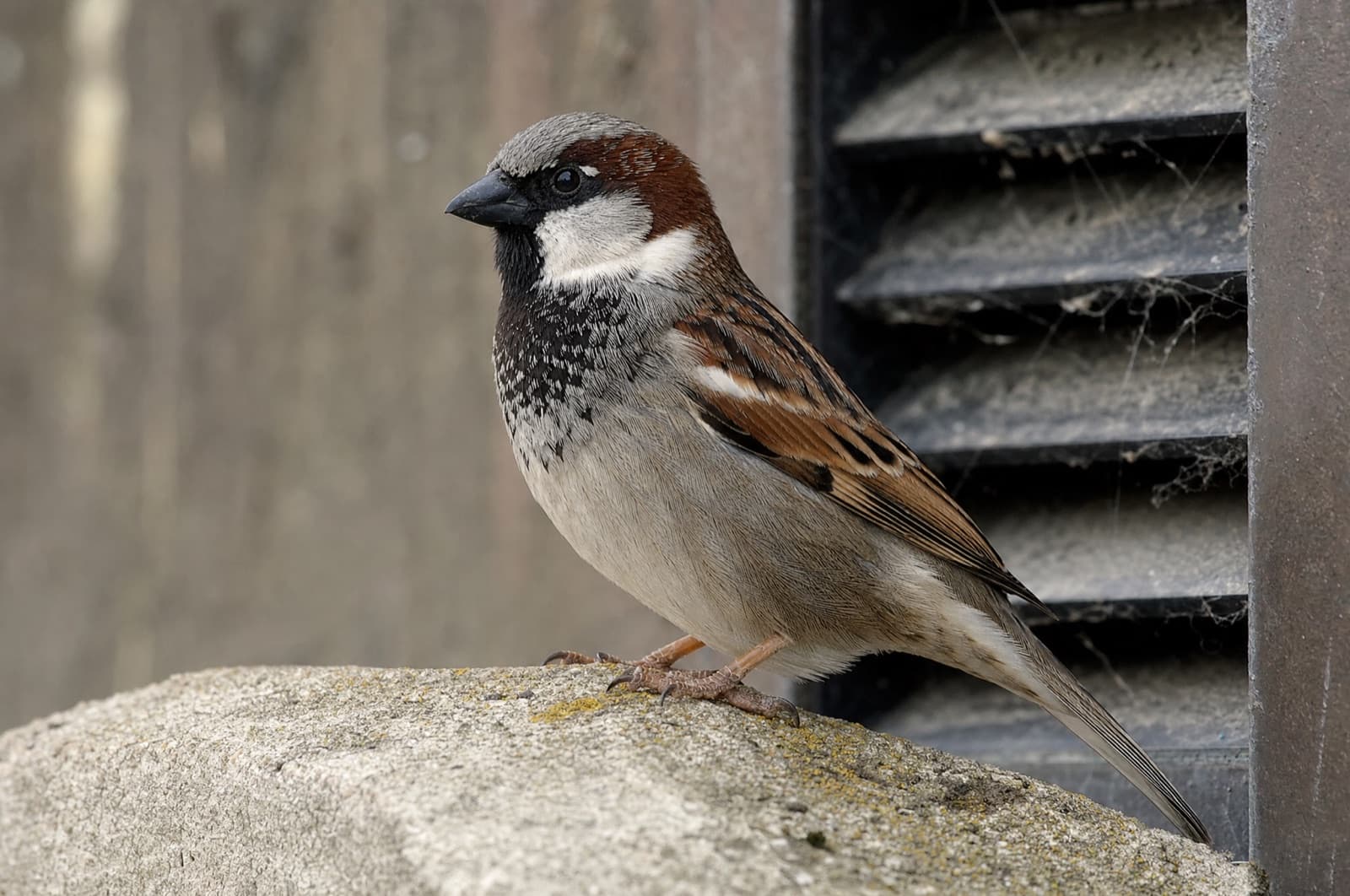
How to Get Rid of House Sparrows
At a glance
- Difficulty: Intermediate
- Time: A weekend to inspect and seal; ongoing deterrent upkeep through nesting season
- Cost: Low — hardware cloth, caulk, ledge deterrents
- Success: Good with complete, repeated exclusion; poor if even one cavity stays open
Can you DIY House Sparrow?
The verdict on House Sparrow DIY
Legal, doable exclusion — because it's a non-native, unprotected bird.
The house sparrow is a non-native, introduced species and is explicitly NOT protected under the federal Migratory Bird Treaty Act, so a homeowner can legally seal nesting cavities, remove nests, and install deterrents — something that would be illegal on a native songbird look-alike. The complication isn't legality, it's thoroughness: sparrows recolonize the one gap you miss, and a colony on a commercial-scale building overwhelms a homeowner's reach.
The 5 DIY methods — honestly graded
Every approach graded for this species, in IPM order — prevention first, chemistry late. Pick a method to see how it works, the steps, and what it actually takes.
Prevention / Exclusion
Works wellThe durable fix — works when every cavity is sealed before nesting season; a single gap left open undoes it.
House sparrows nest in building cavities, vents, signage, and eaves. Physically blocking those openings before the spring nesting season removes the sites they need before they claim them.
Best for: Stopping repeat nesting on a single-family home
Screen every cavity
Install ¼-inch hardware cloth over vents, gable ends, and dryer/exhaust outlets. Fit a proper chimney cap.
TipDo this before spring nesting season begins — sparrows in the Northeast start scouting cavities as early as March.Close the gaps and remove ledges
Seal gaps under eaves and behind signage with exterior sealant. Remove flat ledges or add sloped covers so they can't be used as nest platforms.
CautionSealing an active nest with eggs or young inside is a welfare problem even though it's legal — check for occupancy first.
Tools & materials
Why DIY falls short here
Not scare tactics — the specific, proportionate reasons a home attempt can stall for this species.
Instant re-colonization
Sparrows find and reuse the one cavity you didn't seal — exclusion has to be essentially 100% complete to hold.
Misidentification risk
A native sparrow look-alike (chipping, song, or grasshopper sparrow) IS federally protected — removing or harming one by mistake is an MBTA violation.
Colony scale on larger buildings
Commercial buildings and barns can have dozens of active cavities that need simultaneous sealing, beyond what one homeowner can reasonably tackle alone.
How risky is it, really?
An honest read — most nuisance species are genuinely low risk, and we say so.
House sparrows are primarily a nuisance and sanitation species, not a major direct health threat. The real cost is nesting debris, droppings, and displacement of native birds — not disease from casual contact.
- Droppings and nesting debris (sanitation, occasional mites)Occasional
A problem in heavy, established roosts — not casual contact
CDC / NH DHHS histoplasmosis guidance
- Histoplasmosis from disturbing large droppings accumulationsRare
A proportionate risk only where droppings have built up heavily over time and are disturbed during cleanup — wet the material and wear gloves and an N95 if cleaning a large accumulation
CDC
- Displacement of native cavity-nesting birdsCommon
An ecological cost (competition for nest sites), not a human-health risk
USFWS / All About Birds
House Sparrow Colony Bigger Than One Homeowner Can Handle?
A commercial-scale nesting site needs simultaneous sealing across dozens of cavities. Anchor Pest Services handles full exclusion across southern and central New Hampshire. Family-owned since 2017, NH license #782664.
Call a pro when…
- Nesting keeps recurring despite your own sealing
- A multi-cavity site (barn, commercial building, apartment complex) with dozens of active nests
- Uncertainty about whether the bird is a protected native sparrow look-alike
General Pest Control
Most single-family homes can handle house sparrow exclusion themselves. Call a pro for a commercial-scale colony, repeated failed sealing attempts, or if you're not certain a nest belongs to an unprotected house sparrow rather than a protected native sparrow.
Keep them out
- Seal cavities before spring nesting season begins
- Screen vents, gable ends, and dryer outlets with ¼-inch hardware cloth
- Add ledge deterrents to sills and signage where sparrows perch
House sparrows in New Hampshire
In New Hampshire, house sparrows begin scouting nest cavities as early as March and can raise multiple broods into late summer, so the exclusion window opens well before Manchester's typical warm-up. Sealing gaps in late winter to early spring — before the first broods start — gets ahead of the season instead of chasing an active nest.
Peak season
Spring through late summer, with multiple broods per season
Make sure it's a House Sparrow
Two quick detours worth taking — confirm the ID, then learn what drew it in so it doesn't come back.
Frequently asked
Sources & further reading(4)
- [1]U.S. Fish & Wildlife Service — Service Publishes Final List of Non-Native Bird Species
House sparrow's non-native, MBTA-unprotected status
govverified 2026-07-13 - [2]Federal Register — List of Bird Species to Which the Migratory Bird Treaty Act Does Not Apply
Official MBTA-exempt species list
govverified 2026-07-13 - [3]Cornell Lab / All About Birds — What Is the Migratory Bird Treaty Act?
MBTA protection scope explainer
encyclopediaverified 2026-07-13 - [4]CDC — Histoplasmosis Prevention
Proportionate, cleanup-context histoplasmosis risk from bird droppings
govverified 2026-07-13
Written & reviewed by
VerifiedDaniel Brady
NH-Licensed Pesticide Applicator · License #782664 (NHDAMF, RSA 430)
Daniel Brady is the New Hampshire–licensed applicator behind Anchor Pest Services, a family-owned pest control company serving the Manchester area since 2017.
Last updated July 2026
Other species you can tackle
Same category — the dot shows each one's DIY verdict at a glance (green = friendly, amber = doable with care, red = call a pro).
Professional Pest Control
House Sparrow Colony Bigger Than One Homeowner Can Handle?
A commercial-scale nesting site needs simultaneous sealing across dozens of cavities. Anchor Pest Services handles full exclusion across southern and central New Hampshire. Family-owned since 2017, NH license #782664.
- Legal, humane exclusion methods
- NH-licensed technicians (#782664)
- Free inspection — same-day service across southern NH
NH License #782664 · No obligation · We answer in person
Your next step
- Book a NH pro
Pest Control Services
Licensed, family-owned pest control across southern NH.
Book now - What to do next
House Sparrow in New Hampshire — ID, Signs & Control
Read the answer - Also relevant
House Sparrow in New Hampshire — ID, Signs & Control
Read the answer - Also relevant
Bird & Bat Prevention: Legal, Humane Exclusion in NH
Read the answer - Also relevant
Bird & Bat Prevention: Legal, Humane Exclusion in NH
Read the answer - Also relevant
When Do Birds Nest? NH Timing & Legal Guide
Read the answer