
What Attracts Indian Meal Moths to Your House?
At a glance
- Short answer: Indian meal moths aren't lured indoors. The eggs are usually already inside the product when you buy it.
- The verdict: You didn't attract it — you carried it in
The attractant verdict
Four possible answers to why this species turned up. Three stay unlit — and that's the argument: the honest answer could have been any of them, and for this species it wasn't.
Indian meal moths aren't lured indoors. The eggs are usually already inside the product when you buy it.
Our own previous page said the Indian meal moth is "attracted to various factors in your home, especially food supplies," and lists foods it's "particularly drawn to" — phrasing that reads as the moth searching your cupboards for its favorite food.
Eggs already present in a dried product at the time of purchase — commonly birdseed, grain, cereal, dried fruit, or nuts — contaminated during milling, processing, or storage before the item reached the home.
“The moth doesn't find your cupboard. The eggs are usually already in the bag when you carry it home.”
Why it's here, in full
Birdseed and grain are the documented source, not the house
University of Georgia Extension states directly that "the origin of many stored product pest infestations in cupboards (especially Indianmeal moth and sawtoothed grain beetle) is infested bird seed purchased and brought into the home." University of Maryland Extension similarly notes the moth "can be brought into the home in packages contaminated with eggs that escaped detection in milling or packaging." In both cases, the infestation's origin point is a specific product, identified upstream of the home, not something about the kitchen that drew the moth in.
Our old page's "attracted to various factors in your home, especially food supplies" framing misses that distinction entirely — it describes the moth as responding to what's already in the house, when the more accurate story is that the moth's eggs arrived with the food.
Adult moths move around once established — that's not the same as arriving from outside
Indian meal moth adults are strong, erratic fliers, and once a population is established from an infested product, adults are commonly seen moving through a kitchen or nearby rooms at night, which can make it look like the moths are appearing from nowhere or entering from outside. That's dispersal behavior from an existing indoor source, though — not a new arrival mechanism. The practical implication is the same either way: the useful question is which stored product introduced the eggs, not why the house seems to be attracting more moths over time.
How to tell it's actually this species
Real signs only — a species with four honest tells gets four, and stops. Where a sign is weak on its own, we say so.
Fine silken webbing clumping together grain, cereal, or birdseed inside a package
Small caterpillars (larvae) crawling on pantry shelves, walls, or the ceiling near a food storage area
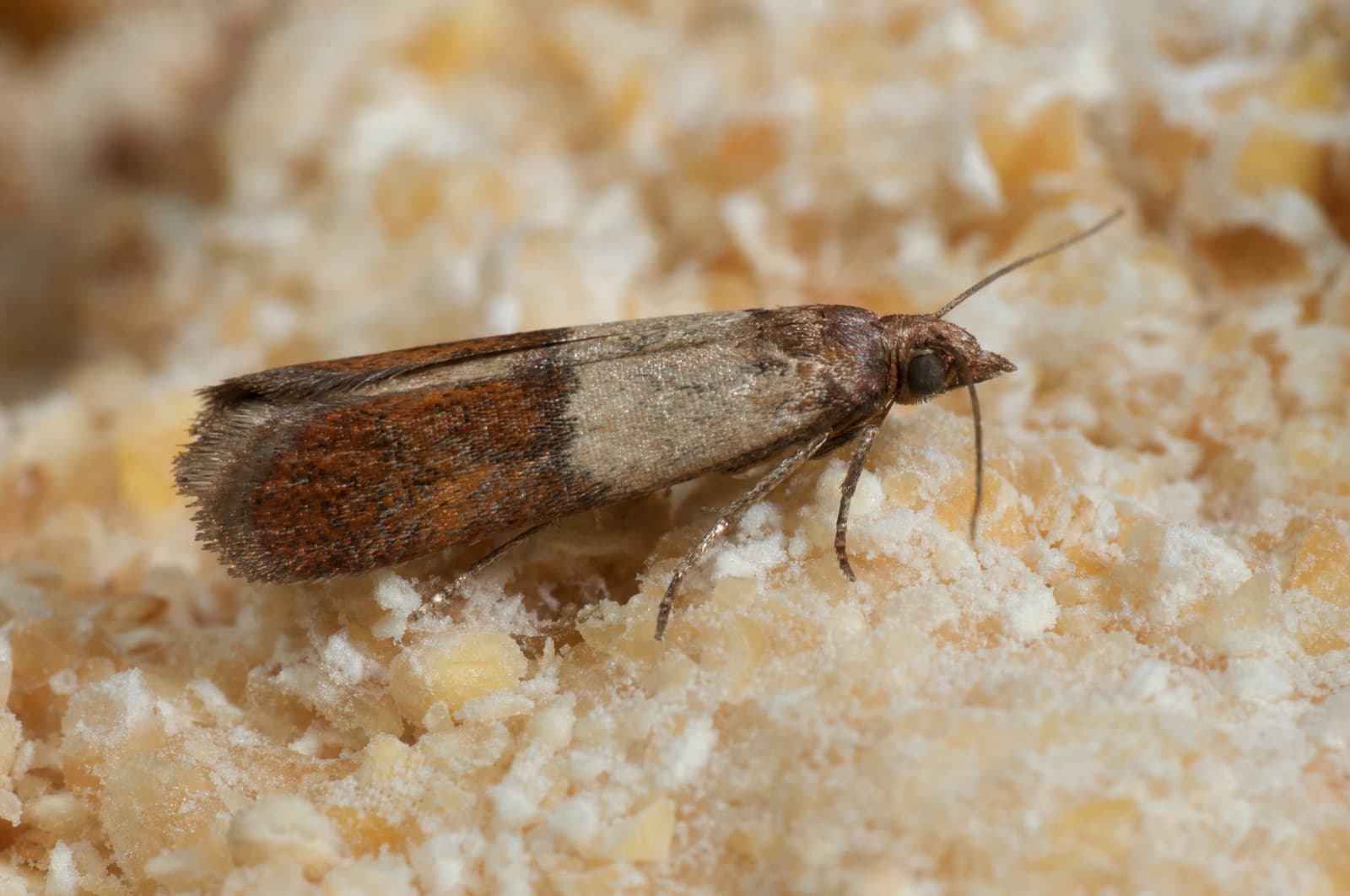
Small tan-and-copper adult moths flying erratically near the kitchen, especially at night
Could be something else: Seeing an adult moth confirms a nearby source but not its exact location; check /pests/indian-meal-moth for identification.
Fine, sand-like droppings mixed into an affected dried product
Could be something else: Droppings alone are a common, non-diagnostic sign shared with several pantry pests.
Want indian meal moths gone?
This page only answers why it's here. Every removal step for this exact species — what to seal, what to set, what actually works — lives on its own dedicated guide.
Two questions, two pages
Here: why it turned up at all — the honest answer, blame removed.
There: the step-by-step removal guide for this exact species.
Key takeaways
- The moth doesn't find your cupboard. The eggs are usually already in the bag when you carry it home.
- Cleanliness isn't the deciding factor here — the actual vector is what matters.
- What actually matters: food.
- If it's already inside, removal is a different question — see /top-diy-methods/indian-meal-moth.
Found webbing or larvae in stored food?
This page is about why they showed up. Locating the infested product and removal steps are covered at /top-diy-methods/indian-meal-moth.
Frequently asked
Sources(2)
- [1]University of Maryland Extension — Indian Meal Moth
Indian meal moths brought into the home via packages contaminated with eggs during milling or packaging
extensionverified 2026-07-17 - [2]University of Georgia Cooperative Extension — Stored Product Pests in the Home (B1378)
Infested birdseed as a leading origin point for Indian meal moth and sawtoothed grain beetle household infestations
extensionverified 2026-07-17
Written & reviewed by
VerifiedDaniel Brady
NH-Licensed Pesticide Applicator · License #782664 (NHDAMF, RSA 430)
Daniel Brady is the New Hampshire–licensed applicator behind Anchor Pest Services, a family-owned pest control company serving the Manchester area since 2017.
Last updated Jul 2026
The eggs usually arrive with the product
Dealing with pantry moths at home?
Same-day inspections across southern and central New Hampshire — we'll help track down the source product, including birdseed.
- Family-owned in Manchester since 2017
- NH commercial applicator #782664, category F1
- We will tell you when the answer is do nothing
NH License #782664 · No obligation · We answer in person