
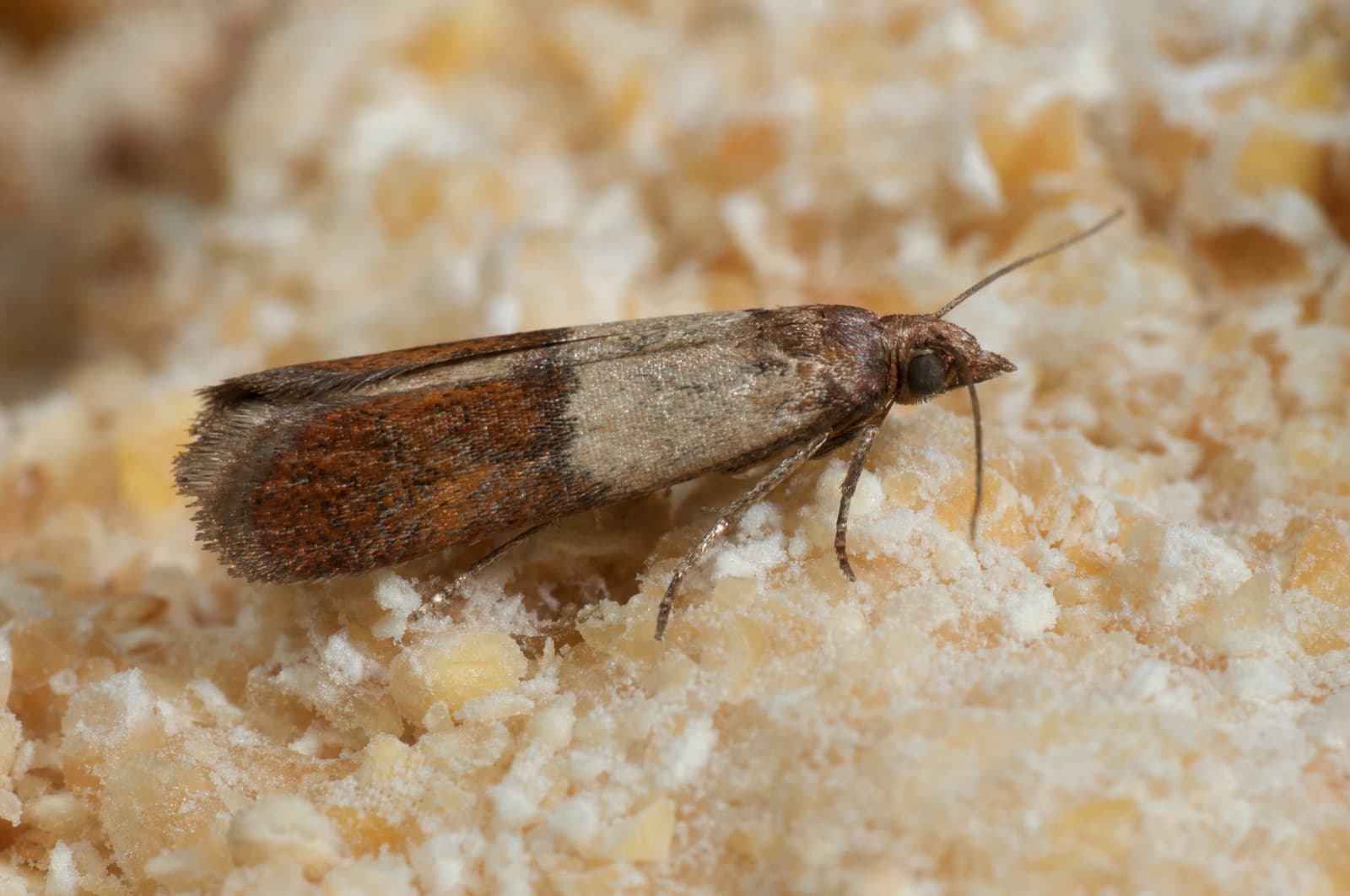
How to Get Rid of Indian Meal Moths
At a glance
- Difficulty: Intermediate
- Time: A thorough afternoon emptying and inspecting cabinets, plus a few weeks of trap-monitoring to confirm success
- Cost: Low — airtight containers and pheromone traps
- Success: Good once every infested item is located; incomplete source removal is the main reason it recurs
Can you DIY Indian Meal Moth?
The verdict on Indian Meal Moth DIY
A DIY win — but only if you find and discard every infested item, not just the obvious one.
Indian meal moth (Plodia interpunctella) larvae infest a wide range of pantry goods — cereals, nuts, dried fruit, spices, pet food, birdseed — and spin telltale silk webbing in the food. Because you legally and practically can't spray stored food, the fix is sanitation: finding and discarding every infested item and storing salvageable goods airtight. Pheromone traps are a genuine, useful tool here, but they only catch males and monitor the problem — they don't eliminate it on their own.
The 5 DIY methods — honestly graded
Every approach graded for this species, in IPM order — prevention first, chemistry late. Pick a method to see how it works, the steps, and what it actually takes.
Prevention / Exclusion
Works wellAirtight storage and prompt inspection of new groceries are the most reliable long-term prevention.
Indian meal moths most often arrive already inside store-bought dry goods rather than flying in from outside, so intercepting new groceries and storing everything in a container larvae can't chew through prevents reinfestation.
Best for: Preventing reinfestation after a clean-out
Store dry goods airtight
Transfer cereals, grains, nuts, dried fruit, spices, pet food, and birdseed into rigid, airtight containers as soon as you bring them home.
TipInspect packaging for tiny holes, webbing, or clumping before you buy or store it.Clean cabinet cracks
Vacuum and wipe out cabinet corners and shelf seams periodically, since larvae crawl into cracks to pupate away from the food source.
Tools & materials
Why DIY falls short here
Not scare tactics — the specific, proportionate reasons a home attempt can stall for this species.
Relying on traps to "solve" it
Pheromone traps only catch males and are a monitoring tool — they don't catch egg-laying females, so trap catches dropping doesn't mean the source is gone if you haven't actually found and removed it.
Wandering larvae pupate far from the food
Mature larvae crawl to wall or ceiling corners to pupate, so people search only near the food and miss where the moths are actually emerging.
Multiple infested sources overlooked
Because the species has such a broad diet — cereals, nuts, dried fruit, spices, pet food, birdseed — a single overlooked item, especially pet food or birdseed, reseeds the whole problem after a thorough pantry clean-out.
How risky is it, really?
An honest read — most nuisance species are genuinely low risk, and we say so.
Indian meal moths are a nuisance and contamination pest, not a health hazard. They don't bite, sting, or spread disease to people. The real cost is food spoilage if the infestation goes unaddressed.
- Food contamination and spoilageCommon
The main real-world harm — infested dry goods develop webbing and should be discarded
Colorado State University Extension
- Bite, sting, or disease transmissionRare
Not documented — this species poses no direct health risk to people or pets
University of Minnesota Extension
- Recurring infestation from an unfound sourceOccasional
A practical, not a health, risk — thorough inspection prevents this
Colorado State University Extension
Can't Find the Source of Your Pantry Moths?
A recurring infestation after a thorough clean-out usually means an overlooked source. Anchor Pest Services offers a full pantry inspection across southern and central New Hampshire. Family-owned since 2017, NH license #782664.
Call a pro when…
- Moths keep reappearing 2–3 weeks after a thorough pantry clean-out
- You can't locate the source despite a careful search
- A large or long-standing infestation in pantry, storage, or utility areas
General Pest Control
You rarely need a pro for Indian meal moths — this is a find-and-discard sanitation job. The exception is a recurring infestation you can't source after a thorough search, or a heavy, established population in hard-to-reach storage areas.
Keep them out
- Store all dry goods in airtight rigid containers as soon as you bring them home
- Inspect groceries, pet food, and birdseed at purchase
- Use pheromone traps to monitor after a clean-out
Indian meal moths in New Hampshire
UNH Cooperative Extension's Kitchen Pests fact sheet identifies the Indian meal moth (Plodia interpunctella) as the most common moth species in New Hampshire kitchens — so if you've got a pantry moth in NH, this is statistically the one. It thrives in the warm, dry indoor conditions of a New Hampshire pantry year-round, isn't tied to any outdoor seasonal cue, and, per UNH, most often arrives already inside infested store-bought goods rather than flying in from outside. That means the timing of control is about how quickly you act after noticing webbing, not a seasonal window.
Peak season
Year-round indoors; no strong seasonal pattern
First-frost anchor
Manchester first hard frost ~Oct 19 (50%) / Oct 29 (80%), NOAA 1991–2020
Make sure it's a Indian Meal Moth
Two quick detours worth taking — confirm the ID, then learn what drew it in so it doesn't come back.
Frequently asked
Sources & further reading(3)
- [1]Colorado State University Extension — Indian Meal Moth
Biology, pheromone trap limitations, sanitation-based control
extensionverified 2026-07-13 - [2]University of Minnesota Extension — Pantry Pests: Insects Found in Stored Food
Host range, harmless-to-humans status, control recommendations
extensionverified 2026-07-13 - [3]UNH Cooperative Extension — Kitchen Pests [fact sheet]
Indian meal moth identified as the most common moth species in New Hampshire kitchens; introduced via infested store-bought goods; sanitation-based control
extensionverified 2026-07-22
Written & reviewed by
VerifiedDaniel Brady
NH-Licensed Pesticide Applicator · License #782664 (NHDAMF, RSA 430)
Daniel Brady is the New Hampshire–licensed applicator behind Anchor Pest Services, a family-owned pest control company serving the Manchester area since 2017.
Last updated July 2026
Other species you can tackle
Same category — the dot shows each one's DIY verdict at a glance (green = friendly, amber = doable with care, red = call a pro).
Professional Pest Control
Can't Find the Source of Your Pantry Moths?
A recurring infestation after a thorough clean-out usually means an overlooked source. Anchor Pest Services offers a full pantry inspection across southern and central New Hampshire. Family-owned since 2017, NH license #782664.
- Thorough source inspection
- NH-licensed applicators (#782664)
- Free inspection — same-day service across southern NH
NH License #782664 · No obligation · We answer in person
Your next step
- Book a NH pro
Pest Control Services
Licensed, family-owned pest control across southern NH.
Book now - What to do next
Indian Meal Moths in New Hampshire: Find the Source & Stop Them
Read the answer - Also relevant
Indian Meal Moths in New Hampshire: Find the Source & Stop Them
Read the answer - Also relevant
Household Pest Prevention: Seal, Store, and Time It Right
Read the answer - Also relevant
What Attracts Indian Meal Moths to Your House?
Read the answer - Also relevant
Can moths become a winter issue indoors?
Read the answer