
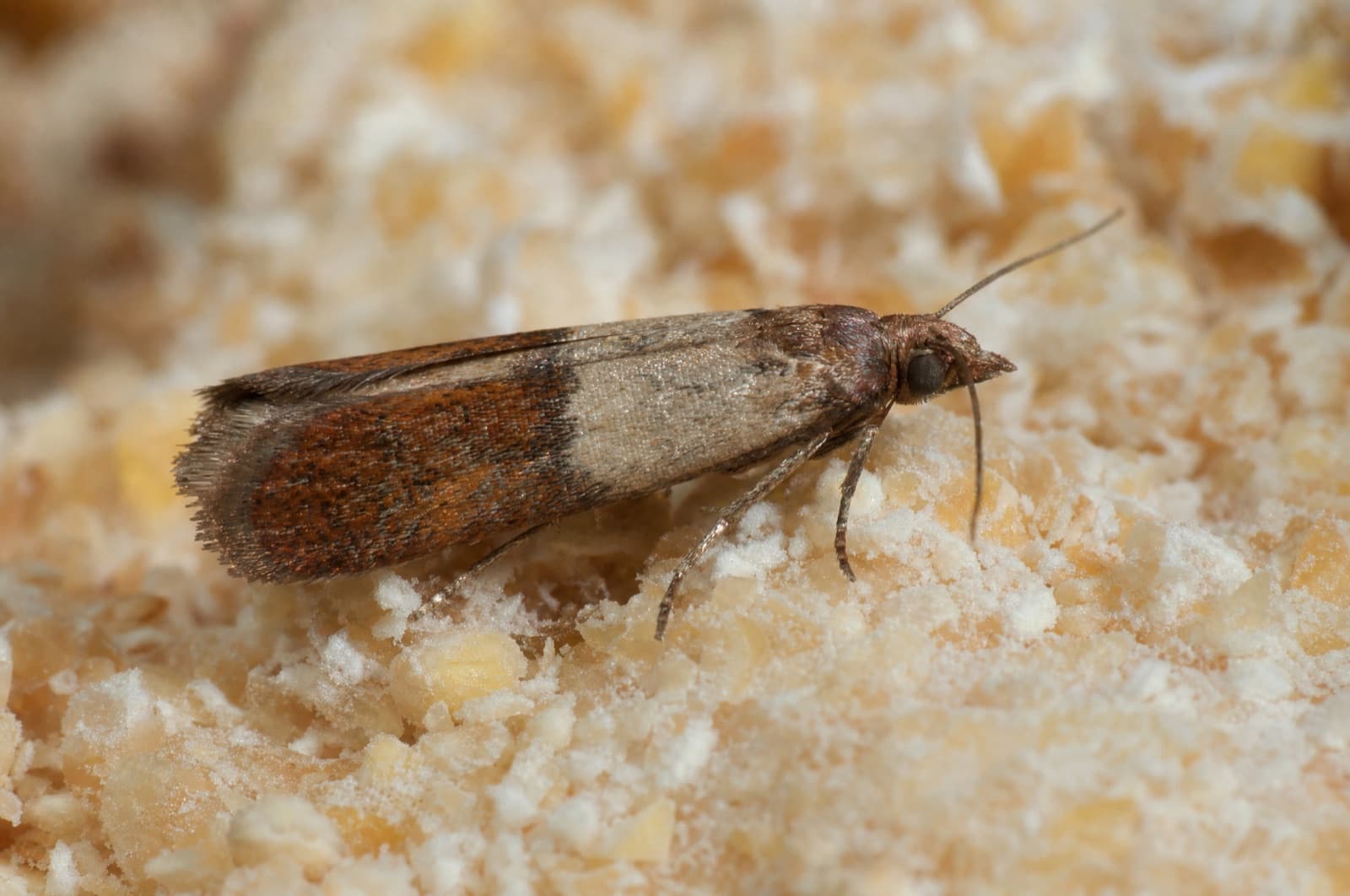
Indian Meal Moths in New Hampshire: Find the Source & Stop Them
Also called Pantry moth · Flour moth · Grain moth
The Indian meal moth is the most common pantry moth — the small moth you see flying around the kitchen at dusk. Its larvae spin telltale silk webbing through grains, cereal, flour, dried fruit, nuts, pet food, and birdseed. It's identified instantly by its two-tone wings: pale gray at the base, reddish-copper at the outer tip. It doesn't bite or harm the house. Don't chase the flying adult — find the larval food source, discard it, and store food airtight.
- Adult size
- ~3/8 inch long; ~5/8-inch (10–15 mm) wingspan
- University of Maryland Extension; Colorado State Extension
- Wing pattern
- Two-tone: pale gray inner base, reddish-copper/bronze outer half — diagnostic
- University of Maryland Extension; Colorado State Extension
- Larval sign
- Silk webbing matting grains, cereal, or pet food — the classic first sign
- Penn State Extension
- Egg production
- 200–400 eggs per female; egg-to-adult ~6–8 weeks in warm conditions
- UC IPM; Oklahoma State Extension
- Larval pupation
- Mature larvae crawl away from food — up walls and onto ceilings — to pupate
- University of Florida IFAS
- Package penetration
- Larvae chew through paper, cellophane, and thin plastic packaging
- Natural History Museum
The small moth in your kitchen at dusk — and where it's actually coming from
A small moth circling the kitchen light at dusk is the Indian meal moth's calling card. It's the most common pantry moth in the United States, and per UNH Cooperative Extension it's among New Hampshire's most common pantry pests. The two-tone wing — pale gray at the base, reddish-copper/bronze at the outer tip — makes it the most visually distinctive of all pantry moths.
The critical insight most people miss: don't chase the flying adult. The adult moth can fly and will appear rooms away from its food source. What you need to find is the larval source — the specific infested package or container where larvae are spinning silk webbing through your grain, cereal, or birdseed. Kill every adult moth you see, and new ones keep hatching from the source.
The second critical insight: larvae crawl far from their food source to pupate. A caterpillar on your kitchen ceiling in the evening is almost certainly not eating food near the ceiling — it crawled there from a package in the pantry, possibly a room away. The moth on the ceiling may have hatched from larvae in birdseed stored in the garage. This is the single most common reason homeowners say they 'can't find the source.'
The fix: a thorough, whole-pantry inspection. Pull out every bag liner, inspect the oldest and least-used goods first, and look for silk webbing, clumped grain, and the small cream larvae with brown heads. Seal and remove all infested goods. Deep-clean the pantry. Store remaining goods airtight. Don't spray food areas.
How to identify the Indian meal moth — the two-tone wing is the tell
The Indian meal moth is identified at a glance by its two-tone wings: the inner third to half is pale gray, and the outer portion is a distinctive reddish-copper or bronze color. This coppery outer wing is unique among common household moths and separates it immediately from the plain golden clothes moth or the smaller pantry beetles. At rest, the wings fold over the body in a tent shape, making the two-tone pattern visible from above.
Indian meal moth
- Scientific name
- Plodia interpunctella
- Family
- Pyralidae
- Size
- ~3/8 inch long; ~5/8 inch (10–15 mm) wingspan
- Coloration
- Two-tone: pale gray inner wing base, reddish-copper/bronze outer portion
- Habitat
- Pantries, kitchens; also garages and sheds where pet food and birdseed are stored
- Active season
- Year-round in heated NH homes; survives and reproduces above approximately 50°F
- Diet
- Grains, cereal, flour, dried fruit, nuts, pet food, birdseed, chocolate, spices, dried flowers
- Reproduction
- 200–400 eggs per female; life cycle approximately 40–55 days (6–8 weeks) in warm conditions
- Lifespan
- Adults short-lived; larvae are the long-lived, damaging stage
Worldwide; one of the most commonly reported stored-grain pests in the United States; common NH pantry pest (UNH Extension)
The tells — key ID features
- Two-tone wing: pale gray inner third-to-half, coppery-bronze outer portion — unmistakable once seen.
- Silk webbing matting grains, cereal, or pet food together — the classic first sign of an active infestation.
- Small moths flying in the kitchen at dusk or night — adults are most active in low light.
- Cream-colored larvae (~1/2 inch) with a brown head, wandering on walls or ceilings to pupate.
- 'White worms' and frass in dried foods.
- Larvae and pupae found far from the food source — they crawl walls and ceilings to pupate.
Size, to scale
~3/8 inch body; ~5/8-inch wingspan
Roughly the size of a grain of rice with wings folded (body only); wingspan about the width of your thumbnail
Clothes moth
How to tell — Smaller, uniform plain golden with no two-tone pattern; avoids light entirely; damages fabric not food; found scurrying in dark closets, not flying to kitchen lights.
Mediterranean flour moth (Ephestia kuehniella)
How to tell — Similar but lacks the strong coppery outer-wing band; wings are more uniformly gray/silver-banded.
Pantry beetles (flour beetle, sawtoothed grain beetle, etc.)
How to tell — Hard-bodied beetles with no wings visible at rest; produce no silk webbing. Indian meal moth larvae produce the webbing; beetles don't.
Signs of a problem
These signs, taken together, tell you where the source is — especially the 'larvae on the ceiling' clue that many homeowners overlook.
Small moths flying around the kitchen at dusk or night
What it means — Adults from a pantry source; don't chase them — find the larval food source instead.
Silk webbing matting cereal, grain, flour, or pet food together
What it means — Active larval feeding — the classic, diagnostic sign; look for webbing-clumped food in the oldest and least-used packages.
Cream-colored caterpillars crawling up walls or on the ceiling
What it means — Mature larvae wandering to pupate — they can be rooms from their food source; their presence on the ceiling tells you nothing about where the source is.
'White worms' or frass inside dried foods
What it means — Active larval feeding confirmed in that specific package — it must be discarded.
Webbed clumps or cocoons in package corners and along seams
What it means — Larval and pupal stages present in that package — the source, or one of the sources, is confirmed.
Moths or webbing near birdseed or pet food in a garage or shed
What it means — An overlooked secondary source — NH homeowners frequently miss garage birdseed as the origin of a kitchen infestation.
The real risks, calibrated
The Indian meal moth is the highest-impact pantry pest in this cluster group, capable of infesting an entire pantry quickly. The risk is entirely to food.
Food contamination
ModerateOnset: Ongoing while any infested package remains
Webbing, frass, larvae, and cast skins in grains, cereal, pet food, and nuts render all contaminated product unfit for consumption.
Whole-pantry spread
HighOnset: Within weeks of an unresolved source
Larvae chew into multiple packages and crawl to new food sources; an infestation in one bag can spread to the entire pantry.
Hidden source confusion
ModerateOnset: Ongoing
Larvae pupate far from their food source, so adult moths appear far from the actual infested package — the single biggest reason people cannot find the source.
Garage and shed birdseed as overlooked source
ModerateOnset: Over NH winters
Birdseed stored in garages and sheds over winter becomes a large, unmonitored infestation source feeding moths into the home.
Mold and microbe issues
Low riskOnset: With heavy prolonged infestation
Dense webbing and frass create conditions favorable to mold in heavily infested packages.
Biting, stinging, or structural damage
Low riskOnset: N/A
None — harmless to people, pets, and the home structure.
DIY — what works, what backfires
Indian meal moth control is the most involved in this cluster group — the whole-pantry inspection is not optional. Partial cleanouts consistently fail.
What actually works
- Inspect every dry-food package: pull bag liners from cereal boxes and roll them looking for webbing and clumps; check grains, cereal, nuts, dried fruit, birdseed, pet food, spices, and dried décor.
- Discard all infested packages — seal in a plastic bag and remove from the house immediately; don't put them in a kitchen trash can.
- Start with the oldest and least-used goods first: back-of-pantry flour, old nuts, holiday dried fruit, long-stored birdseed.
- Don't forget the garage, shed, or mudroom — birdseed and pet food stored there over the NH winter are a frequent undiscovered source.
- After removing all packages, vacuum shelves, cracks, and corners, then wash with soap and water.
- Store remaining dry goods in airtight glass, metal, or hard rigid plastic containers.
- Use pheromone traps to monitor whether adult moths are still emerging — replace traps regularly; they indicate activity but do not eliminate the infestation.
What backfires
- Don't spray insecticide on food, food surfaces, or kitchen utensils — ineffective and risks contaminating food.
- Don't rely on pheromone traps alone to eliminate the infestation; they catch male adults but don't kill larvae in the source.
- Don't skip the garage birdseed or pet food — these are the most commonly missed NH sources.
- Don't do a partial cleanout and assume you've solved it; larvae in one missed package restart the whole cycle.
Indian meal moths in New Hampshire kitchens
The Indian meal moth is among New Hampshire's most common pantry pests per UNH Cooperative Extension, and webbing discovered in oatmeal or cereal is one of the most common first-notice moments for NH homeowners. Heated NH homes allow the moth to breed year-round — the long winter doesn't stop it indoors. A significant NH-specific source: garages and sheds where birdseed and pet food are stored over the winter. These containers are often unchecked for months, and an infestation can grow large before anyone notices. Apply the UNH salvage standard (130°F for 30 minutes or 0°F for four days) to any food item you want to salvage before repackaging airtight.
Peak season
Year-round in heated NH homes; garages and sheds are a key NH winter source
You might actually have
- Clothes moth (plain golden, light-shy, fabric pest — not the moth at your kitchen lights)
- Sawtoothed grain beetle and flour beetles (hard-bodied beetles in same foods; no silk webbing)
We serve these communities
- NH-licensed applicator · #782664
- Same-day service
- Family-owned since 2017
Service Area Map
Southern New Hampshire
When to call a pro for Indian meal moths
If moths keep appearing more than three weeks after a complete pantry cleanout and airtight repackaging, an undiscovered source or larvae and pupae hidden in cracks, behind appliances, or on walls remain. A licensed technician can locate these hidden sites and treat appropriate cracks and crevices. Anchor Pest Services (NH #782664, F1) offers General Pest Control with a free quote and same-day service.
When to call a pro
- Moths persist more than three weeks after a full pantry cleanout, inspection of secondary storage, and airtight repackaging.
- You cannot find any infested package despite a thorough whole-pantry and garage inspection.
- Moths are emerging from walls, baseboards, or ceilings — suggesting larvae or pupae hidden in structural crevices.
- A commercial kitchen or food-service facility with an Indian meal moth infestation requires professional IPM for compliance.
Store all dried goods airtight — and that means birdseed too
Transfer every dry pantry item to airtight glass, metal, or rigid hard plastic containers. Include birdseed, pet food, and dried décor. In NH, garage birdseed stored in loose bags over the winter is one of the most common unnoticed Indian meal moth sources.
Buy 2–4 month quantities and rotate stock
The older and less-used the dry good, the more likely it is to be a source. Keep 2–4 months of stock on hand, date it when purchased, and use oldest first. Inspect any new groceries — especially dried goods in soft packaging — before storing.
Inspect new groceries and dried décor before storing
Indian meal moths often arrive inside a purchased product. Check new dried goods for webbing or larvae before putting them in the pantry, and keep dried decorative items (flower arrangements, wreaths with seeds) away from food storage areas.
Not sure it's a indian meal moth?
A licensed NH technician can confirm the species and tell you honestly whether it's a DIY fix or a job for a pro — free inspection, same-day service across Southern New Hampshire.
Frequently asked questions
Sources(8)
- [1]University of Maryland Extension — Indian Meal Moth
adult size/wingspan, two-tone wing coloration (diagnostic), mature larva size and color
extensionverified 2026-06-30 - [2]Penn State Extension — Indian Meal Moth
silk webbing as classic first sign, larval description
extensionverified 2026-06-30 - [3]Colorado State University Extension — Indian Meal Moth
two-tone wing ID, insecticides not recommended, larvae-not-moths focus
extensionverified 2026-06-30 - [4]University of Florida IFAS — Stored-Product Insect Pests (IN153)
larvae crawl far from food to pupate — key hidden-source insight
extensionverified 2026-06-30 - [5]UC IPM — Pantry Pests
egg count (200–400), life cycle 6–8 weeks, insecticides not recommended, pheromone traps for monitoring only
extensionverified 2026-06-30 - [6]NPIC (Oregon State) — Pantry Moth
supplemental biology and whole-food-supply inspection guidance
extensionverified 2026-06-30 - [7]Natural History Museum — Indian Meal Moth ID Guide
larvae chew paper, cellophane, thin plastic packaging
encyclopediaverified 2026-06-30 - [8]UNH Cooperative Extension — Kitchen Pests Fact Sheet
NH presence (most common pantry pests), UNH salvage standard (130°F/30 min or 0°F/4 days)
extensionverified 2026-06-30
Written & reviewed by
VerifiedDaniel Brady
NH-Licensed Pesticide Applicator · License #782664 (NHDAMF, RSA 430)
Daniel Brady is the New Hampshire–licensed applicator behind Anchor Pest Services, a family-owned pest control company serving the Manchester area since 2017.
Last updated 2026-06-30

New Hampshire pest control
Dealing with indian meal moths in your home?
Anchor Pest Services identifies and handles indian meal moth problems across southern and central New Hampshire. Family-owned since 2017, NH license #782664.
- NH-licensed applicators (#782664)
- Same-day service · free inspection
- Family-owned since 2017
Your next step
- What to do next
How to Get Rid of Indian Meal Moths
Read the answer - What to do next
Where Do Moths Go in the Winter? NH Moth Timing Guide
Read the answer - What to do next
Why do pantry pests sometimes show up in winter instead of summer?
Read the answer - What to do next
How to Get Rid of Clothes Moths
Read the answer - Related guide
Clothes Moths in New Hampshire: Holes in Wool & How to Stop Them
Read the answer