
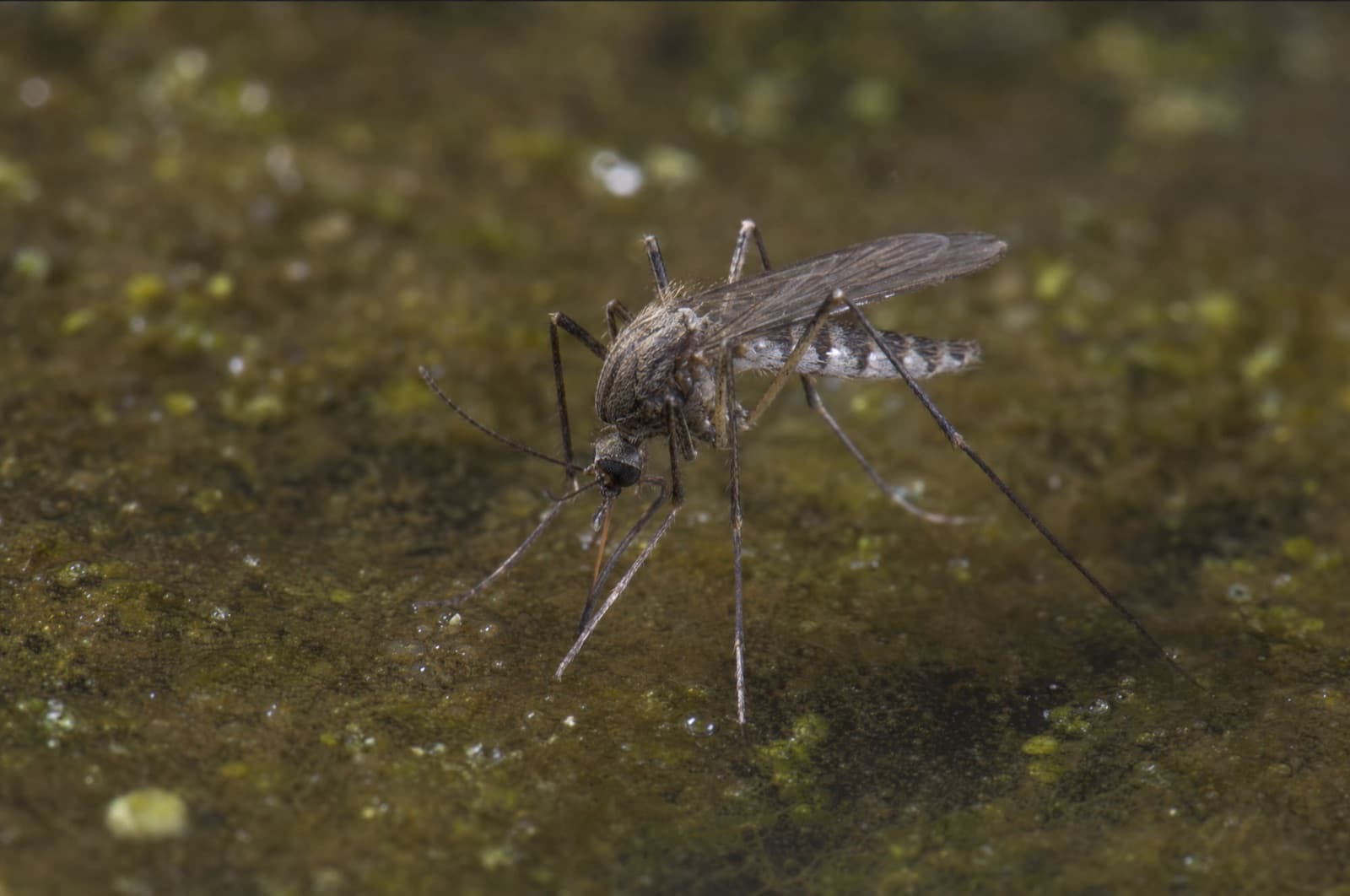
What Attracts Mosquitoes to Your House?
At a glance
- Short answer: Standing water is what makes mosquitoes near your house; carbon dioxide, warmth, and skin chemistry are what makes one bite you.
- The verdict: Something specific
The attractant verdict
Four possible answers to why this species turned up. Three stay unlit — and that's the argument: the honest answer could have been any of them, and for this species it wasn't.
Standing water is what makes mosquitoes near your house; carbon dioxide, warmth, and skin chemistry are what makes one bite you.
Most advice, including our own previous page, says mosquitoes are drawn to a house mainly by warmth, moisture, and "suitable environments," treated as one blended condition. That framing hides that two very different biological questions are being answered at once with one vague phrase.
Mosquitoes near a house are almost always explained by two separate mechanisms, not one. A population builds up because something on or near the property is holding standing water — a clogged gutter, a forgotten bucket, a plant saucer, a low spot that doesn't drain — because the larval and pupal stages are fully aquatic and females need standing water to lay eggs. Separately, whether a mosquito bites a particular person once it's already around has almost nothing to do with the house: it's driven by the carbon dioxide in exhaled breath at long range, skin-surface chemical compounds at closer range, and body heat and moisture right at the skin.
“Standing water is what makes mosquitoes; your breath, warmth, and skin chemistry are what makes them bite you — two different problems with two different answers.”
Standing water sitting somewhere on or near the property long enough to complete a larval life cycle — often in a container people don't think of as a hazard: a clogged gutter, an unused kiddie pool, a tarp with a low spot, a saucer under a potted plant, an old tire.
It reframes the mosquito question from "my yard attracts mosquitoes" to "something specific nearby is holding water long enough to breed them." That distinction matters because eliminating a single container can matter more than any amount of general yard maintenance, and it explains why one property can have a serious mosquito problem while a similar one next door does not.
Calibrated from: Peer-reviewed research on mosquito host-seeking (PMC10789295, PMC5451829, PMC8779787) documents the separate biting-cue cascade; the aquatic requirement of the larval and pupal stages for standing water is the standard entomological basis for why breeding sites, not yard conditions generally, drive local mosquito populations.
Why it's here, in full
The house doesn't attract mosquitoes — a breeding site does
A house or yard does not draw mosquitoes toward it the way, say, a decaying carcass draws a blow fly. Adult mosquitoes are mobile and disperse widely on their own; what determines whether a property has a persistent mosquito problem is almost always whether it's supplying a breeding site nearby. The larval and pupal stages live entirely in water, and a female needs that standing water to lay eggs at all — even a small, easily overlooked volume works: a clogged gutter, a bucket left out after rain, a plant saucer, a tarp with a low fold, an old tire. None of that requires warmth, food debris, or clutter in the way ants or cockroaches do; it requires only water sitting still long enough to complete a life cycle.
That's the useful, checkable version of the answer. A property with no standing water anywhere nearby will still see mosquitoes passing through from elsewhere, but a persistent, worsening local population almost always traces back to a specific container or drainage problem, not to the house being generally hospitable.
Why 'they're attracted to me' is a separate, true question
Whether a mosquito bites a particular person has nothing to do with the house and is governed by a different set of cues entirely. Carbon dioxide from exhaled breath is the long-range signal that first activates and draws a mosquito in; skin-surface chemical compounds, many produced by ordinary skin microbes, help it confirm a human host at closer range; and body heat and moisture take over in the final approach. Peer-reviewed research on mosquito olfaction and host-seeking behavior documents this cascade across multiple mosquito species. None of it is something a house does — it's biology specific to the person being bitten, which is why two people standing in the same yard can have very different experiences.
How to tell it's actually this species
Real signs only — a species with four honest tells gets four, and stops. Where a sign is weak on its own, we say so.
Standing water sitting undisturbed for several days or more in a gutter, container, tarp fold, or low spot on the property
Small, comma-shaped larvae ("wigglers") visible near the surface of standing water, or pupae ("tumblers") that jerk when the water is disturbed
A noticeable increase in biting activity in the yard specifically at dawn and dusk, when many common species are most active
Could be something else: Biting pressure also depends on wind, temperature, and nearby wetlands, so more bites on a given evening doesn't by itself point to a breeding site on your own property.
Mosquitoes resting on shaded vegetation or the underside of decks and porches during the day, rather than actively flying
Want mosquito gone?
This page only answers why it's here. Every removal step for this exact species — what to seal, what to set, what actually works — lives on its own dedicated guide.
Two questions, two pages
Here: why it turned up at all — the honest answer, blame removed.
There: the step-by-step removal guide for this exact species.
Key takeaways
- A yard or house doesn't attract mosquitoes in the abstract — a specific standing-water container nearby breeds them.
- Whether a person gets bitten is a separate question, driven by exhaled CO2, skin chemistry, and body heat.
- Checking gutters, containers, and low spots is more useful than general yard cleanup.
- Repellents and yard treatment options are a different question — see /top-diy-methods/mosquito.
Found standing water you can't eliminate yourself?
This page is about why mosquitoes are near your property. Treatment and repellent options are covered at /top-diy-methods/mosquito.
Frequently asked
Sources(3)
- [1]PMC — Mosquito host-seeking and olfactory coding of carbon dioxide
Carbon dioxide activates and attracts mosquitoes as a long-range host-seeking cue
academicverified 2026-07-17 - [2]PMC — Skin-derived volatile compounds and mosquito host preference
Skin-surface chemical compounds, many microbe-derived, are sensed differentially across mosquito species at close range
academicverified 2026-07-17 - [3]PMC — Heat-seeking behavior gated by carbon dioxide in Culex mosquitoes
Close-range heat-seeking in host-seeking mosquitoes is gated by prior CO2 detection
academicverified 2026-07-17
Written & reviewed by
VerifiedDaniel Brady
NH-Licensed Pesticide Applicator · License #782664 (NHDAMF, RSA 430)
Daniel Brady is the New Hampshire–licensed applicator behind Anchor Pest Services, a family-owned pest control company serving the Manchester area since 2017.
Last updated Jul 2026
It's the water, not the yard
We look for the specific breeding source
Seasonal mosquito service across southern and central New Hampshire, starting with the standing water most people overlook.
- Family-owned in Manchester since 2017
- NH commercial applicator #782664, category F1
- We will tell you when the answer is do nothing
NH License #782664 · No obligation · We answer in person