
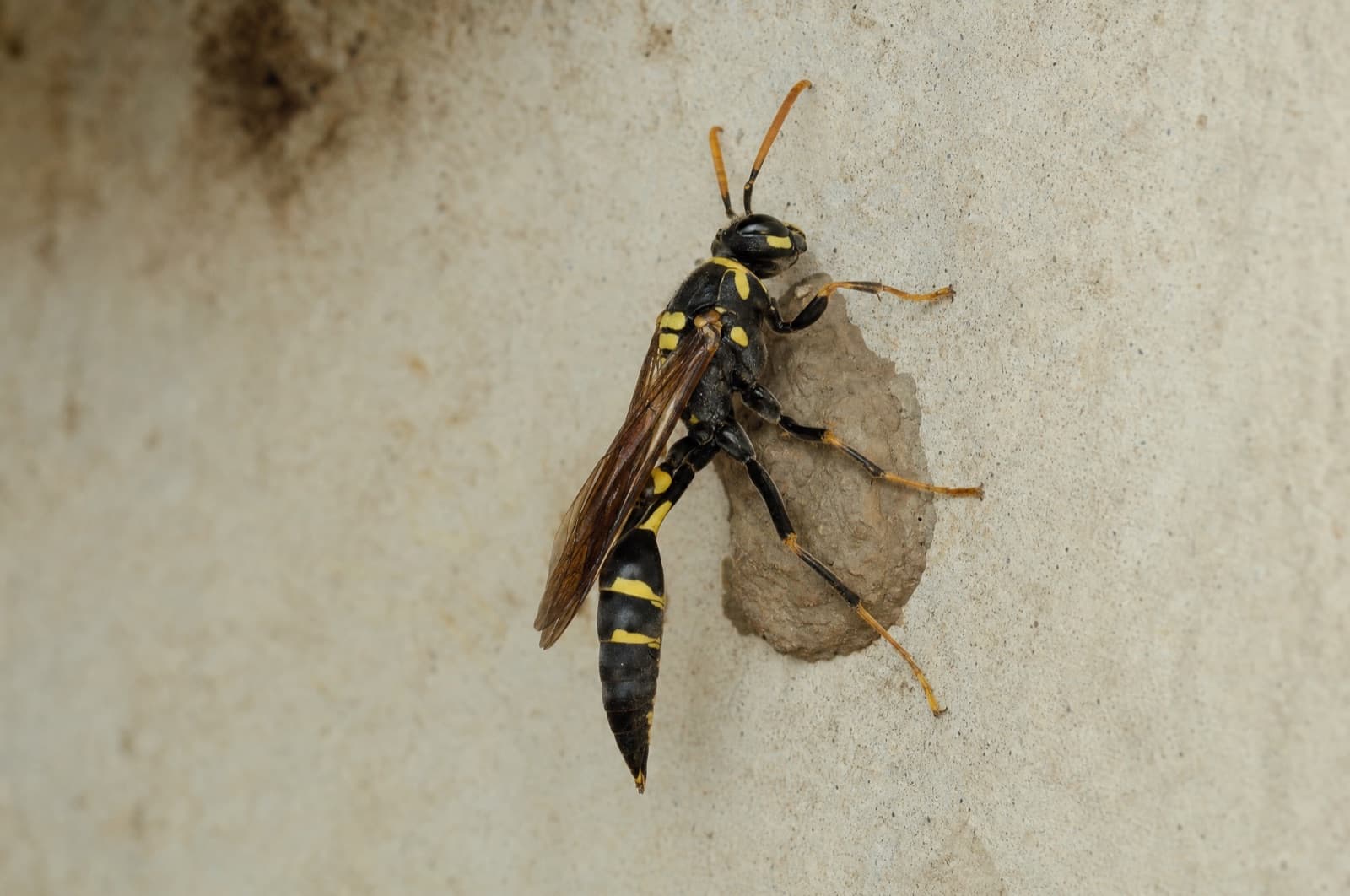
What Attracts Mud Daubers to Your House?
At a glance
- Short answer: Nesting sites and spider prey — nothing about mud daubers is special
- The verdict: The usual four
The attractant verdict
Four possible answers to why this species turned up. Three stay unlit — and that's the argument: the honest answer could have been any of them, and for this species it wasn't.
This is the most common answer in this hub — an answer, not a shortfall.
Nesting sites and spider prey — nothing about mud daubers is special
Our own old page said mud daubers are attracted "mainly for two reasons: shelter and food" — a fair summary, though "food" undersells what's actually happening: they're hunting spiders specifically, not general food debris.
A flat, sheltered surface to build a tube-shaped mud nest on — eaves, overhangs, and wall corners are typical — plus nearby mud and a supply of spiders. Each nest cell gets packed with paralyzed spiders as food for a single wasp larva, which ties this species' presence to whatever spider population is already active around the building.
“Nesting surfaces and spider prey — the same ordinary needs behind most wasps. Nothing about a mud dauber is special, and that's the honest answer.”
Why it's here, in full
Why there's no special story here
Mud daubers are solitary wasps — a single female builds each nest without help from a colony, choosing a flat, sheltered surface such as an eave, wall corner, or overhang, then packing each mud cell with spiders she's hunted and paralyzed as food for one larva. A single nest can end up provisioned with dozens of spiders across its cells, which means an active mud dauber population is really just tracking a nearby spider population.
That's the whole story: a dry, sheltered building surface plus spiders to hunt. Because they're solitary and don't defend a nest the way social wasps do, they're also far less likely to sting unless handled directly.
How to tell it's actually this species
Real signs only — a species with four honest tells gets four, and stops. Where a sign is weak on its own, we say so.
Hard, tube-shaped mud nests attached to an eave, wall, or ceiling overhang
Paralyzed spider remains near an open or broken nest cell
A dark, narrow-waisted wasp working alone at a mud nest rather than in a group
Want mud dauber gone?
This page only answers why it's here. Every removal step for this exact species — what to seal, what to set, what actually works — lives on its own dedicated guide.
Two questions, two pages
Here: why it turned up at all — the honest answer, blame removed.
There: the step-by-step removal guide for this exact species.
Key takeaways
- Mud daubers are solitary wasps that build individual mud nests on sheltered surfaces like eaves and wall corners.
- Each nest cell is provisioned with spiders the female wasp hunts and paralyzes, not general food debris.
- Because they're solitary, they rarely sting unless a nest is directly handled.
- Removal steps live at /top-diy-methods/mud-dauber.
Want it gone, not just explained?
This page is about why mud daubers build nests here. Removal is covered at /top-diy-methods/mud-dauber.
Frequently asked
Sources(2)
- [1]Utah State University Extension — Mason, Potter & Mud-Dauber Wasps
Mud daubers are solitary wasps that build mud nests on sheltered surfaces and rarely sting unless directly handled
extensionverified 2026-07-17 - [2]Purdue University Extension Entomology — Mud Daubers
Mud dauber nest cells are provisioned with spiders that the female wasp hunts and paralyzes as food for her larvae
extensionverified 2026-07-17
Written & reviewed by
VerifiedDaniel Brady
NH-Licensed Pesticide Applicator · License #782664 (NHDAMF, RSA 430)
Daniel Brady is the New Hampshire–licensed applicator behind Anchor Pest Services, a family-owned pest control company serving the Manchester area since 2017.
Last updated Jul 2026
Nesting surfaces and prey — nothing unusual here
If nests are already up, we handle the rest
Same-day inspections across southern and central New Hampshire.
- Family-owned in Manchester since 2017
- NH commercial applicator #782664, category F1
- We will tell you when the answer is do nothing
NH License #782664 · No obligation · We answer in person