
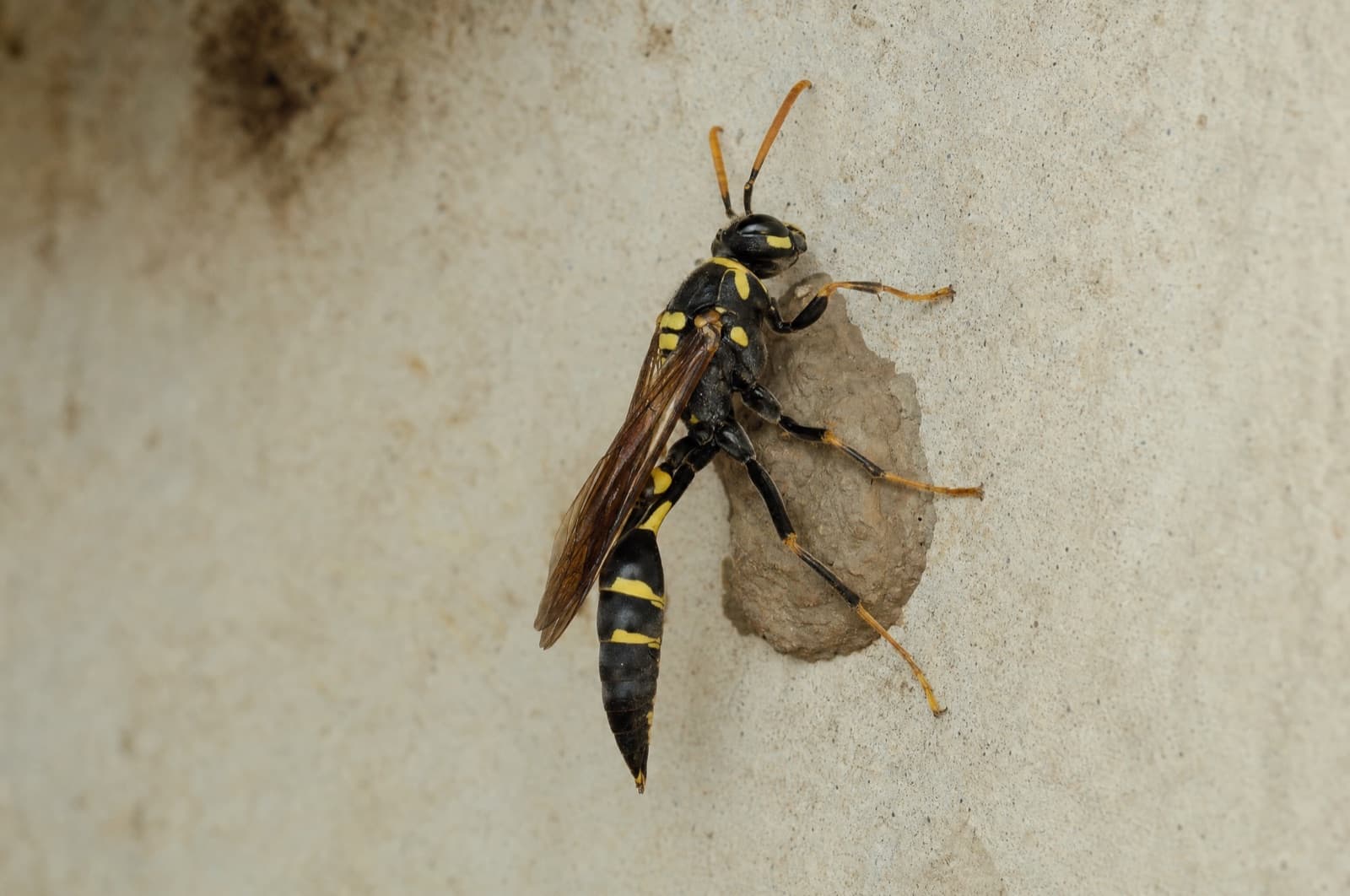
Mud Dauber — Quick ID for New Hampshire Homeowners
Also called Dirt dauber · Mud wasp
Mud daubers are solitary wasps known for their thread-thin waist and mud nests — pipe-organ tubes or a smooth daub on a sheltered wall or eave. They are non-aggressive and rarely sting. This is the fast identifier; for nest cleanup and lookalike comparisons, see the full guide.
- Size
- 20–30 mm
- adult body length; among the longer NH wasps
- Waist
- Thread-thin
- the single best visual tell
- Nest
- Mud tubes or daub
- not paper; passive, not guarded
- Sting risk
- Very low
- solitary; stings only if directly handled
Is it a mud dauber?
Mud daubers are identified by their thread-thin waist and distinctive hardened mud nests on sheltered walls, eaves, and garage ceilings across New Hampshire. They are solitary, non-aggressive wasps — one of the most distinctive-looking insects you'll find on your home.
This page is a fast identifier. For nest cleanup, seasonal timing, and lookalike comparisons, see the complete mud dauber guide in the Wasp Species hub linked above.
Quick mud dauber ID
A few features make mud daubers immediately recognizable from other NH wasps.
Mud dauber
- Scientific name
- Sceliphron caementarium (black-and-yellow mud dauber); Chalybion californicum (blue mud dauber)
- Family
- Sphecidae
- Size
- 20–30 mm
- Coloration
- Black with yellow markings (S. caementarium) or iridescent metallic blue (C. californicum)
- Habitat
- Sheltered vertical surfaces — eaves, shed ceilings, garage walls, barn timbers, porch overhangs
- Active season
- Late spring through early fall
- Diet
- Provisions nests with paralyzed spiders for larvae; adults feed on nectar
- Lifespan
- Single season; no overwintering colony
Found throughout New Hampshire in summer; nests in sheltered structures statewide.
The tells — key ID features
- Thread-thin, elongated waist (petiole) — the single most distinctive feature of any NH wasp.
- Black-and-yellow or iridescent metallic blue body; no bright banding pattern.
- Solitary, calm, non-defensive flight near a wall — not clustered or territorial.
- Builds hardened mud — pipe-organ tubes or a smooth lump — never paper.
Paper wasp
How to tell — Paper wasps have a narrower waist but build open paper combs and dangle their legs in flight; mud daubers build mud tubes and are far more slender overall.
Cicada killer wasp
How to tell — Cicada killers are much larger (30–40 mm), nest in ground burrows, and have amber wings — not mud-nest builders.
Signs of a problem
The mud nest is the giveaway.
Finger-length mud tubes or a smooth mud lump on a sheltered wall or eave
What it means — Active or old mud dauber nest — females provision each tube with spiders for larvae.
A lone slim wasp repeatedly landing at a mud puddle or wet wall
What it means — Female gathering mud or water to provision nests.
Mud dauber removal in New Hampshire
Mud daubers are non-aggressive and beneficial (they reduce spider populations). Nest removal is cosmetic unless nests are numerous or staining a surface. The full guide covers identification and when removal makes sense.
When to call a pro
- Nests are numerous or staining siding, trim, or masonry.
- Old mud nests are attracting other insects (they may be reused by other species).
- You want confirmation the ID is not a more aggressive species.
Not sure it's a mud dauber?
A licensed NH technician can confirm the species and tell you honestly whether it's a DIY fix or a job for a pro — free inspection, same-day service across Southern New Hampshire.
Frequently asked questions
Sources(2)
- [1]University of Florida IFAS Extension — Mud Daubers
biology, behavior, sting risk
extensionverified 2026-06-30 - [2]Anchor Pest — Mud Dauber Wasp Guide
full NH identification, nest removal, lookalikes
industryverified 2026-06-30
Written & reviewed by
VerifiedDaniel Brady
NH-Licensed Pesticide Applicator · License #782664 (NHDAMF, RSA 430)
Daniel Brady is the New Hampshire–licensed applicator behind Anchor Pest Services, a family-owned pest control company serving the Manchester area since 2017.
Last updated 2026-06-30

New Hampshire pest control
Dealing with mud daubers in your home?
Anchor Pest Services identifies and handles mud dauber problems across southern and central New Hampshire. Family-owned since 2017, NH license #782664.
- NH-licensed applicators (#782664)
- Same-day service · free inspection
- Family-owned since 2017
Your next step
- What to do next
How to Get Rid of Mud Daubers
Read the answer - Also relevant
Can mud dauber nests stain walls or eaves?
Read the answer - Related guide
Paper Wasp — Quick ID for New Hampshire Homeowners
Read the answer - Also relevant
Do pests harm decks or outdoor furniture?
Read the answer - Also relevant
Can Removing a Nest Provoke Multiple Stings From Wasps?
Read the answer