
What Attracts Sawtoothed Grain Beetles to Your House?
At a glance
- Short answer: Sawtoothed grain beetles can't fly and aren't drawn to light. There's no route in except an already-infested product.
- The verdict: You didn't attract it — you carried it in
The attractant verdict
Four possible answers to why this species turned up. Three stay unlit — and that's the argument: the honest answer could have been any of them, and for this species it wasn't.
Sawtoothed grain beetles can't fly and aren't drawn to light. There's no route in except an already-infested product.
Our own previous page said this beetle is "attracted to your house primarily because of food sources, particularly stored grains and dried foods," phrasing that implies it's actively seeking out a pantry rather than arriving inside one specific bag.
An already-infested package of birdseed, cereal, dried fruit, nuts, or similar dry goods, carried in without the beetle ever traveling toward the house independently — it cannot fly and does not respond to light the way some other pantry beetles do.
“This beetle can't fly and isn't drawn to light. If it's in your house, a bag of something carried it there — nothing else could have.”
Why it's here, in full
No flight, no light attraction — no route in except the product
What makes the sawtoothed grain beetle the cleanest carried-in case in this hub's pantry-pest group is a simple biological fact: extension entomology describes it as unable to fly and not attracted to light, unlike several of its stored-product relatives. That rules out the two pathways that give other pantry beetles a partial, honest exception — there's no version of this species flying in through a window or crawling toward a porch light. University of Georgia Extension identifies infested birdseed specifically as a leading source of sawtoothed grain beetle infestations, alongside cereal, dried fruit, and nuts.
Our old page's "attracted to your house... because of food sources" framing implies the beetle went looking. It couldn't have — its only way in is inside a package that already had it.
A flat body built for slipping into packaging, not for traveling
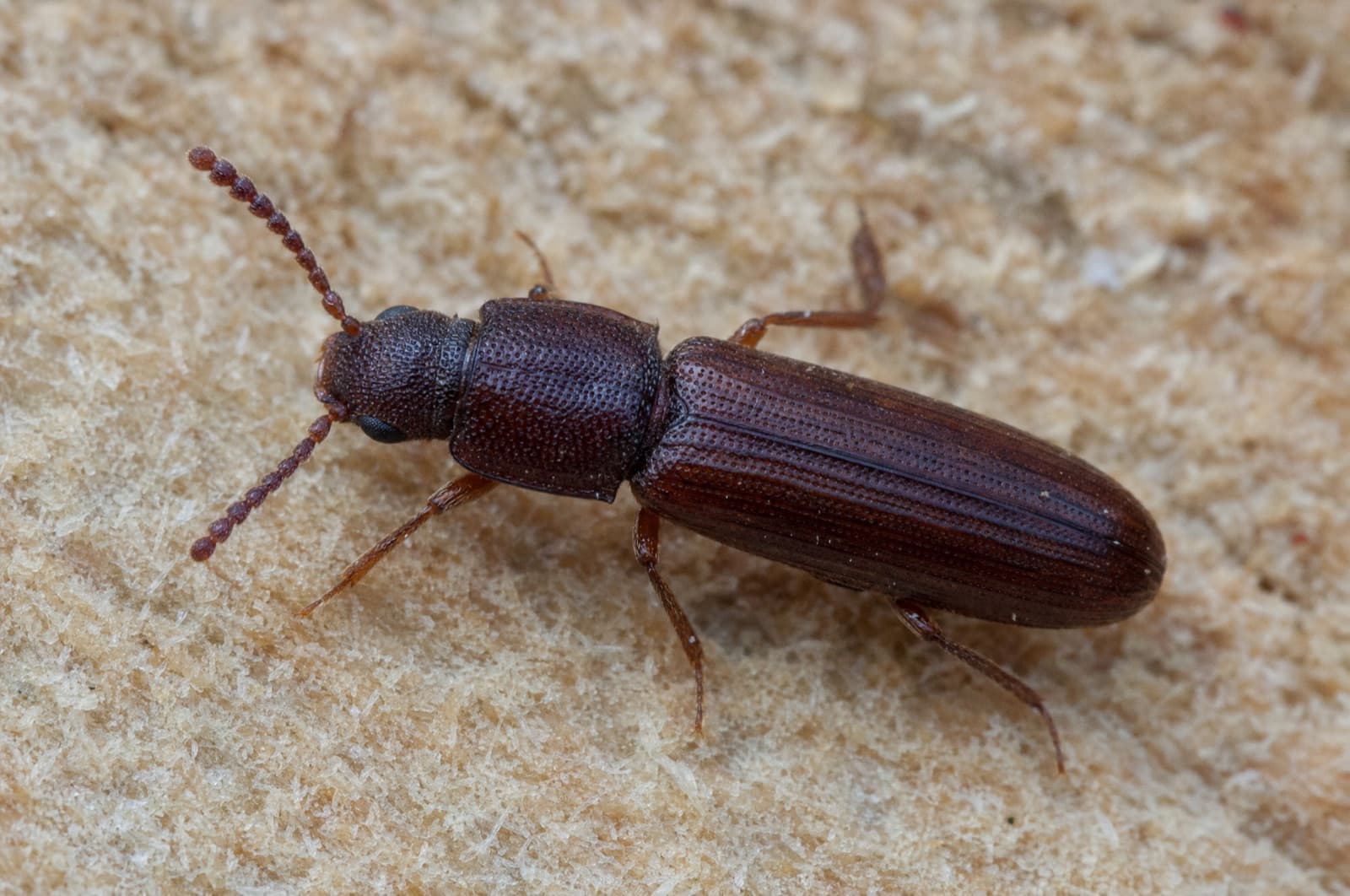
This species' distinctly flattened body is well-documented as an adaptation for squeezing into cracked grain kernels and through tiny gaps in cardboard, foil, or thin plastic packaging — Clemson University's HGIC fact sheet notes it can enter sealed boxes and soft plastic packaging directly. That's a body built for infiltrating a single product, not for traveling across a room or a yard looking for a house. Every documented pathway for this species starts and ends with a specific bag or box; the house itself never enters into it.
How to tell it's actually this species
Real signs only — a species with four honest tells gets four, and stops. Where a sign is weak on its own, we say so.
Small, flat, brownish beetles with saw-like projections along the sides of the thorax found in grain, cereal, or dried fruit
Beetles found inside sealed or nearly sealed packaging, since this species can slip through very small gaps in cardboard and soft plastic
Fine debris or moisture buildup in an affected package that can lead to mold
Could be something else: Moisture and mold in stored food can have other causes; the beetle's presence, not the moisture alone, confirms this species.
Live beetles crawling slowly on a pantry shelf near an opened bag of birdseed, cereal, or dried fruit
Want sawtoothed grain beetles gone?
This page only answers why it's here. Every removal step for this exact species — what to seal, what to set, what actually works — lives on its own dedicated guide.
Two questions, two pages
Here: why it turned up at all — the honest answer, blame removed.
There: the step-by-step removal guide for this exact species.
Key takeaways
- This beetle can't fly and isn't drawn to light. If it's in your house, a bag of something carried it there — nothing else could have.
- Cleanliness isn't the deciding factor here — the actual vector is what matters.
- What actually matters: food.
- If it's already inside, removal is a different question — see /top-diy-methods/sawtoothed-grain-beetle.
Found this beetle in birdseed or grain?
This page is about why they showed up. Locating the infested product and removal steps are covered at /top-diy-methods/sawtoothed-grain-beetle.
Frequently asked
Sources(2)
- [1]Clemson University HGIC — Saw-Toothed Grain Beetle
Flattened body adapted to penetrate broken grain kernels and packaging; inability to fly
extensionverified 2026-07-17 - [2]University of Georgia Cooperative Extension — Stored Product Pests in the Home (B1378)
Infested birdseed as a leading source of sawtoothed grain beetle infestations
extensionverified 2026-07-17
Written & reviewed by
VerifiedDaniel Brady
NH-Licensed Pesticide Applicator · License #782664 (NHDAMF, RSA 430)
Daniel Brady is the New Hampshire–licensed applicator behind Anchor Pest Services, a family-owned pest control company serving the Manchester area since 2017.
Last updated Jul 2026
It can't fly here — a bag had to carry it
Dealing with grain beetles in stored food?
Same-day inspections across southern and central New Hampshire — we'll help pinpoint the source product.
- Family-owned in Manchester since 2017
- NH commercial applicator #782664, category F1
- We will tell you when the answer is do nothing
NH License #782664 · No obligation · We answer in person