
Sawtoothed Grain Beetle: New Hampshire's #1 Kitchen Pest
Also called Malt beetle
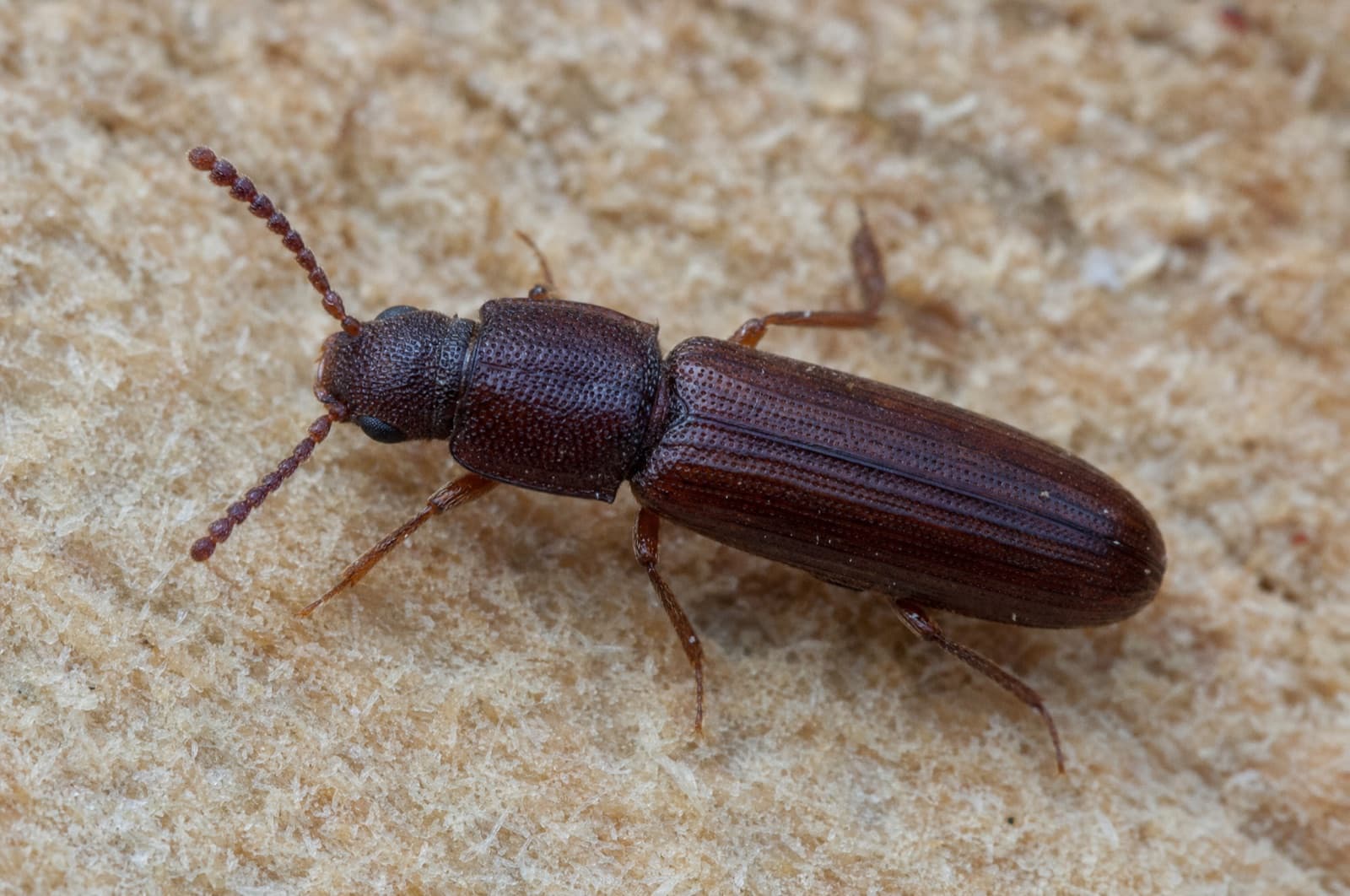
The sawtoothed grain beetle is New Hampshire's most common kitchen pest — a slender, flat, dark-brown beetle named for the six tooth-like projections on each side of its thorax. Because it is flat and tiny, it slips into 'sealed' cardboard boxes and soft plastic packages of cereal, flour, pasta, and pet food. It doesn't bite or harm the home; find and discard the infested source and store dry goods in airtight containers.
- Adult size
- ~2.4–3 mm (about 1/10 inch), slender, flat, dark brown
- UNH Cooperative Extension
- Defining feature
- Six saw-tooth projections on each side of the thorax — visible under a hand lens
- UNH Cooperative Extension
- Package entry
- Flat enough to enter through glue seams and micro-gaps in sealed cardboard and soft plastic
- Oklahoma State University Extension
- Egg production
- ~40–300 eggs per female; life cycle ~20–80 days depending on temperature
- NC State Extension; UNH Cooperative Extension
- Longevity
- Adults live an average of 6–10 months; up to 3 years
- UNH Cooperative Extension
- NH status
- The most common kitchen pest in New Hampshire
- UNH Cooperative Extension 'Kitchen Pests' fact sheet
NH's most common kitchen pest — and why 'sealed' packaging won't stop it
Per UNH Cooperative Extension, the sawtoothed grain beetle is New Hampshire's most common kitchen pest. It earns that title partly through sheer ubiquity and partly through a key adaptation: it is flat and tiny enough to crawl through the glue seams and micro-gaps of 'sealed' cardboard boxes and soft plastic packages. An unopened box of cereal is not proof of safety from this beetle.
The beetle is named for the six saw-tooth projections along each side of the thorax — visible under a hand lens and definitive for identification. It's a slender, ant-like dark brown beetle about 1/10 inch long, often mistaken for a small ant when it walks across a counter.
Like all the pantry beetles in this library, it does not bite, sting, or damage your home. The entire problem is contaminated food. The fix is find-and-discard the source package, clean cabinet cracks where debris accumulates, and transfer dry goods to airtight glass or metal containers — which the beetle cannot enter. The page's key insight: 'sealed' cardboard is not airtight, and this beetle exploits that.
How to identify the sawtoothed grain beetle — the 'teeth' are the tell
The six saw-tooth projections along each side of the thorax (the mid-section between head and abdomen) are the definitive field mark. They're visible to the naked eye but clearer under a hand lens. No other common New Hampshire pantry beetle has these thoracic projections. The body is slender, flat, and dark brown — the flatness is functional, allowing it to enter sealed packaging.
Sawtoothed grain beetle
- Scientific name
- Oryzaephilus surinamensis
- Family
- Silvanidae
- Size
- ~2.4–3 mm (about 1/10 inch)
- Coloration
- Slender, flat, dark to reddish-brown
- Habitat
- Pantry packages and adjacent rooms; cabinet cracks and corners where food debris accumulates
- Active season
- Year-round in heated NH homes
- Diet
- Cereals, flour, pasta, dried fruit, dried meats, candy, pet food — cannot attack intact whole grain
- Reproduction
- ~40–300 eggs per female; life cycle ~20–80 days depending on temperature
- Lifespan
- Average 6–10 months; up to 3 years
Worldwide; the most common kitchen pest in New Hampshire per UNH Cooperative Extension
The tells — key ID features
- Six saw-like 'teeth' along each side of the thorax — use a hand lens; this is the definitive ID feature.
- Slender, flat, dark-brown body ~1/10 inch — the flatness is what allows it to enter sealed packaging.
- Often mistaken for a tiny ant on the counter; check for the thoracic teeth.
- Enters sealed cardboard boxes and soft plastic packages through package seams and micro-gaps.
- Small, slender, cream-colored larvae with a brown head inside packages.
- Frequently found alongside other pantry pests in mixed infestations.
Size, to scale
2.4–3 mm
About the size of a small ant or a short fragment of a rice flake
Merchant grain beetle (Oryzaephilus mercator)
How to tell — Nearly identical, but the merchant grain beetle has slightly larger, more rounded eyes and a more rounded head; it also prefers oilseed products (nuts, seeds, cooking oil) over grain.
Flour beetles (red and confused)
How to tell — Oval and elongate with no thoracic 'teeth'; reddish-brown rather than dark brown; flour beetles lack the saw-tooth projections entirely.
Cigarette and drugstore beetles
How to tell — Humpbacked and oval — very different silhouette from the flat, tooth-edged sawtoothed grain beetle.
Signs of a problem
Sawtoothed grain beetles are easily missed because they're small and flat. These signs reveal both their presence and their source.
Tiny flat brown beetles walking on counters or in cabinets
What it means — Active adults from a nearby source — begin inspecting all pantry packages, especially cereals and pasta.
Beetles inside sealed cereal or cracker boxes
What it means — They entered through package seams or gaps — an unopened box is not proof of safety from this beetle.
Beetles found in several packages at once
What it means — Spread from a primary source has already occurred; all affected packages must be discarded.
Insects in cabinet cracks and corners
What it means — Food debris in cracks is sustaining the population; thorough vacuuming of these spots is critical.
Beetles in dried fruit, pasta, or pet food
What it means — These are preferred foods; check any long-stored dried goods in that area.
Ant-like crawlers near the pantry that are too small to be ants
What it means — Often this beetle — the slender flat body and walking gait mimic a small ant; check under magnification for thoracic teeth.
The real risks, calibrated
The sawtoothed grain beetle is a food-loss pest. Its long adult life and package-penetrating flatness make it persistent, but it poses no health threat.
Food contamination
ModerateOnset: Ongoing while infested packages remain
Infested cereals, pasta, dried fruit, and pet food are contaminated with live insects, cast skins, and frass — must be discarded.
Rapid spread to multiple packages
ModerateOnset: Within weeks of an unresolved source
Adults readily enter new packages through seams; one infested bag can colonize an entire pantry.
Long-lived persistence
Low riskOnset: Ongoing
Adults surviving 6–10 months (up to 3 years) can sustain an infestation even on minimal food debris in cracks.
Mixed infestations complicating cleanup
Low riskOnset: Ongoing
Often co-occurs with flour beetles, Indian meal moth, and other pantry pests — all sources must be found and removed.
Biting, stinging, or disease
Low riskOnset: N/A
None — harmless to people, pets, and structural materials.
DIY — what works, what backfires
The key insight is that 'sealed' packaging is not safe from this beetle. Airtight glass or metal is the real defense.
What actually works
- Find and discard all infested packages — seal in a plastic bag and remove from the house immediately.
- Vacuum and wash cabinet cracks, corners, and shelf surfaces thoroughly; the fine debris and 'fines' in cracks sustain the population after packages are removed.
- Transfer all dry goods to airtight glass, metal, or rigid hard plastic containers — not soft plastic bags or original cardboard packaging.
- Inspect new groceries before storing; check for evidence of beetles or entry holes in packaging.
- Check adjacent rooms and secondary storage areas — pet food and birdseed are common overlooked sources.
- Apply the UNH salvage standard (130°F/30 min or 0°F/4 days) to any borderline item before airtight repackaging.
What backfires
- Don't spray insecticide on food areas — not recommended and risks contaminating food.
- Don't trust intact-looking cardboard or soft plastic packaging to keep beetles out; they enter through microscopic seams and gaps.
- Don't store bulk dry goods long-term in original packaging; airtight rigid containers are essential for any NH pantry.
Sawtoothed grain beetles in New Hampshire kitchens
UNH Cooperative Extension's 'Kitchen Pests' fact sheet is explicit: 'The sawtoothed grain beetle (Oryzaephilus surinamensis), our most common kitchen pest, is a slender, flat, brown beetle approximately 1/10 inch long.' Heated NH homes allow year-round breeding despite outdoor winter temperatures. Good sanitation in cabinet cracks, under sinks, and behind appliances is the core NH prevention step — fine debris in these spots is the beetle's food reservoir. Apply the UNH salvage standard (heat at 130°F for 30 minutes or freeze at 0°F for four days) to any item you want to salvage, then repackage airtight.
Peak season
Year-round in heated NH homes; no outdoor NH population survives winter
You might actually have
- Merchant grain beetle (near-identical; larger eyes, rounder head, prefers oilseeds and nuts)
- Flour beetles (oval/elongate, reddish, no thoracic 'teeth')
- Indian meal moth (silk webbing in food, not hard-bodied beetles)
We serve these communities
- NH-licensed applicator · #782664
- Same-day service
- Family-owned since 2017
Service Area Map
Southern New Hampshire
When to call a pro for sawtoothed grain beetles
If beetles keep appearing despite discarding infested packages and cleaning shelves, fine debris in cabinet cracks, behind appliances, or in a missed package is sustaining them. A licensed technician can treat harborage areas appropriately. Anchor Pest Services (NH #782664, F1) offers General Pest Control with a free quote and same-day service.
When to call a pro
- Beetles persist for more than three weeks after discarding suspect food and thoroughly cleaning the pantry.
- Beetles are appearing in multiple rooms, suggesting spread beyond the kitchen.
- Repeated infestations recur despite regular airtight storage — a structural harborage in cabinet cracks or built-ins needs professional treatment.
- Mixed infestations (multiple pantry pest species) require a comprehensive inspection.
Airtight glass or metal for all dry goods
This is the most important step: sawtoothed grain beetles can enter through cardboard and soft plastic seams. Only airtight glass or metal containers — mason jars, metal tins, hard rigid plastic with a seal — provide an effective barrier.
Vacuum cabinet corners and cracks regularly
Fine debris in cabinet corners, under shelf liners, and behind appliances is the hidden reservoir. Regular vacuuming removes the beetle's food source and prevents population persistence even after all packages are cleared.
Store and check pet food and birdseed separately
Pet food and birdseed stored in NH mudrooms, garages, and pantries are common secondary sources. Keep in sealed hard containers and inspect regularly.
Not sure it's a sawtoothed grain beetle?
A licensed NH technician can confirm the species and tell you honestly whether it's a DIY fix or a job for a pro — free inspection, same-day service across Southern New Hampshire.
Frequently asked questions
Sources(7)
- [1]UNH Cooperative Extension — Kitchen Pests Fact Sheet
NH's most common kitchen pest; adult size; egg hatch 3–5 days; adults up to 3 years; salvage standard
extensionverified 2026-06-30 - [2]UNH Cooperative Extension — Kitchen Pests (migrated PDF)
supplemental NH fact sheet detail
extensionverified 2026-06-30 - [3]Penn State Extension — Sawtoothed and Merchant Grain Beetle
species comparison, head shape difference, food preferences
extensionverified 2026-06-30 - [4]Oklahoma State University Extension — Sawtoothed Grain Beetle
enters sealed cardboard and soft plastic packaging
extensionverified 2026-06-30 - [5]NC State Extension — Common Pantry Pests and Their Management
egg count (~40–300), life cycle range (~20–80 days)
extensionverified 2026-06-30 - [6]Insects Limited — Sawtoothed Grain Beetle
cannot attack intact whole grain; monitoring
industryverified 2026-06-30 - [7]UC IPM — Pantry Pests
food contamination, spread risk, no-spray guidance, persistence
extensionverified 2026-06-30
Written & reviewed by
VerifiedDaniel Brady
NH-Licensed Pesticide Applicator · License #782664 (NHDAMF, RSA 430)
Daniel Brady is the New Hampshire–licensed applicator behind Anchor Pest Services, a family-owned pest control company serving the Manchester area since 2017.
Last updated 2026-06-30

New Hampshire pest control
Dealing with sawtoothed grain beetles in your home?
Anchor Pest Services identifies and handles sawtoothed grain beetle problems across southern and central New Hampshire. Family-owned since 2017, NH license #782664.
- NH-licensed applicators (#782664)
- Same-day service · free inspection
- Family-owned since 2017
Your next step
- What to do next
Chemical Pantry Beetle Control: Why You Shouldn't Spray
Read the answer - Also relevant
Can beetles damage wood, grain, or stored goods?
Read the answer - Related guide
Flour Beetles in New Hampshire: Why Your Flour Smells Off & Control
Read the answer - Also relevant
Is It a Ladybug or an Asian Beetle?
Read the answer - Related guide
Asian Lady Beetle in New Hampshire: Honest ID & What to Do
Read the answer