
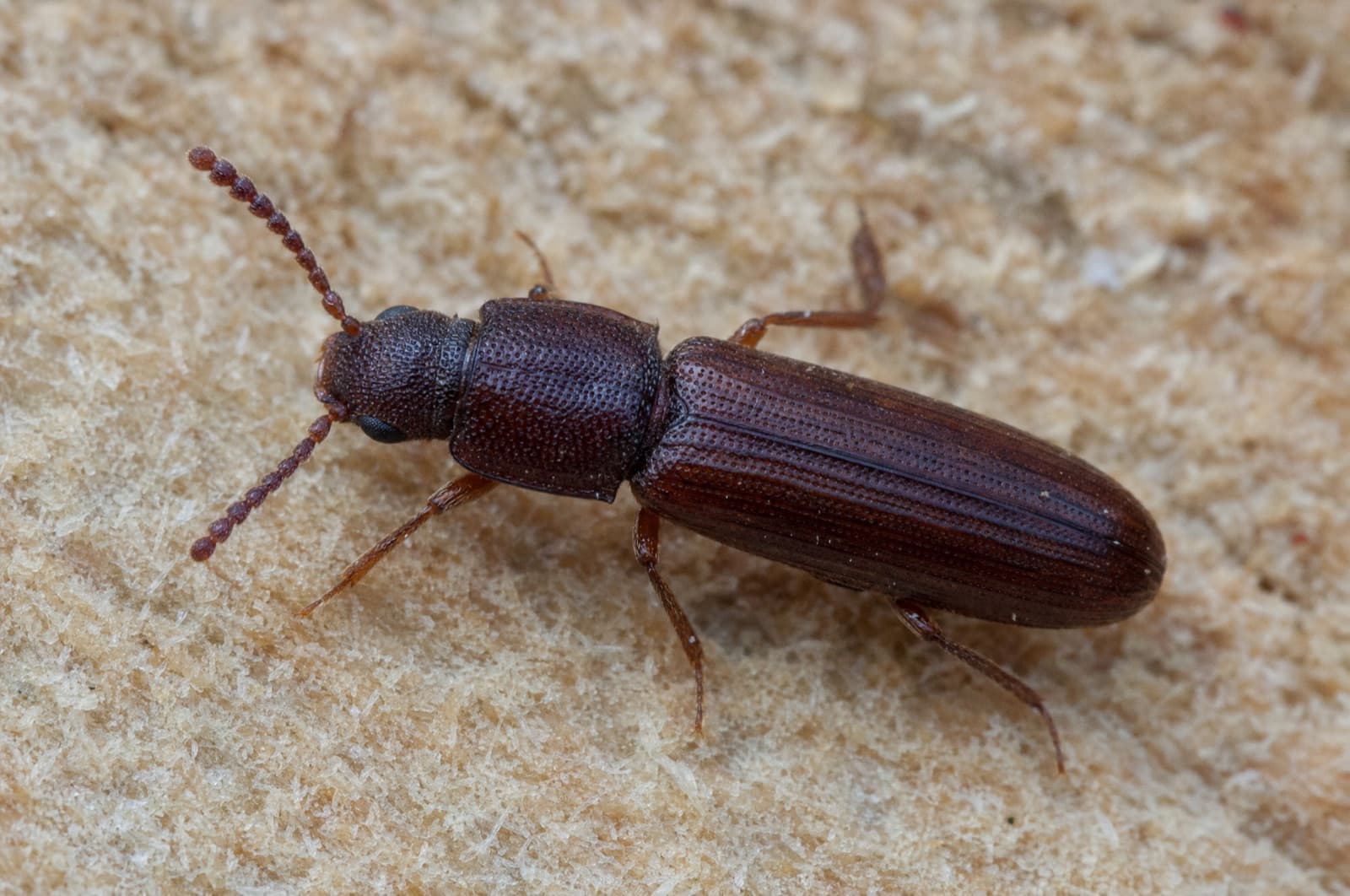
How to Get Rid of Sawtoothed Grain Beetles
At a glance
- Difficulty: Beginner
- Time: A few hours to inspect pet food/birdseed storage and pantry; ongoing airtight storage habit
- Cost: Low — gasketed containers and a vacuum
- Success: High with genuinely airtight (gasketed) storage; low if containers only look sealed but aren't
Can you DIY Sawtoothed Grain Beetle?
The verdict on Sawtoothed Grain Beetle DIY
A beginner-friendly DIY — but you need gasketed containers, not just a closed bag.
At about 1/10 inch and flat, Oryzaephilus surinamensis can slip through cracks and imperfectly sealed packaging that would stop other pantry beetles — its flat body form is literally why sealed containers matter. It can't attack sound whole kernels, but it thrives in cereal, dried fruit, pasta, birdseed, and pet food. There's no pesticide fix: find and discard infested items, then switch to truly gasketed airtight containers, not just a folded bag or a loose-lidded canister.
The 5 DIY methods — honestly graded
Every approach graded for this species, in IPM order — prevention first, chemistry late. Pick a method to see how it works, the steps, and what it actually takes.
Prevention / Exclusion
Works wellThe defining lever for this species — because it fits through fine seams, only true gasketed containers stop it, not a folded bag.
Its flat, small body form lets it enter imperfectly sealed packages and cracks that block other stored-product beetles, so exclusion has to be more rigorous here than for its cluster-mates.
Best for: Stopping introductions given this species' unusual ability to breach imperfect seals
Use containers with a true gasket seal
Store cereal, pasta, dried fruit, birdseed, and pet food in rigid containers with a rubber-gasketed lid — a loosely-closed bag or a snap-lid without a gasket isn't enough for this species.
TipInspect pet food and birdseed storage specifically — these are common sources.Seal cracks and seams
Caulk or seal small gaps in cabinetry and pantry shelving where this flat-bodied beetle can hide and travel between packages.
Tools & materials
Why DIY falls short here
Not scare tactics — the specific, proportionate reasons a home attempt can stall for this species.
Seam penetration
The flat body enters imperfectly sealed packages and small cracks that would stop other pantry beetles, so half-measures — a folded bag, a loose-lidded canister — fail where they'd work for other species.
Cracks and crevices harbor survivors
Beetles and food dust collect in cabinet seams, so a clean-out that skips crack-vacuuming leaves a population behind.
Pet food and birdseed overlooked
These are common sources that get missed when people focus only on the kitchen pantry.
How risky is it, really?
An honest read — most nuisance species are genuinely low risk, and we say so.
Sawtoothed grain beetles are a nuisance/contamination pest — no bite, sting, or disease. The only real harm is spoiled grain products and pet food/birdseed.
- Contamination of cereal, pasta, birdseed, and pet foodCommon
The main real-world harm — discard infested items and switch to gasketed containers
Dodson Pest Control / stored-product Extension references
- Health or property harm to people or petsRare
No bite, sting, or disease association
University of Minnesota Extension
Sawtoothed Grain Beetles Keep Coming Back?
A recurring infestation usually means storage that isn't truly sealed or a source in pet food/birdseed. Anchor Pest Services offers inspection across southern and central New Hampshire. Family-owned since 2017, NH license #782664.
Call a pro when…
- Beetles reappear despite switching to gasketed containers
- You suspect a hidden source in pet food or birdseed storage you can't fully inspect
- You want a professional inspection to rule out a broader stored-product issue
General Pest Control
You almost never need a pro for sawtoothed grain beetles — this is a find-and-seal job. The exception is a persistent infestation despite genuinely gasketed storage.
Keep them out
- Use containers with a true gasket seal, not just a closed bag
- Inspect pet food and birdseed storage specifically
- Vacuum cabinet cracks and seams regularly
Sawtoothed grain beetles in New Hampshire
UNH Cooperative Extension's Kitchen Pests fact sheet singles out the sawtoothed grain beetle as one of the four primary stored-product pests it documents in New Hampshire kitchens, alongside the confused flour beetle, dermestid (carpet) beetles, and the Indian meal moth. Like those, it doesn't follow a seasonal outdoor cycle — New Hampshire's heated homes let it persist year-round wherever cereal, pasta, birdseed, or pet food sits in imperfectly sealed storage. There's no frost-timing shortcut; the UNH-consistent fix is sanitation and genuinely gasketed containers, in every season.
Peak season
Year-round indoors — no seasonal die-off
Make sure it's a Sawtoothed Grain Beetle
Two quick detours worth taking — confirm the ID, then learn what drew it in so it doesn't come back.
Frequently asked
Sources & further reading(3)
- [1]Dodson Pest Control — Stored Product Pests
Flat body/seam-penetration mechanism, damage to grain not sound kernels
industryverified 2026-07-13 - [2]University of Minnesota Extension — Pantry Pests: Insects Found in Stored Food
Sanitation control, heat/freeze treatment
extensionverified 2026-07-13 - [3]UNH Cooperative Extension — Kitchen Pests [fact sheet]
Sawtoothed grain beetle named as one of four primary stored-product kitchen pests in New Hampshire; sanitation-based control
extensionverified 2026-07-22
Written & reviewed by
VerifiedDaniel Brady
NH-Licensed Pesticide Applicator · License #782664 (NHDAMF, RSA 430)
Daniel Brady is the New Hampshire–licensed applicator behind Anchor Pest Services, a family-owned pest control company serving the Manchester area since 2017.
Last updated July 2026
Other species you can tackle
Same category — the dot shows each one's DIY verdict at a glance (green = friendly, amber = doable with care, red = call a pro).
Professional Pest Control
Sawtoothed Grain Beetles Keep Coming Back?
A recurring infestation usually means storage that isn't truly sealed or a source in pet food/birdseed. Anchor Pest Services offers inspection across southern and central New Hampshire. Family-owned since 2017, NH license #782664.
- Source-tracing inspection
- NH-licensed applicators (#782664)
- Free inspection — same-day service across southern NH
NH License #782664 · No obligation · We answer in person