
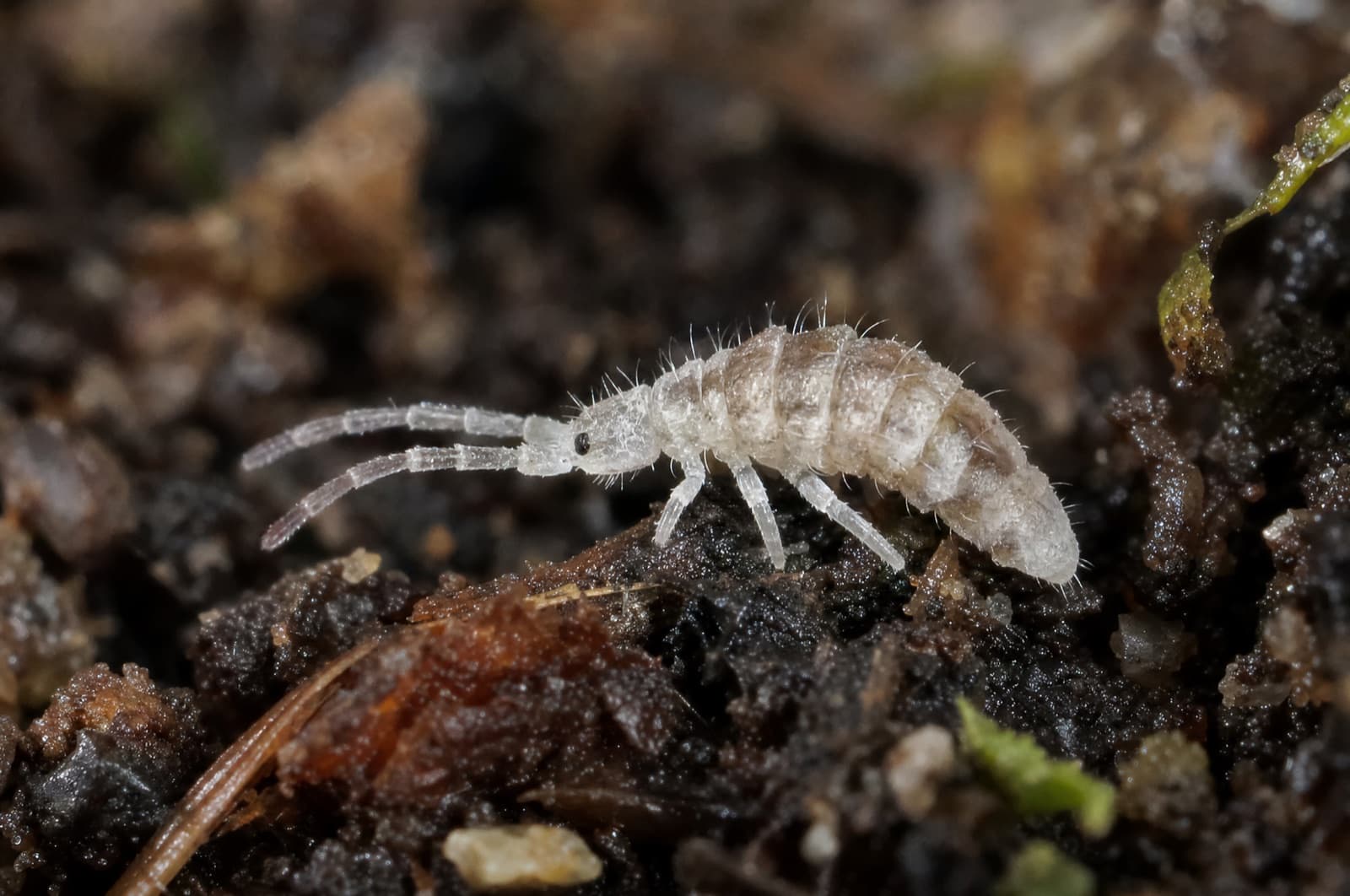
What Attracts Springtails to Your House?
At a glance
- Short answer: Springtails are basically walking humidity gauges — indoors they mean dampness or mold, and they vanish when the moisture is fixed.
- The verdict: Something specific
The attractant verdict
Four possible answers to why this species turned up. Three stay unlit — and that's the argument: the honest answer could have been any of them, and for this species it wasn't.
Springtails are basically walking humidity gauges — indoors they mean dampness or mold, and they vanish when the moisture is fixed.
Most advice, including our own previous page, describes springtails as small jumping insects that "can sometimes find their way into your home," mainly attracted to "moisture and decay." That's directionally right but doesn't explain how tightly this species is bound to water balance specifically, rather than to shelter or food in any broader sense.
Springtails (Collembola) have a thin cuticle that lets water escape easily, making them extremely prone to drying out, so their entire distribution is governed by moisture. They show up indoors for one of two closely related reasons: their outdoor habitat dried out and they moved toward a damp indoor spot, or an indoor area already has the dampness and mold they need — a leaking pipe, a damp crawlspace, overwatered potted plants, or a chronically wet basement corner. Either way, springtails are less a household pest in the ordinary sense and more a visible signal that moisture is sitting somewhere it shouldn't be.
“Springtails are basically walking humidity gauges — indoors they mean dampness or mold, and they vanish when the moisture is fixed.”
Persistent dampness, often paired with mold or fungal growth — a leaking pipe, a damp crawlspace, overwatered potted-plant soil, or a chronically wet basement corner.
It means treating a springtail sighting as a moisture-location task rather than a general pest problem. Because springtails can't survive dry conditions for long, a population that appears and then disappears on its own is a strong clue that the underlying dampness has already resolved.
Calibrated from: University of Missouri Extension, University of Maryland Extension, and UC IPM: springtails require consistently damp conditions due to high water loss through their cuticle, and indoor populations track directly to a moisture or mold source.
Why it's here, in full
Why springtails track moisture so precisely
Springtails have a thin cuticle that makes them lose water quickly, so unlike many household insects, their presence isn't really a matter of preference — it's closer to a physical requirement. University of Missouri Extension, University of Maryland Extension, and UC IPM all describe the same underlying constraint: springtails need consistently damp conditions to survive, and they turn up indoors either because their outdoor habitat dried out and they moved toward available moisture, or because an indoor spot already offers the dampness and often the mold or fungal growth they feed on.
That makes a springtail sighting a genuinely useful diagnostic rather than a nuisance to just clear away. A population clustered around a windowsill, a bathroom floor, a leaking pipe, or overwatered potted-plant soil is pointing at a specific, findable moisture source, and because springtails can't tolerate drying conditions for long, a population that fades on its own is a reasonable sign that the underlying dampness has already improved.
How to tell it's actually this species
Real signs only — a species with four honest tells gets four, and stops. Where a sign is weak on its own, we say so.
Tiny, dark, jumping insects appearing in large numbers on a damp windowsill, bathroom floor, or around a potted plant
Activity concentrated in one consistently damp spot — a leaking pipe area, a crawlspace, or overwatered soil — rather than spread through the house
A visible mold or mildew patch near where springtails are found
Want springtail gone?
This page only answers why it's here. Every removal step for this exact species — what to seal, what to set, what actually works — lives on its own dedicated guide.
Two questions, two pages
Here: why it turned up at all — the honest answer, blame removed.
There: the step-by-step removal guide for this exact species.
Key takeaways
- Springtails need consistently damp conditions and cannot tolerate drying out.
- An indoor population points to a specific moisture or mold source nearby, not food or shelter generally.
- Activity is typically concentrated in one damp spot rather than spread through the house.
- Moisture correction and removal steps are covered at /top-diy-methods/springtail.
Seeing springtails near a damp spot?
This page is about why they're there. Moisture correction and removal steps are covered at /top-diy-methods/springtail.
Frequently asked
Sources(3)
- [1]University of Missouri Extension — Springtails (G7363)
Springtail biology and dependence on consistently damp conditions
extensionverified 2026-07-17 - [2]University of Maryland Extension — Springtails
Springtails require moist habitats and are associated with mold and fungal growth
extensionverified 2026-07-17 - [3]UC Statewide IPM Program — Springtails
Indoor springtail populations track to a specific moisture source
extensionverified 2026-07-17
Written & reviewed by
VerifiedDaniel Brady
NH-Licensed Pesticide Applicator · License #782664 (NHDAMF, RSA 430)
Daniel Brady is the New Hampshire–licensed applicator behind Anchor Pest Services, a family-owned pest control company serving the Manchester area since 2017.
Last updated Jul 2026
It's the dampness, not the bugs
We find the moisture source, not just the springtails
Inspections across southern and central New Hampshire that trace springtail activity back to its moisture source.
- Family-owned in Manchester since 2017
- NH commercial applicator #782664, category F1
- We will tell you when the answer is do nothing
NH License #782664 · No obligation · We answer in person