
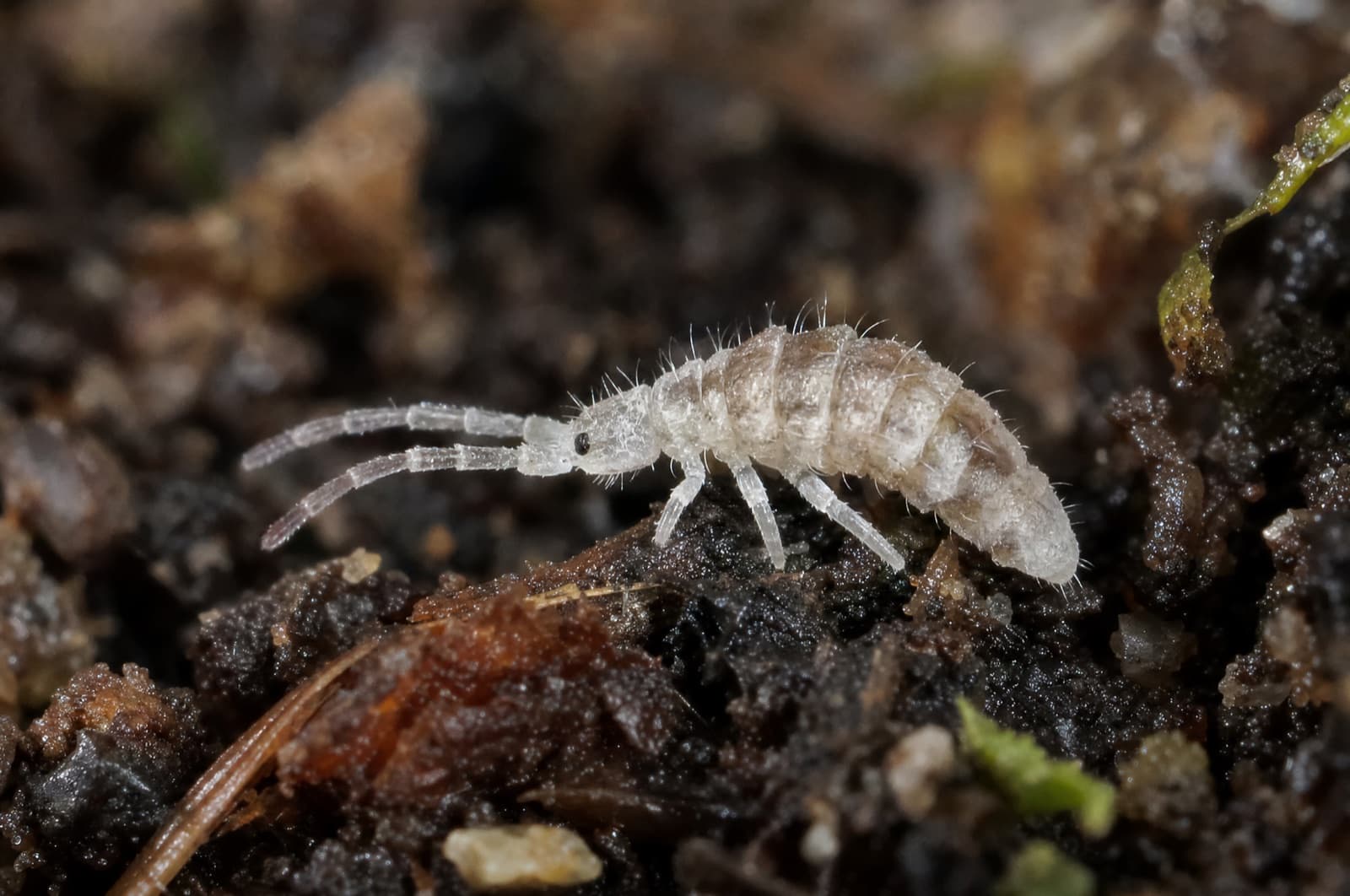
Springtails in New Hampshire — Tiny Jumping Bugs Explained
Also called snowflea (some species) · jumping dirt
Springtails are tiny (1–2 mm) jumping arthropods that appear in large numbers in damp spots — sinks, bathrooms, potted-plant soil, and basements. They jump using a tail-like furcula, which causes people to mistake them for fleas, but they do not bite and are completely harmless. They are the purest humidity-symptom pest: drop relative humidity below 60% and they disappear.
- Size
- ~1–2 mm
- MU Extension; UC IPM
- Jump mechanism
- Furcula (forked spring organ) — up to ~100x body length
- MU Extension
- Bite/disease?
- None — not fleas
- CSU Extension; UC IPM
- Driver indoors
- High humidity or drying potted-plant soil
- MU Extension
- Plant harm?
- None — indicates moist, healthy soil
- MU Extension
- Diversity
- 8,200+ species (order Collembola)
- UMaine Extension
The clearest moisture-symptom pest in NH
Springtails are tiny (1–2 mm) arthropods that appear suddenly in enormous numbers around sinks, in bathrooms, in potted-plant soil, in mulch, and in basements. Their defining move is the jump — they use a forked tail-like structure called a furcula to launch themselves distances up to roughly 100 times their body length, which is exactly why panicked homeowners mistake them for fleas. They are not fleas: they don't bite people or animals, don't spread disease, and don't harm plants.
They are the most straightforward humidity-symptom pest in this cluster. Springtails require moisture to survive — when indoor humidity is high or potted soil is overwatered, they thrive; when conditions dry, they die. Drop relative humidity below 60% and they disappear on their own. The fix is moisture control, not insecticide — they resist many pest-control products, and spraying without fixing the moisture just kills adults temporarily while the population rebounds from the damp source. In New Hampshire, they are abundant statewide, peaking in spring and early summer and during humid spells.
How to identify a springtail
Springtails are identified by three things at once: their tiny size (1–2 mm), their sudden jumping when disturbed, and their location — always near a moisture source. They are hexapods (six-legged) but not true insects; they belong to order Collembola. The flea confusion is common but easy to resolve: springtails do not bite.
Springtail
- Scientific name
- Order Collembola
- Family
- Multiple families (Collembola)
- Size
- ~1–2 mm (most under ¼ inch)
- Coloration
- White, gray, brown, or black depending on species
- Habitat
- Damp soil, leaf litter, mulch, potted plants, sinks, shower grout, crawl spaces, and basements
- Active season
- Spring through early summer peaks; year-round in moist indoor sites
- Diet
- Fungi, algae, pollen, and decaying plant matter
- Reproduction
- Eggs laid in moist soil or organic matter; rapid when conditions are wet
- Lifespan
- Weeks to months depending on species and conditions
Worldwide; abundant native and cosmopolitan species throughout New Hampshire.
The tells — key ID features
- Tiny 'peppery' specks that suddenly hop when disturbed — the best and most alarming tell.
- Furcula (forked spring organ under the abdomen) launches them into the air — up to ~100 times body length.
- ~1–2 mm, appearing in large numbers rather than as single individuals.
- Six legs, soft body — hexapod but not a true insect (order Collembola).
- Various colors (white, gray, brown, black) depending on species.
- Always concentrated near a moisture source — sinks, drains, potted soil, damp walls.
Size, to scale
~1–2 mm
About the size of a fleck of ground pepper — so small they are usually noticed only in large numbers.
Flea
How to tell — Fleas are flattened side-to-side, jump from a host, and bite people and pets. Springtails cluster on damp surfaces, do not bite, and have no preferred host. If it jumps but doesn't bite, it is almost certainly a springtail.
Booklice (psocids)
How to tell — Booklice are slightly larger and do not jump; they crawl slowly on damp surfaces and old books. Springtails hop and cluster near water.
Signs of a problem
Springtails announce themselves by numbers and location. These pairings tell you what you are seeing and what it means for the moisture level in your home.
Clusters of tiny hopping specks in bathrooms, kitchens, or around sinks
What it means — High indoor humidity — springtails require consistent moisture and gather where it is highest.
Springtails in potted-plant soil or emerging from the drainage holes
What it means — Overwatered soil — let the soil dry between waterings; the springtails follow the moisture.
Masses of tiny specks on damp basement walls or near a sump pump
What it means — Excess moisture in the basement or crawl space — a dehumidifier and leak inspection are the first steps.
Pepper-like dots on water surfaces in pools, puddles, or rain barrels
What it means — Outdoor springtail activity — normal and harmless in the garden or landscape.
The real risks, calibrated
Springtails are harmless to people, pets, and plants. Their only meaningful impact is as a reliable signal of excess moisture.
Bite or disease
Low riskOnset: N/A
Springtails do not bite people or animals and do not transmit disease. They are completely harmless to people and pets.
Plant damage
Low riskOnset: N/A
Springtails do not harm plants. Their presence in potted soil indicates moist, healthy conditions for the fungi they feed on.
Moisture indicator — structural risk if uncorrected
ModerateOnset: When humidity is persistently high
A large springtail population is a reliable signal of excess moisture that can promote mold growth and structural moisture damage if the underlying condition is not corrected.
Nuisance when numerous
Low riskOnset: During humid periods or after overwatering
Large hopping swarms in a bathroom or kitchen are unpleasant and alarming even though they are harmless to people.
DIY — what works, what backfires
Springtail control is humidity control. The insects resist many pesticides, and spraying without fixing the moisture source is temporary at best. Here is what actually works.
What actually works
- Use a hygrometer to measure relative humidity in affected rooms and target below 60% RH.
- Run a dehumidifier in the basement, crawl space, or any persistently damp area.
- Fix leaks under sinks, around pipes, and in the crawl space — springtails follow water.
- Allow overwatered potted plants to dry between waterings; tap a white card under the pot to check for jumping springtails before watering.
- Vacuum visible springtails and empty the bag or canister outside.
What backfires
- Do not apply insecticides as a primary fix — springtails are resistant to many products and populations rebound when the moisture source persists.
- Do not overwater houseplants — moist potted soil is one of the most common indoor springtail sources.
- Do not ignore a large springtail population as merely cosmetic — it signals excess moisture that can lead to mold.
Springtails in New Hampshire homes
Across Manchester, Nashua, Concord, and the wider southern NH service area, springtails are abundant year-round and particularly visible in spring and early summer and during humid spells. NH's older homes with damp basements, crawl spaces, and overwatered houseplants are ideal habitat. They frequently appear in large visible numbers around sinks, in shower grout, in basement floor drains, and in potted-plant soil — always as a direct signal that the area is too wet.
Peak season
Spring through early summer; year-round in persistently moist sites
You might actually have
- Fleas (springtails are the most common flea lookalike — the key difference: springtails don't bite)
- Camel crickets (also moisture-loving basement jumpers — much larger, humpbacked)
- Silverfish (another damp-basement indicator — silvery and darting, not hopping)
We serve these communities
- NH-licensed applicator · #782664
- Same-day service
- Family-owned since 2017
Service Area Map
Southern New Hampshire
When to call a pro for springtails
If large springtail populations persist after reducing humidity and fixing obvious leaks, a licensed technician can identify hidden moisture sources — crawl-space seepage, plumbing leaks, condensation zones — and combine moisture correction with targeted treatment for faster, lasting results.
When to call a pro
- Large persistent indoor populations that do not improve after running a dehumidifier and fixing visible leaks.
- Springtails appearing in multiple rooms or on multiple floors — a sign of a widespread moisture issue.
- Unable to identify the moisture source despite DIY investigation.
Keep relative humidity below 60%
Use a hygrometer to monitor basement and bathroom humidity year-round. Springtails cannot sustain populations in humidity below 60% RH.
Fix crawl-space and basement moisture
NH crawl spaces and stone-foundation basements are common springtail sources. Vapor barriers, adequate ventilation, and sump pumps address the root cause.
Water plants wisely
Let potted-plant soil dry between waterings. The most effective treatment for potted-plant springtails is drying the soil, not spraying.
Not sure it's a springtail?
A licensed NH technician can confirm the species and tell you honestly whether it's a DIY fix or a job for a pro — free inspection, same-day service across Southern New Hampshire.
Frequently asked questions
Sources(5)
- [1]MU Extension — Springtails
size, furcula jump mechanism, moisture driver, indoor sources, plant non-damage
extensionverified 2026-06-30 - [2]CSU Extension — Springtails
harmless to people, not fleas, insecticide resistance, control guidance
extensionverified 2026-06-30 - [3]UC IPM — Springtails
moisture-first control, insecticide ineffectiveness as standalone approach
govverified 2026-06-30 - [4]UMaine Extension — Springtails
8,200+ species diversity, order Collembola classification
extensionverified 2026-06-30 - [5]UNH Cooperative Extension — Insect Identification
NH presence and moisture-first guidance for southern NH homeowners
extensionverified 2026-06-30
Written & reviewed by
VerifiedDaniel Brady
NH-Licensed Pesticide Applicator · License #782664 (NHDAMF, RSA 430)
Daniel Brady is the New Hampshire–licensed applicator behind Anchor Pest Services, a family-owned pest control company serving the Manchester area since 2017.
Last updated 2026-06-30

New Hampshire pest control
Dealing with springtails in your home?
Anchor Pest Services identifies and handles springtail problems across southern and central New Hampshire. Family-owned since 2017, NH license #782664.
- NH-licensed applicators (#782664)
- Same-day service · free inspection
- Family-owned since 2017
Your next step
- Fall guide
Fall Pest Control in New Hampshire
What matters before frost: the fall invader window, mice at the foundation, and what to seal first.
Read the answer - What to do next
How to Get Rid of Springtails
Read the answer - What to do next
How to Get Rid of Jumping Spiders
Read the answer - Also relevant
Do insects cause mold or mildew problems?
Read the answer - Related guide
Jumping Spider in NH: ID, Bite Risk & State Spider
Read the answer