
What Attracts Thrips to Your House?
At a glance
- Short answer: Nearby plants and shelter — nothing about thrips is special
- The verdict: The usual four
The attractant verdict
Four possible answers to why this species turned up. Three stay unlit — and that's the argument: the honest answer could have been any of them, and for this species it wasn't.
This is the most common answer in this hub — an answer, not a shortfall.
Nearby plants and shelter — nothing about thrips is special
Our own old page said thrips are drawn in by "specific conditions" without naming them — the honest, specific version is that thrips are outdoor plant feeders first, and an indoor sighting is almost always about a nearby plant, not the house.
Thrips feed on plant tissue and pollen outdoors, and they turn up indoors two ways: drifting in on air currents from nearby landscaping, especially near an open window, or arriving already established on a houseplant brought in from outside. As their outdoor host plants die back in fall, some species overwinter as adults in sheltered spots like leaf litter, bark, or structures, which can bring them indoors seeking cover rather than food.
“Nearby plants and a sheltered spot to wait out the season — the same ordinary pattern behind most incidental invaders. Nothing about thrips is special, and that's the honest answer.”
Why it's here, in full
Why there's no special story here
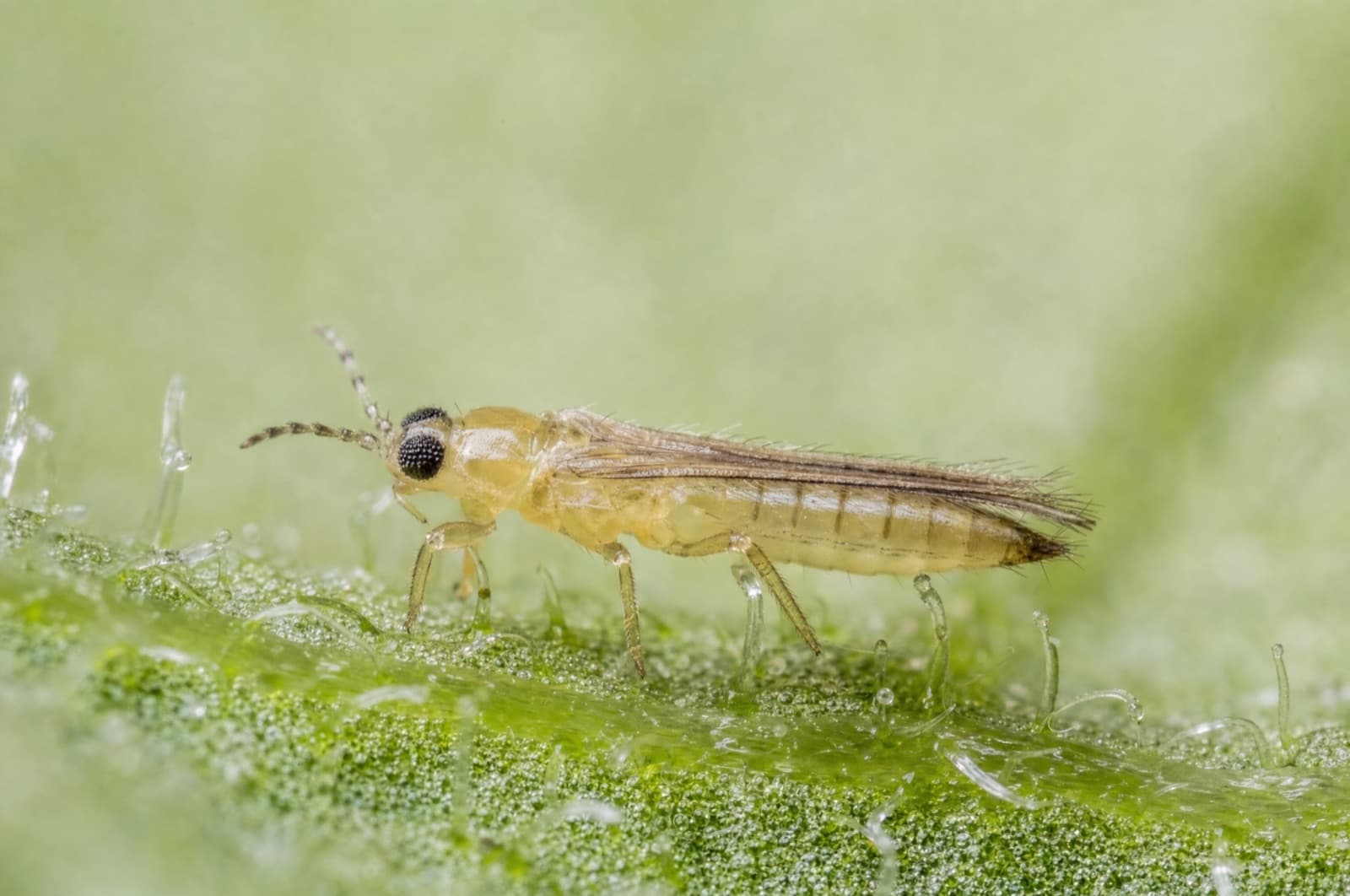
Thrips are, first and foremost, outdoor and greenhouse plant feeders — they damage foliage and flowers by piercing plant cells and feeding on the contents, and their entire life cycle usually plays out on living plants rather than inside a house. When thrips do show up indoors, it's almost always for one of two reasons: they've drifted in on air currents from nearby outdoor vegetation, especially through an open window in summer, or they arrived already on a houseplant that was brought in from outside.
As outdoor host plants decline in fall, some thrips species shift to overwintering as adults in sheltered spots like leaf litter, loose bark, or building crevices, which occasionally brings a few indoors looking for cover rather than food. None of this points to anything about a specific house — it's about what's growing nearby and what got carried in.
How to tell it's actually this species
Real signs only — a species with four honest tells gets four, and stops. Where a sign is weak on its own, we say so.
Silver or white streaks and black flecking on the leaves of a houseplant
Tiny, slender insects visible on flowers or leaves when disturbed, often needing a hand lens to see clearly
Stunted or deformed new growth on an affected plant
Want thrips gone?
This page only answers why it's here. Every removal step for this exact species — what to seal, what to set, what actually works — lives on its own dedicated guide.
Two questions, two pages
Here: why it turned up at all — the honest answer, blame removed.
There: the step-by-step removal guide for this exact species.
Key takeaways
- Thrips are outdoor and greenhouse plant feeders first, not a house-seeking pest.
- Indoor sightings usually trace to nearby vegetation or an infested houseplant brought in.
- Some species overwinter as adults in sheltered spots as their outdoor host plants decline in fall.
- Removal steps live at /top-diy-methods/thrips.
Want them gone, not just explained?
This page is about why thrips show up. Removal is covered at /top-diy-methods/thrips.
Frequently asked
Sources(2)
- [1]University of Maryland Extension — Thrips in Home Gardens
Thrips are primarily outdoor and greenhouse plant feeders that occasionally wander indoors from nearby vegetation or on infested plants
extensionverified 2026-07-17 - [2]UC Statewide IPM Program — Thrips
Some thrips species overwinter as adults in sheltered locations as their outdoor host plants decline in fall
extensionverified 2026-07-17
Written & reviewed by
VerifiedDaniel Brady
NH-Licensed Pesticide Applicator · License #782664 (NHDAMF, RSA 430)
Daniel Brady is the New Hampshire–licensed applicator behind Anchor Pest Services, a family-owned pest control company serving the Manchester area since 2017.
Last updated Jul 2026
Nearby plants — nothing unusual here
If thrips are already established on your plants, we can help
Same-day inspections across southern and central New Hampshire.
- Family-owned in Manchester since 2017
- NH commercial applicator #782664, category F1
- We will tell you when the answer is do nothing
NH License #782664 · No obligation · We answer in person