
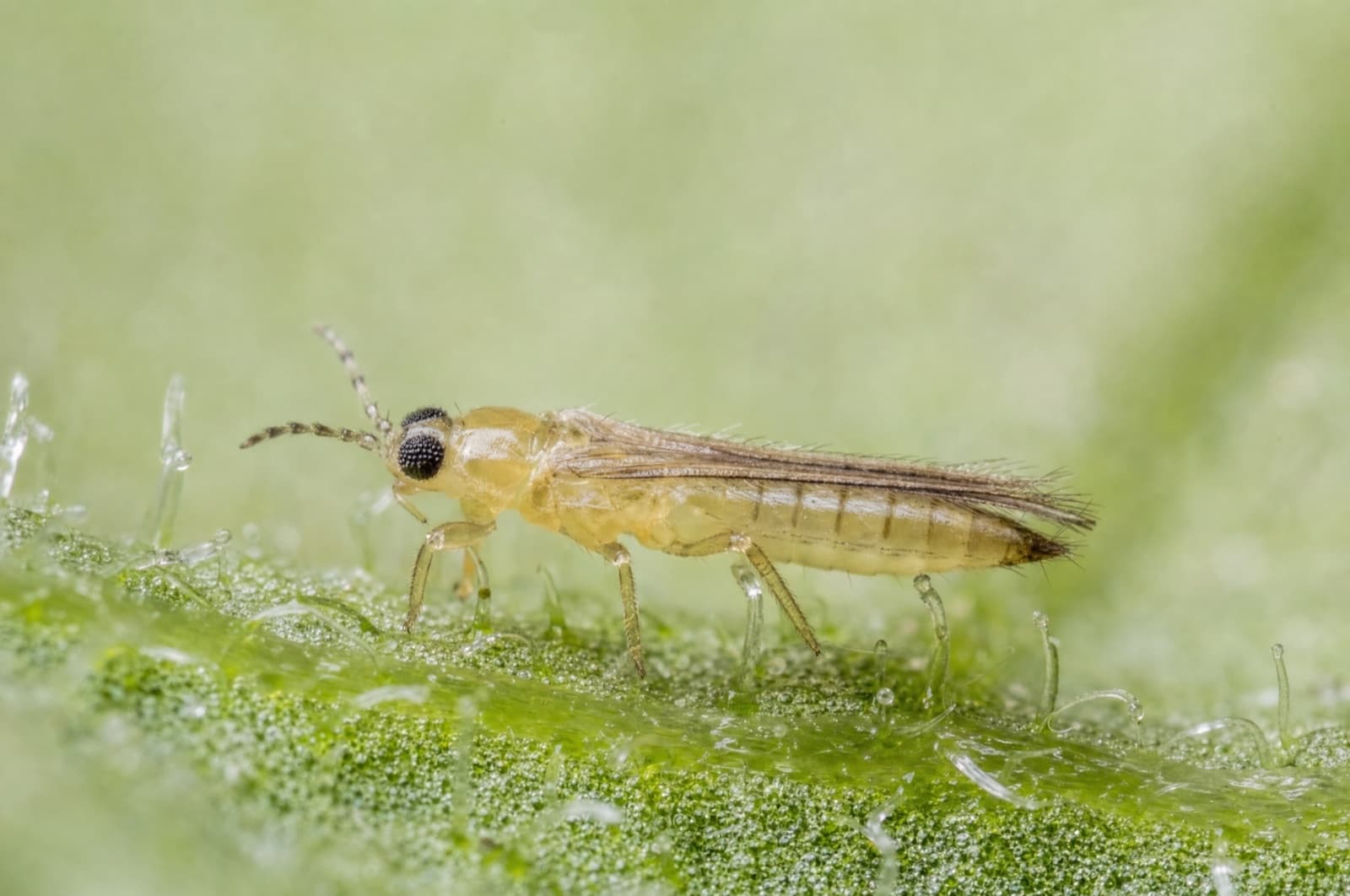
How to Get Rid of Thrips
At a glance
- Difficulty: Intermediate
- Time: Ongoing — inspect weekly, treat every 7-10 days until clear
- Cost: Low — insecticidal soap or neem, sticky traps, a quarantine space
- Success: Good with consistent, repeated treatment; single applications routinely disappoint because eggs and pupating stages survive
Can you DIY Thrips?
The verdict on Thrips DIY
A genuine DIY win, but only if you treat it as a plant problem, not a home-invader problem.
Thrips are tiny, slender insects that feed on houseplants, garden plants, and landscape plantings — not a species that invades homes the way seasonal nuisance bugs do. The standard exclusion-and-sealing playbook for this hub's other species simply doesn't apply here; you can caulk every gap in your house and still have thrips scarring your fiddle-leaf fig. The real work is plant-focused: quarantining new plants, inspecting leaf undersides, rinsing, and treating with insecticidal soap or neem on a repeat schedule, because thrips have overlapping, hard-to-catch-in-one-pass life stages.
The 5 DIY methods — honestly graded
Every approach graded for this species, in IPM order — prevention first, chemistry late. Pick a method to see how it works, the steps, and what it actually takes.
Prevention / Exclusion
Works wellPlant hygiene, not house exclusion, is the effective prevention here — quarantine new plants before they infest your existing collection.
Thrips typically arrive on a new plant brought into the home or greenhouse, then spread to nearby plants. Isolating and inspecting new arrivals before they join your collection catches an infestation before it spreads, which is a fundamentally different kind of "exclusion" than sealing gaps in a house.
Best for: Preventing a new plant from infesting your existing collection
Quarantine new plants
Keep newly purchased or gifted houseplants separate from your existing collection for about 30 days, checking them regularly before moving them in.
TipThrips are easy to miss at a glance — inspect leaf undersides and new growth with a hand lens if possible.Inspect weekly
Check plants weekly for stippled, silvery, or distorted leaves, and look closely at new growth and leaf undersides where thrips concentrate.
Tools & materials
Why DIY falls short here
Not scare tactics — the specific, proportionate reasons a home attempt can stall for this species.
Wrong mental model
Treating thrips like a home invader — sealing gaps, dehumidifying the house — does nothing, because this is a plant problem, not a structural one; effort spent on house exclusion is effort not spent on the actual fix.
Life-stage gaps in a single treatment
Eggs and soil-pupating stages survive a single spray or rinse, so one treatment routinely looks successful for a week and then rebounds as the next generation matures.
Hidden on leaf undersides and new growth
Thrips concentrate where casual inspection misses them, so spotty coverage during treatment lets untouched populations rebuild the infestation.
How risky is it, really?
An honest read — most nuisance species are genuinely low risk, and we say so.
Thrips pose no bite, sting, or disease risk to people or pets. The real harm is entirely to your plants — leaf scarring, silvering, and distorted new growth on infested houseplants or garden plants — which is a plant-health issue, not a household health concern.
- Leaf scarring, silvering, and distorted growth on infested plantsCommon
The primary harm on an infested houseplant or garden plant if left untreated
UC IPM
- Bite, sting, or disease transmission to people or petsRare
Not documented — thrips pose no direct health risk to humans
UMN Extension
- Spread to other houseplantsOccasional
Thrips can migrate between nearby plants, which is why quarantining new arrivals matters
UMN Extension
Thrips Not Clearing Up After Weeks of Treatment?
A large plant collection or landscape infestation can be hard to fully treat alone. Anchor Pest Services offers a full assessment across southern and central New Hampshire. Family-owned since 2017, NH license #782664.
Call a pro when…
- A large plant collection or landscape infestation isn't responding to repeated treatment
- You want a plant-health assessment to rule out other causes of leaf damage
- Thrips are spreading across multiple rooms or garden beds despite quarantine
General Pest Control
Most houseplant and garden thrips infestations are a solvable DIY job with rinsing, insecticidal soap, and patience. A pro is worth considering for a large indoor plant collection or landscape-scale infestation that's spreading despite consistent treatment.
Keep them out
- Quarantine new plants for about 30 days before adding them to your collection
- Inspect leaf undersides and new growth weekly
- Use sticky traps to monitor for early activity
Thrips in New Hampshire
In New Hampshire, thrips are most active on outdoor garden and landscape plants during the warm growing season, while indoor houseplant infestations can occur year-round, often traced back to a new plant brought in during winter months when homes are sealed up and dry indoor air can stress plants further. Because thrips are a plant issue rather than a seasonal home-invader, there's no fall exclusion window to anchor to the way there is for overwintering nuisance bugs.
Peak season
Warm growing season outdoors; year-round possible on houseplants
First-frost anchor
Manchester first hard frost ~Oct 19 (50%) / Oct 29 (80%), NOAA 1991–2020
Make sure it's a Thrips
Two quick detours worth taking — confirm the ID, then learn what drew it in so it doesn't come back.
Frequently asked
Sources & further reading(2)
- [1]University of Minnesota Extension — Insects on Indoor Plants
Thrips biology, quarantine practice, insecticidal soap guidance, plant-focused control
extensionverified 2026-07-13 - [2]UC Statewide IPM Program — Thrips
Life-stage overlap, treatment intervals, plant damage symptoms
extensionverified 2026-07-13
Written & reviewed by
VerifiedDaniel Brady
NH-Licensed Pesticide Applicator · License #782664 (NHDAMF, RSA 430)
Daniel Brady is the New Hampshire–licensed applicator behind Anchor Pest Services, a family-owned pest control company serving the Manchester area since 2017.
Last updated July 2026
Other species you can tackle
Same category — the dot shows each one's DIY verdict at a glance (green = friendly, amber = doable with care, red = call a pro).
Professional Pest Control
Thrips Not Clearing Up After Weeks of Treatment?
A large plant collection or landscape infestation can be hard to fully treat alone. Anchor Pest Services offers a full assessment across southern and central New Hampshire. Family-owned since 2017, NH license #782664.
- Plant-focused assessment
- NH-licensed applicators (#782664)
- Free inspection — same-day service across southern NH
NH License #782664 · No obligation · We answer in person